Pinguicula hemiepiphytica Zamudio & Rzed.
Species sheet, updated on 30/10/2026.
At a glance
| Scientific name | Pinguicula hemiepiphytica Sergio Zamudio & Jerzy Rzedowski, Acta Botanica Mexicana 14, 1991 |
| Family | Lentibulariaceae (section Longitubus) |
| Distribution | North slope of the Sierra de Juárez (Oaxaca, Mexico) |
| Habitat | Very moist mossy banks and rocks, mossy tree trunks in cloud forest, from 1,900 to 2,300 m |
Photos in the wild
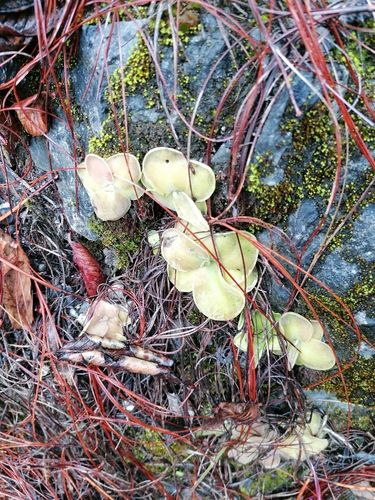
Etymology
- Pinguicula: see the genus sheet.
- hemiepiphytica: “half epiphytic”, because it often grows on tree trunks (probable meaning, not confirmed).
History
First collected under the name P. moranensis, it was recognised as a new species through the study of herbaria and fieldwork, then described in 1991 together with another butterwort from Oaxaca.
Description (how to recognise it)
- Summer leaves elliptic to almost round; winter leaves narrow and numerous.
- Large violet-purple to red flowers, 3.5 to 8 cm, with a white throat and a spur of 1.2 to 3 cm.
Distribution
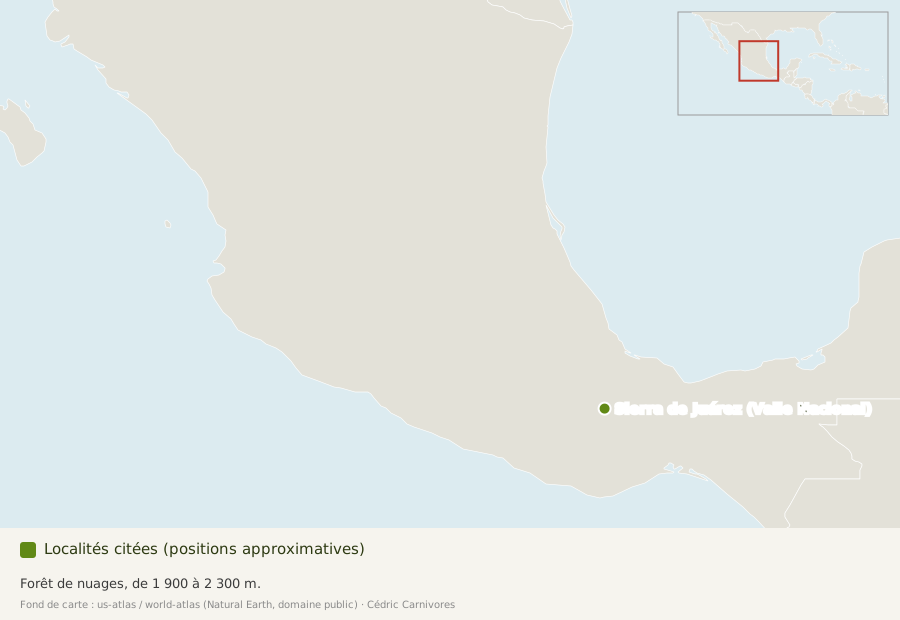
Known only from the north slope of the Sierra de Juárez (Oaxaca); the type locality is about 58 km north of Ixtlán, above Valle Nacional, at about 2,200 m. From 1,900 to 2,300 m.
Habitat
- Steep banks and mossy rocks, in very moist places;
- often on moss-covered tree trunks, in cloud forest (bosque mesófilo de montaña), with oaks and Engelhardtia mexicana.
Threats
The flora of the region is threatened by logging, farming, grazing, urbanisation, the collecting of ornamental plants and possible hydroelectric dams.
Sources
- pinguicula.org, P. hemiepiphytica: Zamudio & Rzedowski 1991, history, description, range, altitude, habitat, threats.