Pinguicula ibarrae Zamudio
Species sheet, updated on 30/10/2026.
At a glance
| Scientific name | Pinguicula ibarrae Sergio Zamudio, Acta Botanica Mexicana 70, 2005 |
| Hobbyist name | “Pinguicula sp. Tlanchinol” |
| Family | Lentibulariaceae |
| Distribution | Around Tlanchinol and south of Huejutla (Hidalgo, Mexico) |
| Habitat | Almost vertical slopes of sedimentary clay, between cloud forest and tropical forest, from 900 to 1,100 m |
Etymology
- Pinguicula: see the genus sheet.
- ibarrae: probably in honour of Adolfo Ibarra Vásquez, the grower who found and cultivated it (not confirmed).
Description (how to recognise it)
- Thick winter leaves, 1.2 to 2.5 cm; thin, flat summer leaves, 3.5 to 9.5 cm.
- 5 to 12 stems per rosette, each bearing a whitish to pale lilac flower, spotted with violet in the throat, with very hairy lobes.
- Rosettes very variable in colour, from yellow-green to pinkish red.
- Flowers in winter, from about September to March.
Distribution
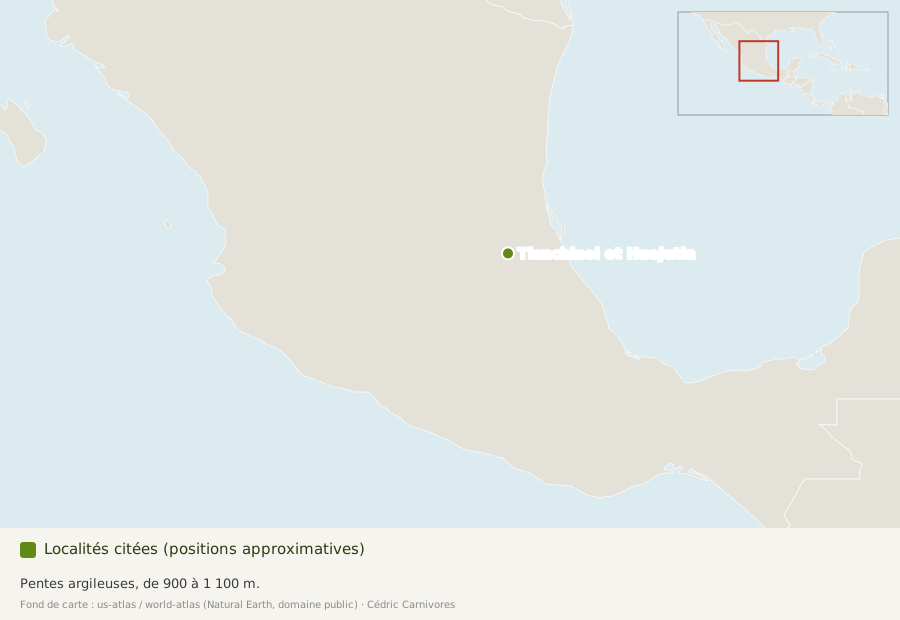
Endemic to Hidalgo: three populations, north and north-east of Tlanchinol, and between Pachuca and Tampico, south of Huejutla; from 900 to 1,100 m.
Habitat
Steep, almost vertical slopes of clayey sedimentary rock, often facing north: on bare rock, in cracks, among mosses or ferns, between cloud forest and evergreen tropical forest. In 2009, Radek Kastner saw thousands of plants there in dense colonies.
Relationships
Its flowers recall P. agnata, and its hairy lobes P. pilosa.
Sources
- pinguicula.org, P. ibarrae: Zamudio 2005, hobbyist name, description, range, altitude, habitat, flowering, 2009 observations, relationships.