Pinguicula immaculata Zamudio & Lux
Species sheet, updated on 30/10/2026.
At a glance
| Scientific name | Pinguicula immaculata Sergio Zamudio & Alexander Lux, Acta Botanica Mexicana 20, 1992 |
| Family | Lentibulariaceae (section Temnoceras) |
| Distribution | Between Rayones and Galeana, and near Santa Rita (Nuevo León, Mexico) |
| Habitat | Gypsum cliffs and slopes in foothill scrub, from 1,300 to over 2,180 m |
Etymology
- Pinguicula: see the genus sheet.
- immaculata: from the Latin, “spotless”, probably for its white flowers (not confirmed).
History of the discovery
January 1990: Alexander Lux discovers it while photographing the landscape around Rayones. Described in 1992.
Description (how to recognise it)
- Succulent winter rosette with thick, non-carnivorous leaves; elliptic, carnivorous summer leaves.
- White flowers of 1 to 2 cm, with a yellow-green spot on the lower lip, on 1 to 3 hairless stems. They arise from the winter rosette.
Distribution
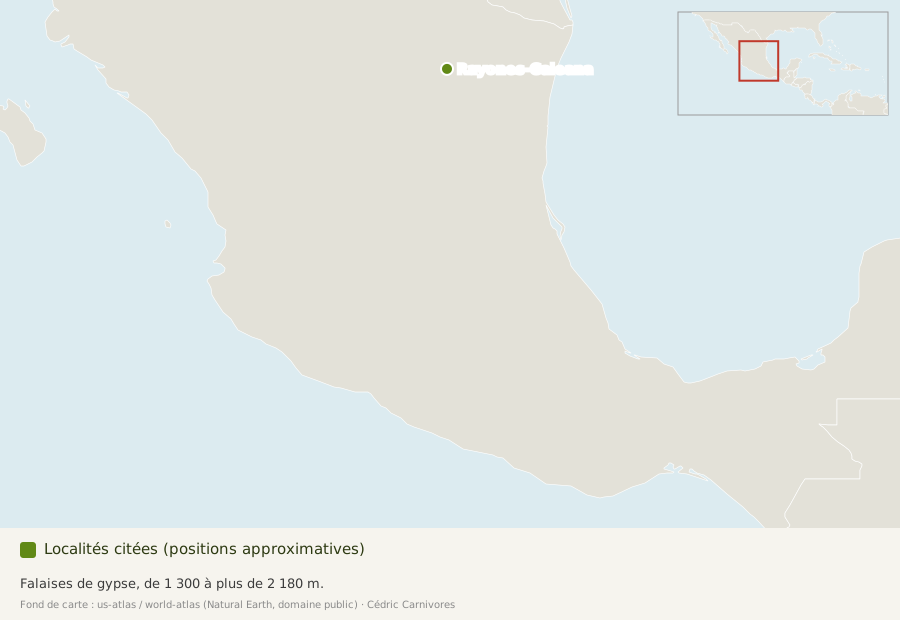
Nuevo León: type locality between Rayones and Galeana (at about 1,300 m); other populations near Santa Rita (above 2,180 m).
Habitat
Gypsum cliffs in a gorge and gypsum slopes, in foothill scrub, with Mortonia greggii, Gochnatia hypoleuca, agaves and Hechtia; among colonies of spikemosses.
Sources
- pinguicula.org, P. immaculata: Zamudio & Lux 1992, 1990 discovery, description, range, altitudes, habitat.