Pinguicula jackii Barnhart
Species sheet, updated on 30/10/2026.
At a glance
| Scientific name | Pinguicula jackii John Hendley Barnhart, Addisonia 15: 61, 1930 (published in 1931) |
| Family | Lentibulariaceae (subgenus Pinguicula, section Homophyllum) |
| Distribution | Central Cuba (Cienfuegos area) |
| Habitat | One collection at about 750 m (GBIF) |
Etymology
- Pinguicula: see the genus sheet.
- jackii: probably in honour of a person called Jack.
Description (how to recognise it)
- A rupicolous butterwort (growing on rock), endemic to the Guamuhaya massif (south-central Cuba); Cuba has 13 species of Pinguicula, all endemic (Vasallo Rodríguez et al., 2018).
- Its corolla has been described as blue; Temple et al. (2023) note that, with P. benedicta (in fact rather purple), it is one of the only Cuban butterworts said to have blue flowers.
Distribution
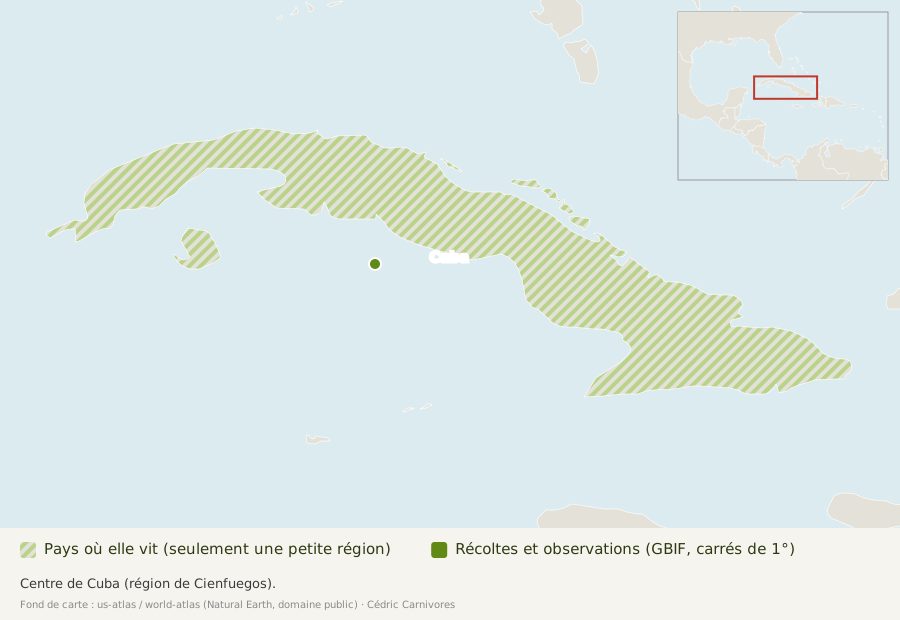
Endemic to Cuba: the geolocated collections are at about 22° N and 80.2° W, in the centre of the island (GBIF).
Habitat
According to Vasallo Rodríguez et al. (2018), it lives on limestone walls (“farallones”) in the basin of the río Mataguá (Cienfuegos): a canyon cut into the limestone of the Carso de Buenos Aires (wall up to 34 m), the south face of a mogote at Vegas de Mataguá, and a vertical limestone cliff at Mundo Nuevo (Pico San Juan protected area); all populations border old shade-coffee plantations or vegetable crops. Shade coffee does not threaten it, but vegetable growing (ploughing, burning, clearing, pesticides) is said to reduce its populations; extent of occurrence about 13 km²: “Critically endangered” under the IUCN criteria.
Natural hybrids
Resembles P. lithophytica, according to the authors of the latter.
Sources
- Wikipedia (English), Pinguicula lithophytica: resemblance to P. lithophytica.
- List of Pinguicula: section.
- Vasallo Rodríguez et al., Acta Botanica Mexicana 126, 2018 (open licence): ecology, populations, conservation.
- Temple et al., Carnivorous Plant Newsletter 52, 2023 (ICPS open archive): flower colour.
- GBIF, Pinguicula jackii: author, original publication, countries and localities of herbarium specimens and observations.