Pinguicula laxifolia Luhrs
Species sheet, updated on 30/10/2026.
At a glance
| Scientific name | Pinguicula laxifolia Hans Luhrs, Phytologia 79(2): 116, 1995 (published in 1996) |
| Family | Lentibulariaceae (subgenus Pinguicula, section Orchidioides) |
| Distribution | Tamaulipas (Mexico): El Cielo Biosphere Reserve |
| Habitat | Well-shaded vertical rock faces in cloud forest, at about 1,900 to 2,100 m |
Etymology
- Pinguicula: see the genus sheet.
- laxifolia: from the Latin, “with loose leaves”: its drooping leaves are unusual in butterworts.
History of the description
1995: Hans Luhrs describes it, in the same article as P. stolonifera. It is the only species in the section Orchidioides.
Description (how to recognise it)
- Perennial rosette plant, with drooping or half-upright, elliptic leaves of 40 to 68 mm.
- Leaves covered with sticky, digestive glands.
- Winter rosette of fleshy, non-carnivorous leaves, which is also used for propagation.
- Pink to pale violet flowers, with a white throat marked with dark violet, probably from February to March.
Distribution
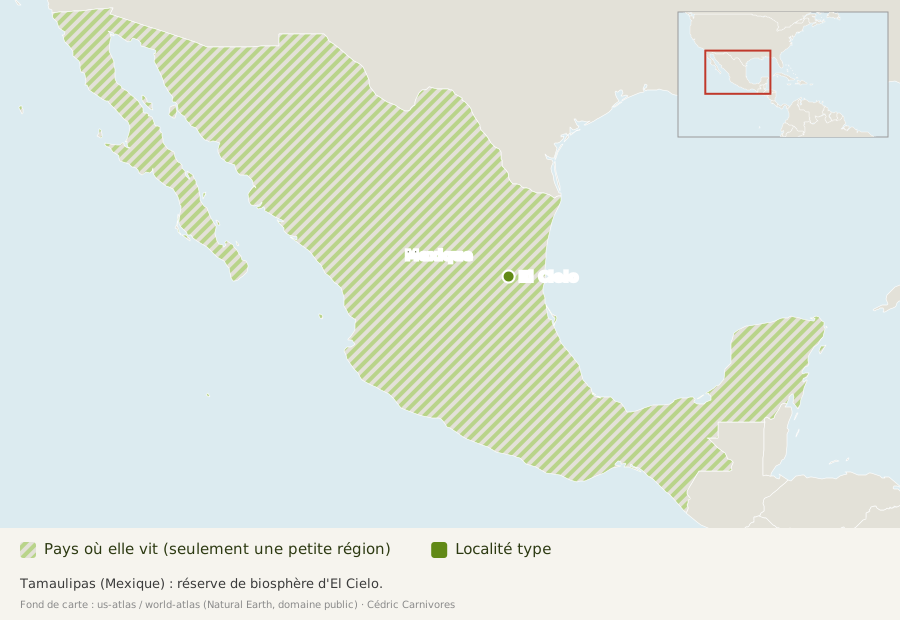
Known only from its isolated type locality, in the El Cielo Biosphere Reserve (Tamaulipas, Mexico).
Habitat
Well-shaded vertical rock faces in cloud forest, between 1,900 and 2,100 m (6,300 to 6,800 feet).
Threats and protection
Extremely small range; the species remains little known.
Sources
- Wikipedia (English), Pinguicula laxifolia: range, altitude, habitat, description, flowering, section.
- List of Pinguicula: section.
- GBIF, Pinguicula laxifolia: author, original publication, countries and localities of herbarium specimens and observations.