Pinguicula lithophytica Panfet & P. Temple
Species sheet, updated on 30/10/2026.
At a glance
| Scientific name | Pinguicula lithophytica Cristina M. Panfet Valdés & Paul Temple, Carnivorous Plant Newsletter 37(3): 92, 2008 |
| Family | Lentibulariaceae (subgenus Isoloba, section Agnata) |
| Distribution | Central Cuba (Trinidad mountains, Sierra del Escambray) |
| Habitat | Limestone hills covered with low, dense forest, at about 900 m |
Etymology
- Pinguicula: see the genus sheet.
- lithophytica: from the Greek, “plant of the rocks”: it grows on rock.
History of the description
- 18 July 1953: G. L. Webster, R. Dressler and their colleagues collect it on the “limestone hills near El Naranjo”, in the Trinidad mountains, at about 900 m.
- 28 February 1995: C. Panfet, P. Temple and J. Gutiérrez collect it at El Sopapo (Cienfuegos).
- 2008: Panfet and Temple describe it and place it in section Agnata, noting its similarities with P. jackii.
Description (how to recognise it)
- According to Temple and Panfet-Valdés (2008), who described it: flowers white in the wild; in cultivation, the petals show a very thin blue-violet edging and fine blue-violet veins, so discreet that they can hardly be seen without a magnifying glass, a colouring unique among butterworts.
- The authors think it is the plant that Barnhart had already reported as “probably P. albida, with white corollas sometimes edged with colour”.
Distribution
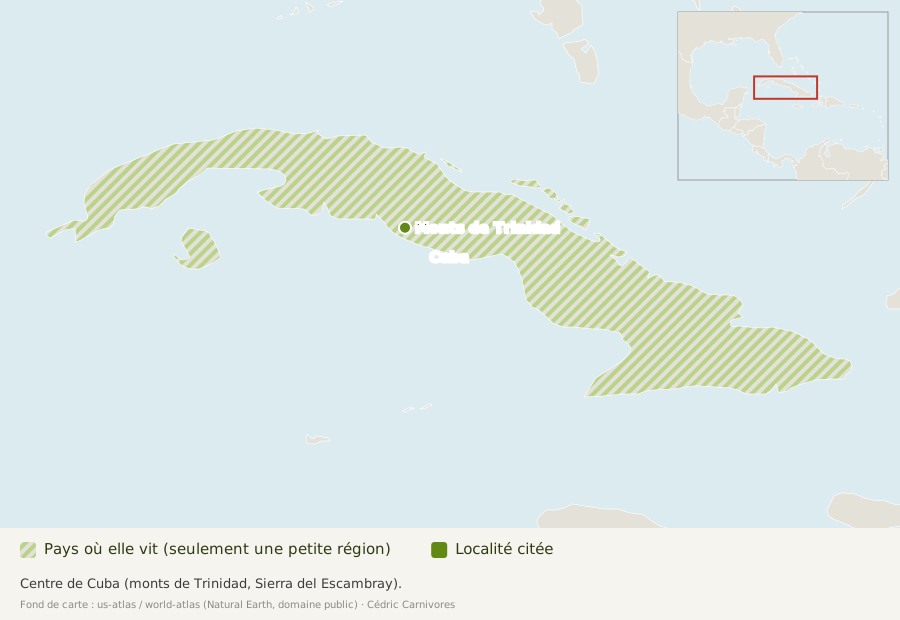
Endemic to central Cuba: Trinidad mountains (Sierra del Escambray), between the provinces of Cienfuegos and Sancti Spíritus.
Habitat
Limestone hills covered with a low, dense forest, at about 900 m (specimen labels). Temple and Panfet-Valdés (2008) studied it in the Escambray massif (central Cuba): it grows on vertical or nearly vertical limestone walls, mainly near the top, on damp, crumbly rock worn by seepage; it is a pioneer plant, which disappears when shade (notably from the coffee plants grown around it) or other plants take over, its colonies moving a few metres from one generation to the next. It is found in a national park.
Sources
- Wikipedia (English), Pinguicula lithophytica: authors, year, range, section, relationship with P. jackii.
- GBIF, specimen labels and observations: localities and altitudes given on the labels of herbarium specimens.
- List of Pinguicula: section.
- Temple and Panfet-Valdés, Carnivorous Plant Newsletter 37, 2008 (archive.org): field observations, flower colour, threats.
- GBIF, Pinguicula lithophytica: author, original publication, countries and localities of herbarium specimens and observations.