Pinguicula moctezumae Zamudio & R. Z. Ortega
Species sheet, updated on 30/10/2026.
At a glance
| Scientific name | Pinguicula moctezumae Sergio Zamudio & Ricardo Zirahuén Ortega, Acta Botanica Mexicana 28, 1994 |
| Family | Lentibulariaceae (section Orcheosanthus) |
| Distribution | Canyon of the río Moctezuma, Hidalgo–Querétaro border (Mexico) |
| Habitat | Limestone deposits (tufa): stream beds, dripping walls, damp limestone slopes, at about 900 to 1,100 m |
Etymology
- Pinguicula: see the genus sheet.
- moctezumae: from the canyon of the río Moctezuma, where it was found.
History of the discovery
Found in 1994 during the impact studies for the Zimapán dam project, the same survey that led to the discovery of P. elizabethiae. Its habitat was therefore threatened by the dam.
Description (how to recognise it)
- Summer leaves: erect and very narrow, 6 to 10 cm long (up to 13), with rolled edges.
- Winter rosette: small elliptical leaves.
- Large pink to violet-purple flowers, 3.5 to 6.5 cm, with a spur 2.5 to 3.8 cm long.
Distribution
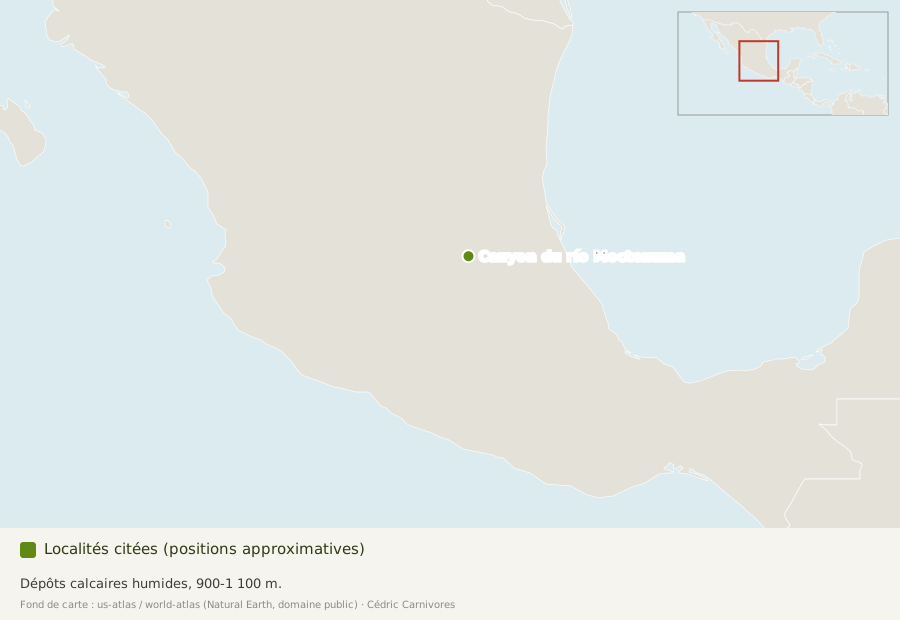
Canyon of the río Moctezuma, on the border between Hidalgo and Querétaro, near San Joaquín (Cadereyta), at about 900 to 1,100 m.
Habitat
On calcium carbonate deposits (probably tufa): stream beds, dripping walls, damp limestone slopes.
Sources
- pinguicula.org, P. moctezumae: Zamudio & Ortega 1994, etymology, discovery, Zimapán dam, description, range, altitude, habitat.