Pinguicula poldinii Steiger & Casper
Species sheet, updated on 29/10/2026.
At a glance
| Scientific name | Pinguicula poldinii Jurg Steiger & Siegfried Jost Casper, Wulfenia 8, 2001 |
| Family | Lentibulariaceae (section Pinguicula) |
| Distribution | Pre-Alps of Friuli-Venezia Giulia, near Udine (Italy): Val d'Arzino, Canale di Cuna |
| Habitat | Steep, damp rock faces beside a road, from 450 to 550 m |
| Status | Threatened by collecting |
Etymology
- Pinguicula: see the genus sheet.
- poldinii: in honour of Professor Livio Poldini, of Trieste, a great expert on the flora of his region.
Description (how to recognise it)
- A rosette with leaves that are green in shade, red-brown in full sun, and a small hibernaculum.
- Large blue-violet flowers, 21 to 32 mm including the spur, one per scape (3 to 8 cm).
- Flowering: May; tiny seeds (0.6–0.7 mm).
Distribution
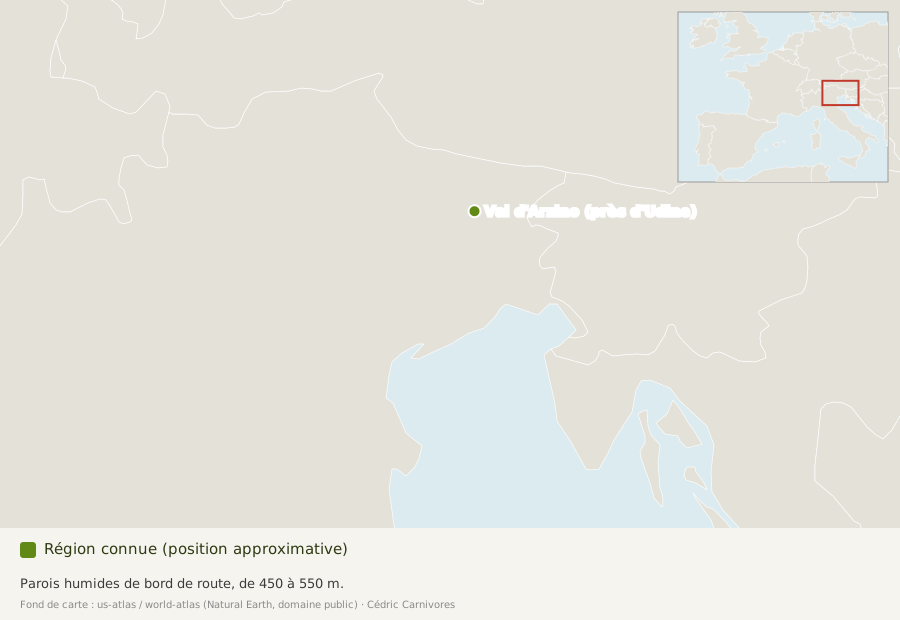
Pre-Alps of northern Italy, in Friuli-Venezia Giulia, near Udine: the Val d'Arzino north of San Francesco and the Canale di Cuna. From 450 to 550 m.
Habitat: a roadside-bank plant
It grows on steep, damp rock faces along a road: many of these sites are thought to have been created when the rock was cut to build the road. The nearby forest is a pinewood of Austrian black pine. Companion plants: maidenhair fern, grass of Parnassus, Scottish asphodel, P. alpina and dwarf snowbell.
Threats and protection
- Only a few small populations are known, and their locations are kept confidential.
- The Italian Carnivorous Plant Association found signs of collecting at the type locality: not a single seed capsule remained on hundreds of plants. Seeds have appeared on the market.
Sources
- pinguicula.org, P. poldinii: Steiger & Casper 2001, etymology, description, range, altitude, habitat, companion plants, threats.
- Wikipedia (English), Pinguicula poldinii: habitat created by the roadworks, collecting.