Pinguicula takakii Zamudio & Rzed.
Species sheet, updated on 30/10/2026.
At a glance
| Scientific name | Pinguicula takakii Sergio Zamudio & Jerzy Rzedowski, Phytologia 60, 1986 |
| Family | Lentibulariaceae (section Isoloba) |
| Distribution | Municipality of Villa Juárez (San Luis Potosí, Mexico) |
| Habitat | Gypsum hills in desert scrub, from 1 350 to 1 400 m |
Etymology
- Pinguicula: see the genus sheet.
- takakii: in honour of the biologist Francisco Takaki, its first collector, known in Mexico for his mapping of the country's vegetation.
Description (how to recognise it)
- A small rosette of 3 to 8 leaves of 5 to 16 mm, with rolled-in edges.
- Small violet flowers of 6 to 12 mm, with a yellow throat and palate, on purple stems; dark purple calyx.
- Annual, without a resting rosette: it probably spends the dry season as seed.
Distribution
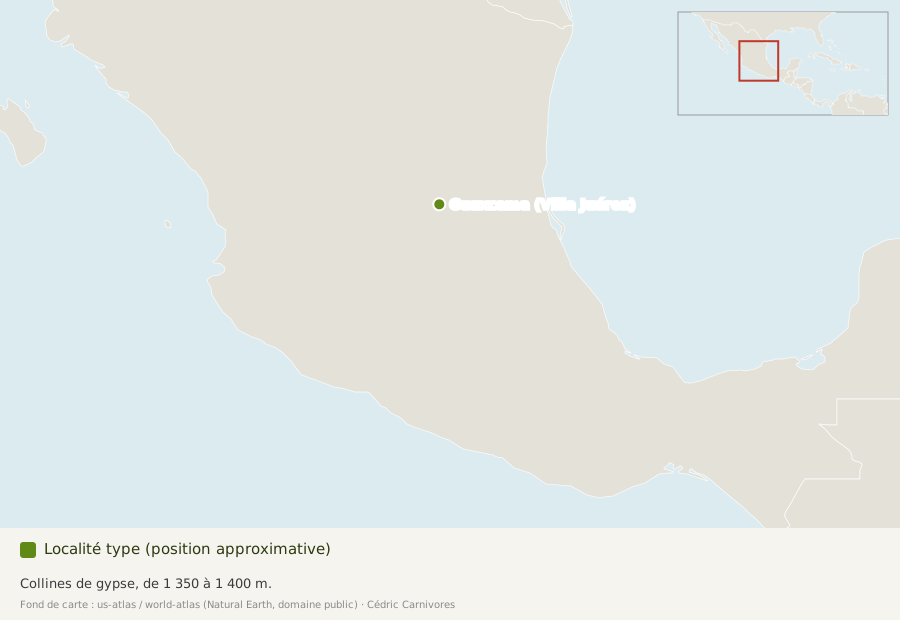
San Luis Potosí, municipality of Villa Juárez: type locality at the Minas de Guaxcama, about 2 km south-east of Buenavista; also at the Minas de San Rafael.
Habitat
Gypsum hills in desert scrub with rosette plants, with Hechtia, Agave striata, Dasylirion longissimum, Dodonaea viscosa and spikemosses. It grows alongside P. gypsicola.
Relationships
Close to P. lilacina and P. sharpii, which grow on rocks in forest and have yellow-green stems.
Sources
- pinguicula.org, P. takakii: Zamudio & Rzedowski 1986, etymology, description, range, altitude, habitat, companion plants, relationships.