Pinguicula utricularioides Zamudio & Rzed.
Species sheet, updated on 30/10/2026.
At a glance
| Scientific name | Pinguicula utricularioides Sergio Zamudio & Jerzy Rzedowski, Acta Botanica Mexicana 14, 1991 |
| Family | Lentibulariaceae (section Longitubus) |
| Distribution | Cerro Azul, north of Niltepec (Oaxaca, Mexico) |
| Habitat | At about 1 830 to 2 130 m |
| Status | Known from a single collection |
Etymology
- Pinguicula: see the genus sheet.
- utricularioides: “resembling a bladderwort”, for its leaves shaped like little sacs (probable meaning, not confirmed).
History: a single collection
It has been collected only once, by T. MacDougall in 1956, and was described from dried specimens. It has never been cultivated.
Description (how to recognise it)
- Two kinds of leaves: spoon-shaped inner leaves (5 to 20 mm), and long-petioled outer leaves whose blade forms a small sac, like a bladder.
- Red to scarlet flowers, 2.7 to 3.7 cm, with a funnel-shaped tube.
- The lower lip of the calyx has its two lobes almost entirely fused.
A “missing link”?
Its sac-shaped leaves and its calyx are reminiscent of the bladderworts: for Jan Schlauer, it could be linked to a “missing link” between the three genera of the family (butterworts, bladderworts, Genlisea). Laurent Legendre doubts this: its flower resembles that of P. laueana.
Distribution
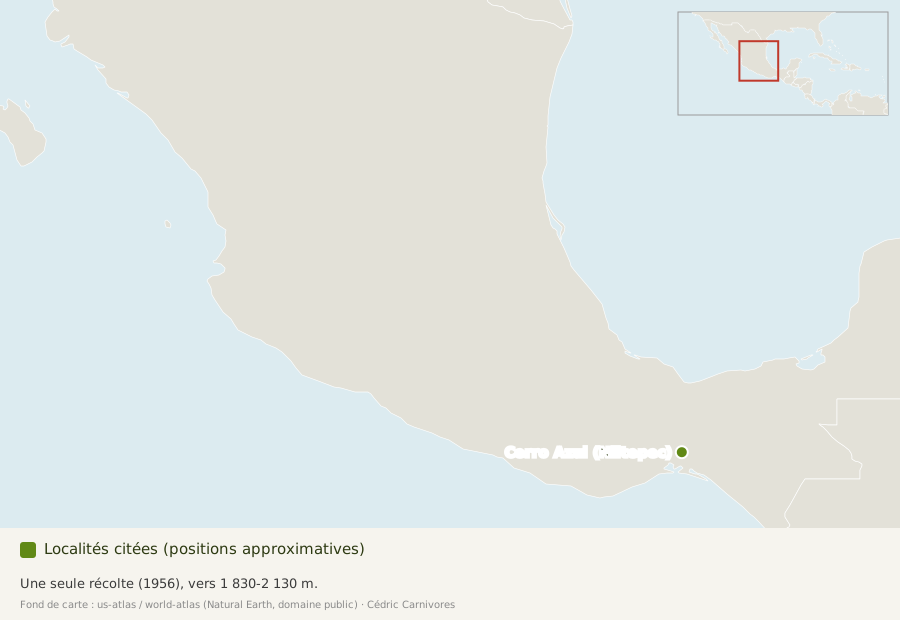
Known only from Cerro Azul, north of Niltepec (Oaxaca), between about 1 830 and 2 130 m, a site that is hard to reach.
Sources
- pinguicula.org, P. utricularioides: Zamudio & Rzedowski 1991, 1956 collection, description, Schlauer's hypothesis, Legendre's opinion, range, altitude.