Roridula gorgonias Planch.
Species sheet, updated on 29/10/2026.
At a glance
| Scientific name | Roridula gorgonias Jules Émile Planchon, 1848 |
| Family | Roridulaceae (two species: R. gorgonias and R. dentata), order Ericales |
| Common names | Gorgon's dewstick, fly bush, fly catcher bush; in Afrikaans vliebos, vlieëbossie (“fly bush”) |
| Distribution | Mountains of the south-west of the Western Cape province, South Africa |
| Habitat | Cool, damp places, mountain seeps, acid sandy soils, from 155 to 915 m |
| Flowering | July to October (late winter and southern spring) |
| Status | Not on the South African Red List, but its range is small |
Photos in the wild
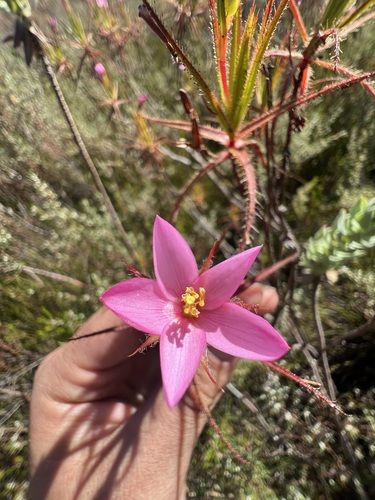
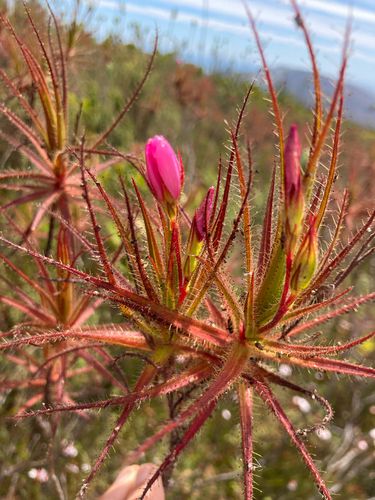
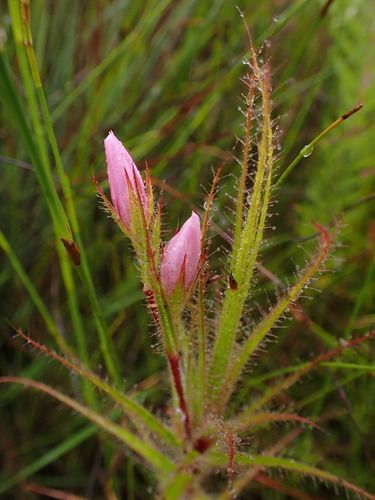
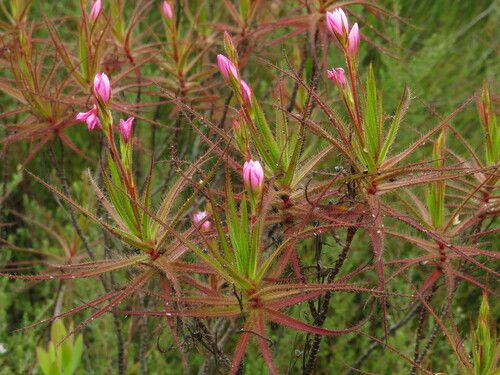
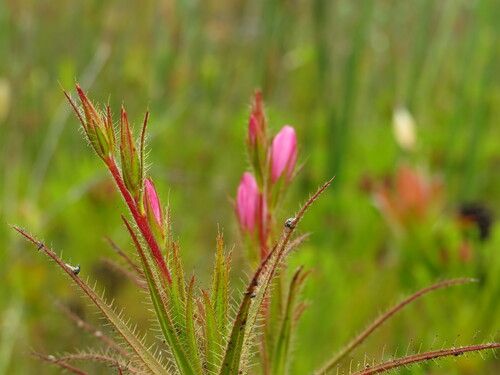
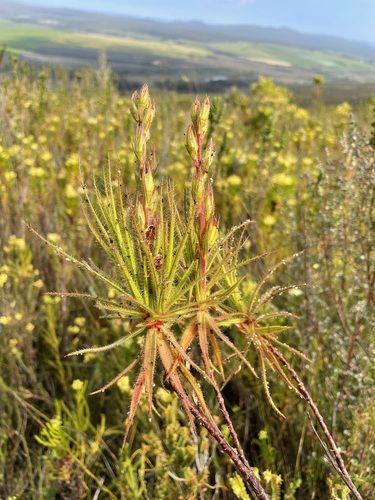
Etymology
- Roridula: from the Latin ros, roris, “dew”, and roridus, “covered in dew”. The name refers to the shining droplets that cover its leaves, like dew (generally accepted meaning).
- gorgonias: said to come from the Greek gorgós, “terrible”, and to refer to the Gorgons of mythology, the creatures with snakes for hair. The long sticky hairs on its leaves may recall this hair (probable origin, according to the South African National Biodiversity Institute).
History of the description
The French botanist Jules Émile Planchon described it in 1848. It later received other names, such as R. crinita (1913), now regarded as synonyms.
Description (how to recognise it)
- Habit: an evergreen, branched, upright shrub, 60 cm to 1 m tall. The fairly thick, brownish stems bear clearly visible scars of fallen leaves.
- Leaves:
- awl-shaped or ribbon-like, up to 12 cm long and 5 mm wide, clustered at the ends of the branches;
- their edges bear long tentacles ending in a teardrop-shaped gland, which secretes a sticky, shining resin;
- the upper surface bears smaller tentacles mixed with white hairs.
- Resin, not glue: unlike sundews, its droplets are made of resin, not a water-based mucilage. It even sticks flying insects that brush against the plant.
- Flowers:
- in spikes of up to 12 flowers, from July to October;
- each flower measures about 2.5 cm, with 5 purplish-pink or white petals;
- after flowering, the shoot dies, and new side branches grow beneath the old flowers.
Distribution
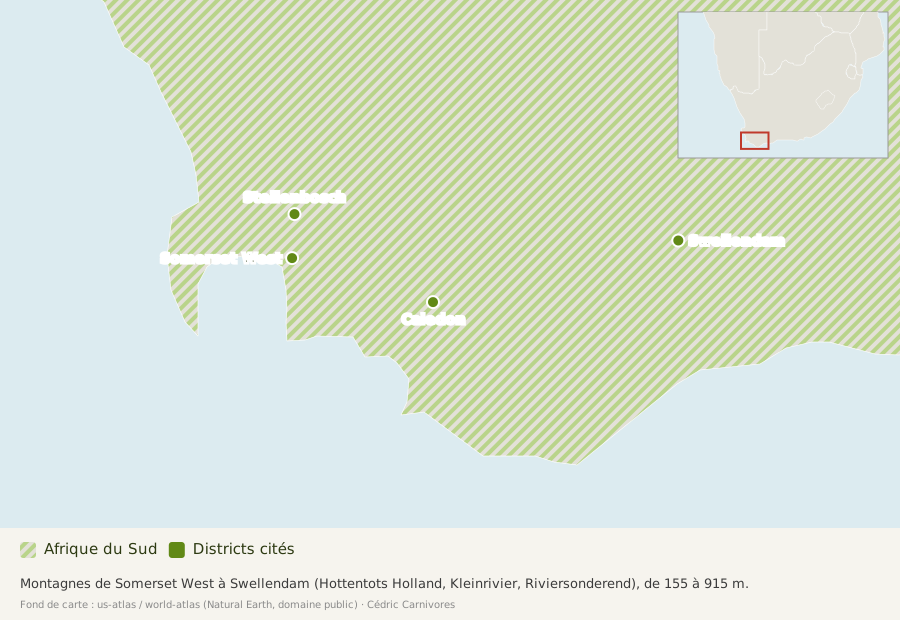
Endemic to the south-western Western Cape, in South Africa:
- in the mountains, from Somerset West to Swellendam;
- districts of Somerset West, Stellenbosch, Caledon and Swellendam;
- from the Hottentots Holland ranges to the Kleinrivier and Riviersonderend mountains.
Altitude: from 155 to 915 m.
Habitat
- Cool, damp places in the mountains;
- mountain seeps, as in the coastal Kleinrivier mountains;
- acid, very poor sandy soils, in the fynbos, the scrub vegetation typical of the Cape region.
Ecology: an alliance with a bug
- It captures but does not digest: its leaves trap many insects, but it produces no digestive enzymes.
- The bug Pameridea roridulae lives on the plant without sticking to it (thanks to a protective layer on its body, not confirmed). It sucks out the contents of the captured insects.
- The bug's droppings, left on the leaves, are absorbed by the plant, which thus recovers the nitrogen from its prey. It is a famous example of digestion “outsourced” to another animal.
- For this reason, it is often classed among the protocarnivorous plants (“almost carnivorous”), rather than among the true carnivores.
Threats and protection
It is not listed as rare or threatened. But its range is small, and farming and overly frequent fires could one day put it on the South African Red List.
Did you know?
- It hunts, but it is a bug that “digests” for it: the plant feeds on its droppings.
- Its droplets are resin: its branches were once used as flypapers in houses, hence its Afrikaans name vliebos, the “fly bush” (old use, not confirmed).
Sources
- Wikipedia (English), Roridula gorgonias: Planchon 1848, synonyms, names, description, flowering, Pameridea roridulae, protocarnivory.
- Wikipedia (English), genus Roridula: acid, poor sandy soils.
- SANBI, Plants of South Africa, Roridula gorgonias (summary of search results): range, altitude, etymology of gorgonias, status.
- SANBI Biodiversity Advisor: districts and ranges.
- Fierce Flora, Roridula gorgonias: seeps of the Kleinrivier mountains.