Sarracenia alabamensis Case & R. B. Case
Species sheet, 29/10/2026, based on the Flora of North America. Points marked “(not confirmed)” rest on a single, unreliable source.
At a glance
| Scientific name | Sarracenia alabamensis F. W. Case & R. B. Case, Sida 21: 2169, 2005 |
| Other name | Sarracenia rubra subsp. alabamensis |
| Family | Sarraceniaceae |
| Common names | Alabama canebrake pitcher plant; in French sarracénie d'Alabama |
| Subspecies | subsp. alabamensis (central Alabama) and subsp. wherryi (coastal plain of Alabama, Florida and Mississippi) |
| Flowering | April-May |
| Status | Subspecies alabamensis is very rare (about 12 populations), endangered under US federal law and listed in CITES Appendix I |
Photos in the wild
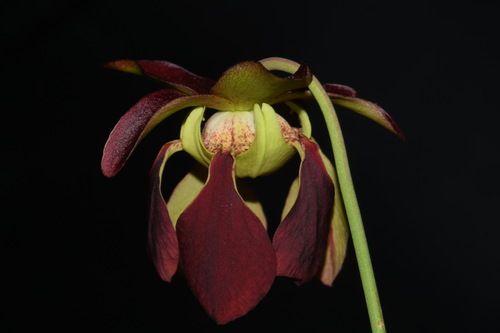
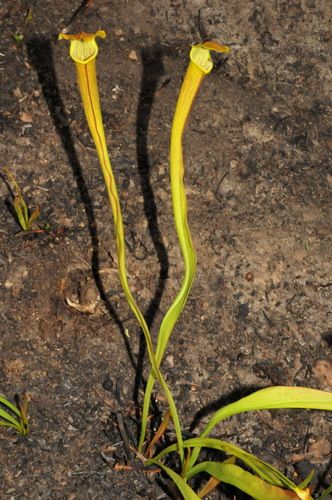
Etymology
- Sarracenia: the genus honours Michel Sarrazin de l'Étang (1659-1734), the king's physician in New France (see the genus sheet).
- alabamensis: “from Alabama”, the state where it was discovered.
- wherryi: the coastal plain subspecies is dedicated to the botanist Edgar T. Wherry, a great specialist in pitcher plants.
- Its English name canebrake refers to canebrakes, the thickets of native bamboo of the genus Arundinaria in the wetlands of the south-eastern United States.
History of the description
Frederick and Roberta Case distinguished this plant as early as 1975-1976, in their work on the rubra group. For reasons of nomenclatural rules, these first names were not accepted. Donald Schnell in turn named the coastal plain form in 1978 (S. rubra subsp. wherryi). In 2005, the Cases definitively published the species S. alabamensis and its two subspecies in the journal Sida. Other botanists continue to treat it as a subspecies of S. rubra.
Description of the species (how to recognise it)
- Habit: sparse or dense clumps, on rhizomes of 0.5 to 1.5 cm.
- Pitchers:
- lying down or upright, 8 to 72 cm;
- soft, always finely and densely downy on the outside;
- dull green or yellow-green, often washed with bronze to red. The large veins at the top of the tube are burgundy to purple on the inside, but hardly visible on the outside;
- no white spots;
- they wither in winter but stay on the plant.
- Mouth: oval, with a yellow-green, rarely red rim, often forming a beak above the wing.
- Lid: curved, held above the mouth, dull green to yellow-green washed with bronze to red. Oval, wavy, longer than wide.
- Flowers:
- one or two scapes, about as tall as the pitchers;
- moderate scent;
- burgundy-green sepals, folded back after flowering;
- burgundy petals, 2.5 to 4 cm, with finely toothed edges;
- green style “umbrella”, 2.5 to 4 cm.
- Fruits: capsules of 0.6 to 1.2 cm, seeds of 1.2 to 1.5 mm.
How it differs from its relatives: S. jonesii and S. rubra have firm pitchers, smooth or barely downy, with well-marked dark red veins, inside and out. They generally live in wetter habitats. S. alabamensis has softer, always downy pitchers, with less distinct red veins. Above all, its subspecies alabamensis has three forms of pitchers.
The two subspecies
subsp. alabamensis: the pitcher plant with three forms of pitchers
- Three kinds of pitchers in the year (rarely two), a unique case in the genus:
- in spring: lying or leaning, S-curved pitchers, yellow-green often washed with bronze to red, 18 to 50 cm;
- in late spring: upright pitchers, 18 to 50 cm, with a small mouth (0.7 to 2 cm);
- in summer: upright, larger and sturdier pitchers, 19 to 72 cm, often strongly washed with bronze to red, with small translucent areas between the veins below the mouth. They swell markedly for several centimetres below the mouth, which can reach 6.7 cm, with a true beak.
- Phyllodes: usually absent, sometimes a few flat blade-like leaves in late spring.
- Scapes: 27 to 57 cm. Flowering: April-May.
- Habitat: seeps along streams and on slopes, in meadows, thickets and sloping woods, from 50 to 200 m altitude.
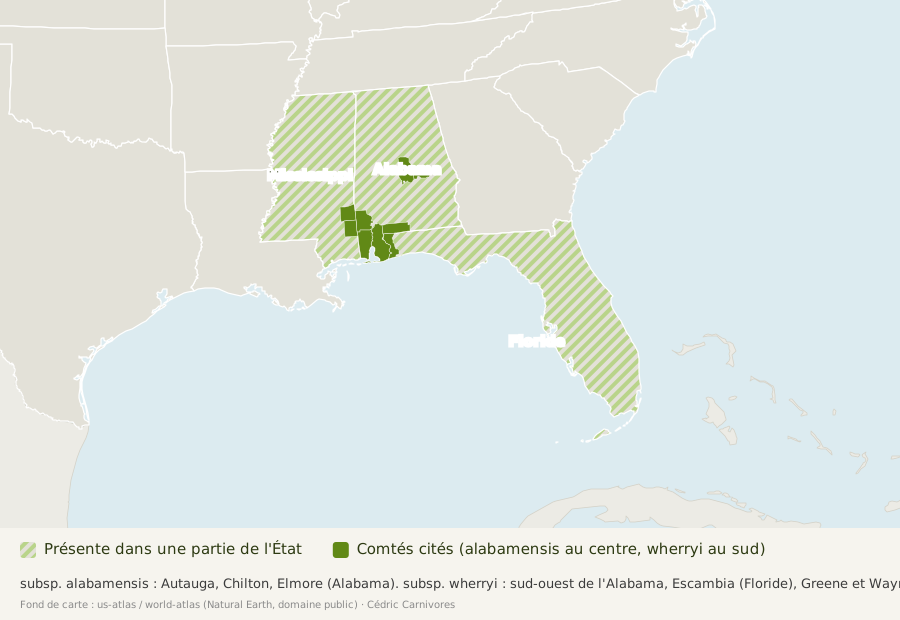
- Range: only about 12 populations, all in the sand hills of the “Fall Line” (the boundary between the Piedmont and the coastal plain) in Autauga, Chilton and Elmore counties, in central Alabama. It has been introduced in south-eastern Virginia.
- A survivor: it could be a relic of an older era. Today, as fires are suppressed, its open habitats are maintained only by chance, thanks to moderate grazing by cattle.
subsp. wherryi: the coastal plain form
- Much smaller plants, in sparse clumps.
- Pitchers of a single form, in spring as in summer: upright, dull green, often strongly washed with bronze or strawberry red, 8 to 48 cm.
- No phyllodes. Scapes: 14 to 40 cm. Flowering: April.
- Habitat: the typical habitats of coastal plain pitcher plants: boggy ditches, seeps, meadows, savannas, open wet pine forests, from 20 to 90 m altitude.
- Range: uncommon.
- Florida: just east of the Perdido River, in north-western Escambia County;
- Alabama: northern Baldwin County, south-western Escambia County, northern Mobile County, south-western Washington County;
- Mississippi: far east of Greene and Wayne counties.
Distribution
An evolutionary story
The authors of the Flora of North America propose a scenario for the origin of the rubra group:
- An ancestor in the mountains: an ancestral form is thought to have appeared in the uplands of the southern Appalachians, at the end of the Cretaceous.
- The descent along the rivers: it is thought to have migrated south along the great rivers, down to the coastal plain that was then forming.
- The descendants:
- on the coastal plain, it is thought to have spread east and south without changing much, giving the forms of S. rubra of the Carolinas, Georgia and western Florida;
- S. jonesii is thought to have stayed in the low mountains of the western Carolinas;
- S. alabamensis, isolated from the rest, is thought to have followed the Coosa River down to the sand hills of the Alabama Fall Line. From there a coastal plain form is thought to have arisen, the subspecies wherryi.
- The separation: in the Tertiary, geological events are thought to have broken up these populations, giving three variable but very closely related species.
The five plants of the group all live in separate regions. For the authors, combining them all as subspecies of S. rubra would hide their differences and their history.
Threats and protection
- The subspecies alabamensis is very rare and endangered under US federal law (year of listing; probably 1989, not confirmed). It is listed in CITES Appendix I and deserves active protection.
- Threats: fire suppression (its habitats only stay open thanks to grazing), drainage and urban development.
Did you know?
- It is the only pitcher plant that produces three different kinds of pitchers in the same year.
- Its last sites stay open thanks to cows: moderate grazing replaces the natural fires that have disappeared.
Sources
- Flora of North America, vol. 8, p. 353-355, Sarracenia alabamensis and its subspecies alabamensis and wherryi (T. L. Mellichamp and F. W. Case), floranorthamerica.org/Sarracenia_alabamensis: publication, description, three forms of pitchers, flowering, habitats, altitudes, counties, 12 populations, Virginia, grazing, evolutionary scenario.
- Wikipedia (English), Sarracenia rubra: English name, federal status.