
 Français
 Español
 Deutsch
 Italiano

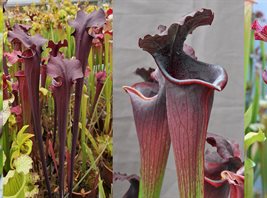


Encyclopedia: the genus Sarracenia


The genus Sarracenia
The 11 species of North American pitcher plants: origin, forms, natural hybrids, fire and protection.
Genus profile, 29/10/2026, based on the Flora of North America.
At a glance
Nom
Sarracenia Linnaeus, Species Plantarum 1: 510, 1753; spelt Sarracena in Genera Plantarum (5th ed., 1754)
Family
Sarraceniaceae (with Darlingtonia in California and Heliamphora in South America)
Common names
Pitcher plants; in French sarracénies
Number of species
1111 according to the Flora of North America
Distribution
North America; introduced in Europe and Asia
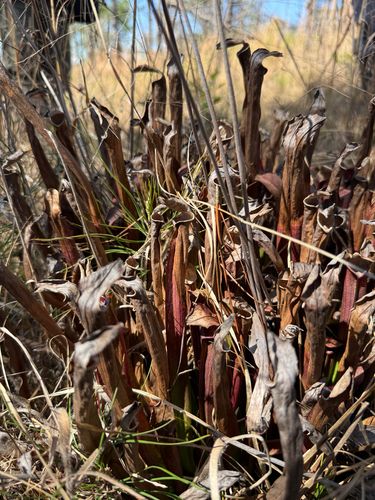
In the wild
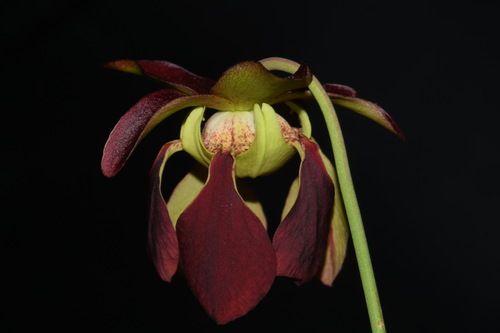
Brian Finzel, CC BY-SA
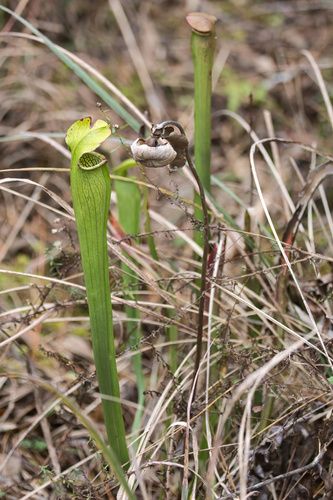
Lauren McLaurin, CC BY
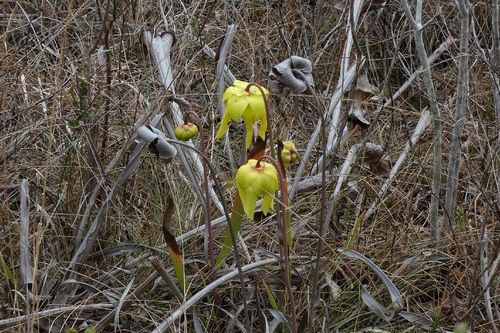
JD Flores, CC0
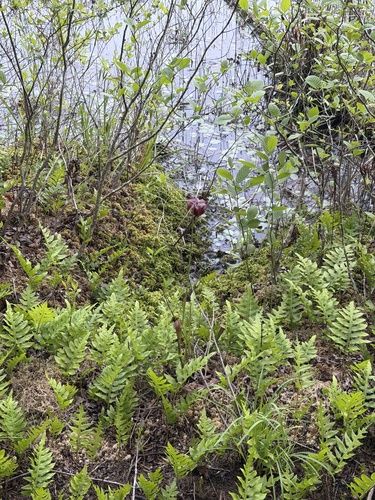
novvictan, CC BY
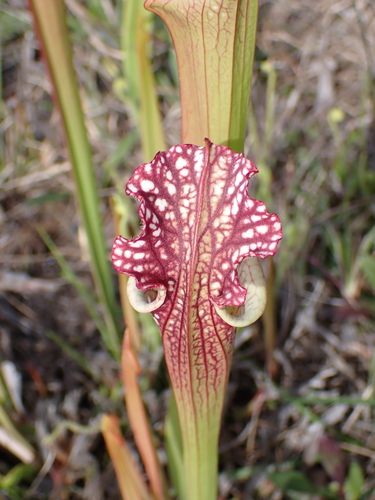
Laura Gaudette, CC BY
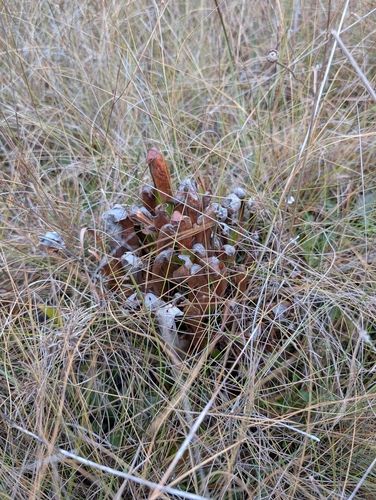
i like lizards, CC BY
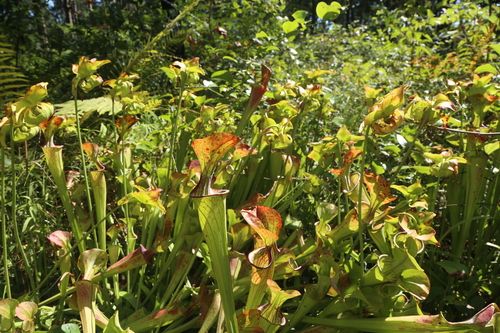
Reid Hardin, CC BY
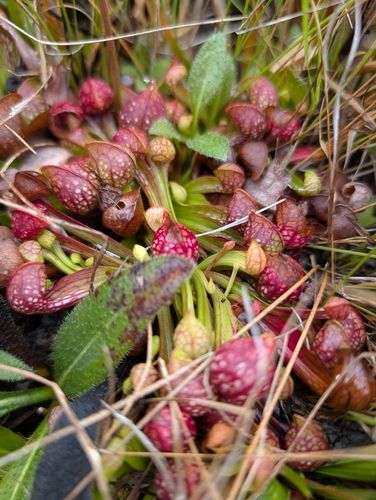
i like lizards, CC BY
Etymology
The genus honours Michel Sarrazin de l'Étang (1659-1734), royal physician in New France (today's Quebec), who sent specimens to Europe. The French botanist Tournefort created the name Sarracena in 1700 from the plant Sarrazin had sent him, the purple pitcher plant. Linnaeus took up the name as Sarracenia in 1753.
The 11 species
| Species | Note |
|---|---|
| S. alabamensis | Treated elsewhere as a subspecies of S. rubra; the only species whose pitchers change shape between spring and summer |
| S. jonesii | Treated elsewhere as a subspecies of S. rubra |
| S. leucophylla | The only species whose capsule opens from the bottom up |
| S. minor | The only species with almost scentless flowers |
| S. psittacina | The only species whose opening is not at the top of the pitcher |
| S. purpurea | Pot-bellied, jug-shaped pitchers |
| S. rosea | Pot-bellied, jug-shaped pitchers; separated from S. purpurea |
Note: the authors of the Flora of North America acknowledge that some of their choices are debated. Other botanists include S. alabamensis and S. jonesii in S. rubra, and S. rosea in S. purpurea.
What all pitcher plants have in common
- Habit: perennial herbaceous plants, in clumps or mats, on a horizontal or vertical rhizome. They do not produce stolons.
- Pitchers: leaves rolled into a tube, gradually widening from the base to the opening. They are upright in most species, lying down in S. psittacina, and pot-bellied jugs in S. purpurea and S. rosea.
- The hood (operculum) grows from the back edge of the opening. It can be upright, curved, flat or domed, and is often attached by a “neck”.
- In some species, the pitchers wither in winter but stay on the plant (they are called “marcescent”); in others, they stay green all year round.
- Phyllodes: in midsummer some species produce flat, blade-shaped or sickle-shaped leaves that do not catch insects.
- Flowers :
- a single flower per scape (sometimes two in S. alabamensis, S. jonesii and S. rubra);
- usually scented: sometimes smelling of roses, sometimes an unpleasant smell, compared to cat urine. Only S. minor is almost scentless;
- drooping, fiddle-shaped petals that fall after flowering, while the sepals remain;
- 50 to 100 stamens;
- the style widens into a large umbrella-shaped disc with five lobes. The tiny stigmas (about 1 mm) are hidden in the notches between the lobes.
- Fruits and seeds: a round capsule covered with small bumps, containing 400 to 1,000 seeds.
- Chromosomes: base number x = 13 (2n = 26).
The yearly cycle
- The flower buds form at the end of summer, then stay dormant until the following spring. Flowers sometimes open out of season, at the end of summer or in autumn.
- Depending on the species, the pitchers appear before, during or after the flowers. This timing helps to identify the species.
- Some species produce very different leaves depending on the season. S. alabamensis can even have three kinds of pitchers in a year.
A genus that hybridises easily
- Pitcher plants hybridise very easily. The hybrids are fertile: they cross back with each other and with their parents, forming “hybrid swarms”.
- These swarms are legendary on the Gulf Coast. They may have increased with habitat disturbance, and they make identifying the species very difficult.
Forms without red
Almost every species has been found in the wild in a form without red pigment (without anthocyanins), with entirely yellow or green flowers and pitchers.
- The best known comes from the north-east: S. purpurea forma heterophylla. Its name recalls that the original specimen bore shade and sun pitchers of different shapes.
- By extension, growers often call any yellow variant a “heterophylla form”.
- These plants are very rare and almost absent from herbaria.
Fire, guardian of the pitcher plants
In the south-eastern United States, pitcher plant habitats are maintained by fire, especially open pine woodlands and savannas.
- Without frequent fires, these open, sunny, acidic and poor habitats quickly turn into dense thickets of shrubs or tall grasses.
- The pitcher plants end up in the shade, weaken and take on an abnormal look.
- Most survive all the same, and grow back vigorously after a fire.
Identifying the species
Identification often depends less on the flowers than on small details of the pitchers. The authors of the Flora of North America advise:
- looking at the largest, well-formed pitchers of healthy plants growing in moist soil and full sun. In shade or dry conditions, the pitchers are smaller, flat or floppy and lying down;
- examining several leaves on several plants of the same population;
- noting whether phyllodes are present or absent;
- knowing the exact geographical origin of the plant, especially for the S. purpurea and S. rubra groups. Species that are hard to tell apart generally live in different regions.
Pitcher plants and people
- They have been sought-after ornamental plants since the early 19th century.
- The first artificial hybrids were created in England at the end of the 19th century (J. H. Veitch, 1906).
- Today, all the species and many hybrids, natural or man-made, are grown by enthusiasts and botanical gardens all over the world.
- For the authors of the Flora of North America, they are among the most beautiful and fascinating plants in the world. Yet very little is still known about their origins and relationships.
Further reading
References cited by the Flora of North America:
- Bell, C. R. (1952). Natural hybrids in the genus Sarracenia I. J. Elisha Mitchell Sci. Soc. 68 : 55-80.
- Bell, C. R. & Case, F. W. (1956). Natural hybrids in the genus Sarracenia II. J. Elisha Mitchell Sci. Soc. 72 : 142-152.
- Case, F. W. & Case, R. B. (1976). The Sarracenia rubra complex. Rhodora 78 : 270-325.
- Folkerts, G. W. (1982). The Gulf Coast pitcher plant bogs. American Scientist 70 : 260-267.
- Schnell, D. E. (2002). Carnivorous Plants of the United States and Canada, 2nd ed.
- Wherry, E. T. (1935). Distribution of the North American pitcherplants.
Source
- Flora of North America, vol. 8, p. 350, genus Sarracenia (T. L. Mellichamp and F. W. Case), floranorthamerica.org/Sarracenia.
All the species (11)
Each profile presents the species in the wild: origin of the name, history, description, distribution map, habitat and sources. To search by name or by growing method: search for a species.
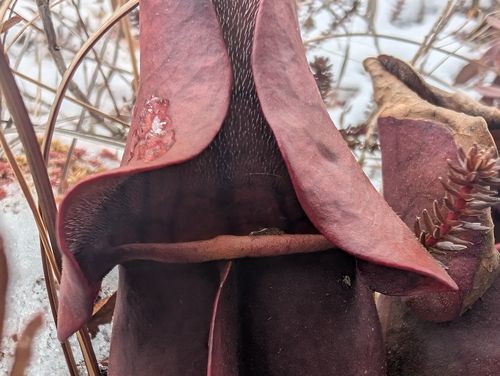
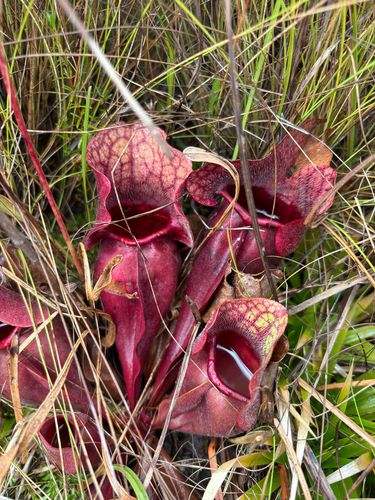
Share this article:


Similar posts

Encyclopedia: the genus Nepenthes
Nepenthes, the tropical pitcher plants of Asia: more than 180 species, their habitat, their prey and their amazing partnerships.

Encyclopedia of carnivorous plants: search for a species
More than 900 carnivorous plants, species by species: search by name, by genus, or by growing method (outdoors, indoors…).