Sarracenia alata (Alph. Wood) Alph. Wood
Species sheet, 29/10/2026, supplemented with the Flora of North America. Points marked “(not confirmed)” rest on a single, unreliable source.
At a glance
| Scientific name | Sarracenia alata (Alphonso Wood) Alphonso Wood, Leaves and Flowers: 159, 1863 |
| First name | Sarracenia gronovii var. alata Alph. Wood, Class-Book of Botany: 222, 1861 |
| Family | Sarraceniaceae |
| Common names | Pale pitcher plant, winged pitcher plant; in French sarracénie ailée |
| Former name | Sarracenia sledgei Macfarlane (synonym) |
| Distribution | From south-western Alabama to eastern Texas |
| Habitat | Wet pine savannas, bogs, seeps, from 0 to 50 m altitude |
| Flowering | March-April |
| Status | Near threatened (IUCN, 2000 assessment); G4 for NatureServe; CITES Appendix II |
Photos in the wild
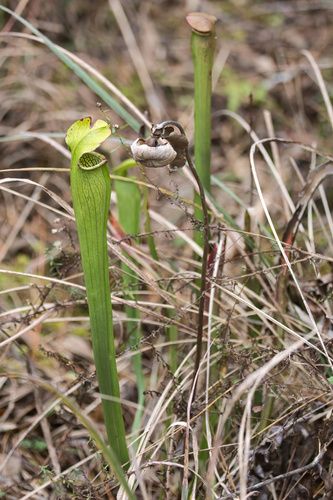
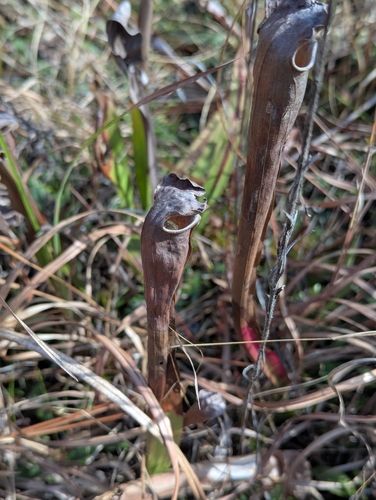
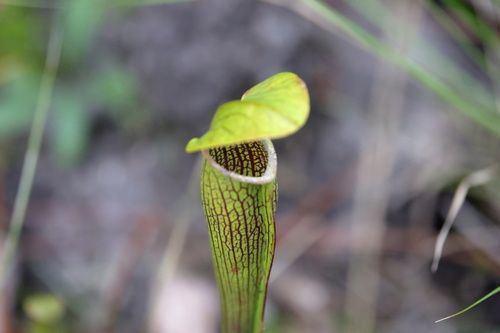
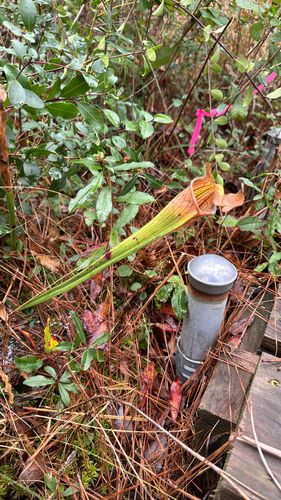
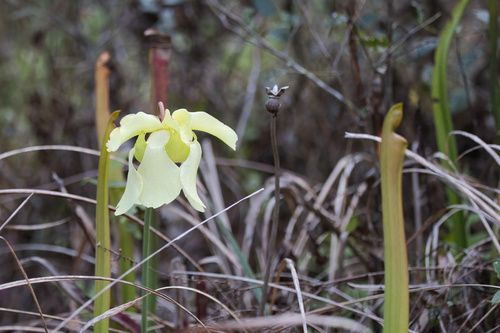
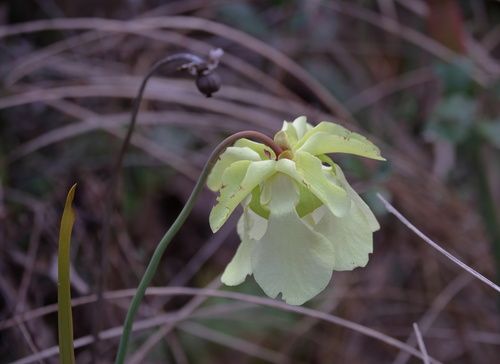
Etymology
- Sarracenia: the genus honours Michel Sarrazin de l'Étang (1659-1734), the king's physician in New France (see the genus sheet).
- alata: a Latin word meaning “winged”. Its English name winged pitcher plant (in French sarracénie ailée) points the same way. It is thought to refer to the wing, the ridge of tissue that runs along the front of the pitcher (origin of the name uncertain).
History of the description
The American botanist Alphonso Wood first described it in 1861 as a variety of another pitcher plant, Sarracenia gronovii var. alata, in his Class-Book of Botany. In 1863, on page 159 of Leaves and Flowers, he raised it to species rank. That is why its name carries Wood's name twice: the author in brackets is the author of the first name.
Description (how to recognise it)
- Habit: dense clumps, on rhizomes 0.8 to 1.5 cm in diameter.
- Pitchers:
- upright and firm, 15 to 75 cm;
- the top of the tube is most often yellow-green, but sometimes veined or streaked with purple, or even entirely purple. Their shape is very constant, but their colour extremely variable;
- no white spots;
- wing of 1 to 2 cm;
- they wither in winter but stay on the plant.
- Two flushes a year: a set of pitchers in spring, shortly after the first flowers, then a second, sturdier set in late summer. These are the largest pitchers of the year.
- Mouth: oval, 2 to 5 cm, with a tightly rolled green rim.
- Lid: curved, held well above the mouth. Oval, 3.5 to 6 cm, often wider than long, the same colour as the pitcher, without a narrowed neck.
- Phyllodes: usually absent, rarely 1 or 2, up to 40 cm.
- Flowers:
- scapes of 15 to 60 cm, shorter than the pitchers;
- rather unpleasant smell;
- yellowish-green sepals; pale yellow to bright yellow petals, 5 to 7 cm;
- green style “umbrella”, 5 to 8 cm.
- The flowers have the same shape as those of the S. rubra group, but larger.
- Fruits: capsules of 1.2 to 1.8 cm, seeds of 1.9 to 2.3 mm.
- Chromosomes: 2n = 26.
Distribution
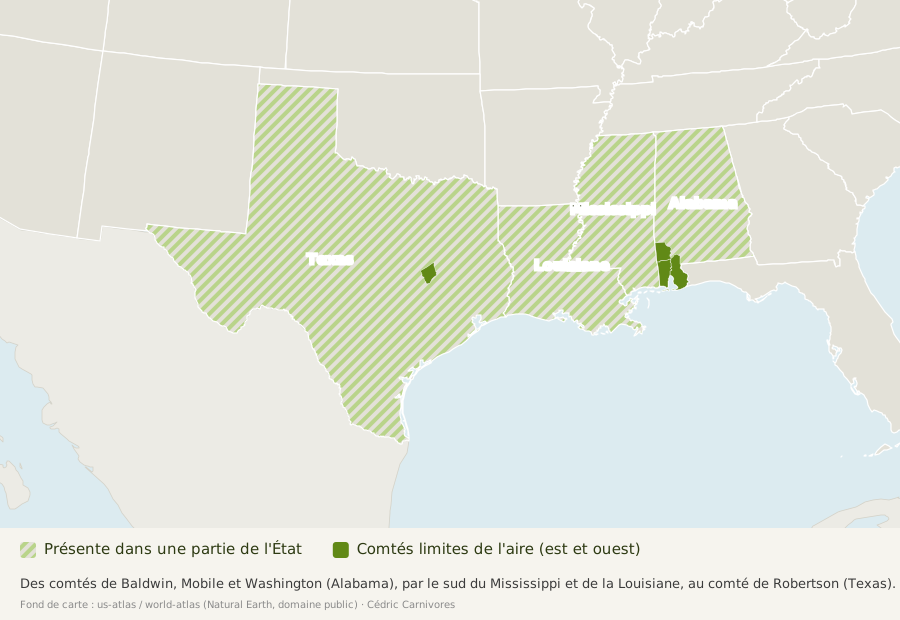
- Alabama: Baldwin, Mobile and Washington counties, in the south-west.
- Mississippi and Louisiana: the south of both states.
- Texas: as far as Robertson County, to the west.
The species is thus split in two by the Mississippi: an eastern block (Alabama, Mississippi, eastern Louisiana) and a western block (western Louisiana, eastern Texas).
Habitat
- Wet pine savannas and open wet pine forests;
- bogs and seepage slopes under pines;
- sometimes on mineral soils poor in organic matter.
In Texas, it lives in wetlands without longleaf pine, in the middle of regions dominated by oaks of dry habitats. There it grows in bogs, seeps and meadows where it is water coming out of the ground, not rain, that keeps the plants moist.
Altitude: from sea level to 50 m.
Ecology
- Fire: like the other south-eastern pitcher plants, it benefits from fires, natural or prescribed, which clear out the shrubs. After a burn, new pitchers quickly come up.
- Prey: mainly flying insects, attracted by the nectar on the rim of the pitcher.
Two hidden species?
In 2013, a genetic study (Carstens and Satler) analysed 21 DNA regions from plants across the whole range. It shows that S. alata is in fact made up of two distinct lineages, in the east and in the west. They are separated by the Mississippi and the Atchafalaya basin, a natural barrier known for many other species. The authors propose raising the western populations to species rank. For now, this change has not been adopted.
Natural hybrids
| Hybrid | Other parent |
|---|---|
| S. × ahlesii | S. rubra |
| S. × alava | S. flava |
| S. × areolata | S. leucophylla |
| S. × exornata | S. purpurea |
Full list of the genus's hybrids: see “Genus Sarracenia: complete list of taxa”.
Threats and protection
- Status: “near threatened” for the IUCN (2000 assessment); G4 for NatureServe; CITES Appendix II.
- Threats: those of the Gulf Coast pine savannas. Most of these habitats have disappeared, drained or planted with pines, and fire suppression lets shrubs invade the remaining sites.
Did you know?
- In Texas, it grows far from pines, in seeps in the middle of dry oak forests.
- One “species” could be hiding two: the winged pitcher plant of Texas and that of Alabama have DNA different enough for them to be separated one day.
Sources
- Flora of North America, vol. 8, p. 355, Sarracenia alata (T. L. Mellichamp and F. W. Case), floranorthamerica.org/Sarracenia_alata: publication, first name, full description, flowering, habitats, altitude, boundary counties, Texas habitats.
- Wikipedia (English), Sarracenia alata: statuses, veins, flower colours.
- Carstens & Satler 2013, Biological Journal of the Linnean Society: two hidden lineages.