Sarracenia flava L.
Species sheet, 29/10/2026, supplemented with the Flora of North America. Points marked “(not confirmed)” rest on a single, unreliable source.
At a glance
| Scientific name | Sarracenia flava Linné, Species Plantarum 1: 510, 1753 |
| Family | Sarraceniaceae |
| Common names | Yellow pitcher plant, trumpets, fly-catchers, fly-traps, dumbwatches; in French sarracénie jaune |
| Distribution | Atlantic coastal plain, from south-eastern Virginia to Georgia, and the western Florida Panhandle |
| Habitat | Wet pine savannas, “Carolina bays”, cypress swamps, bogs, from 0 to 300 m altitude |
| Flowering | March-April |
| Status | Least concern (IUCN); G5 for NatureServe; CITES Appendix II. But critically endangered in Virginia, where only one natural population remains |
Photos in the wild
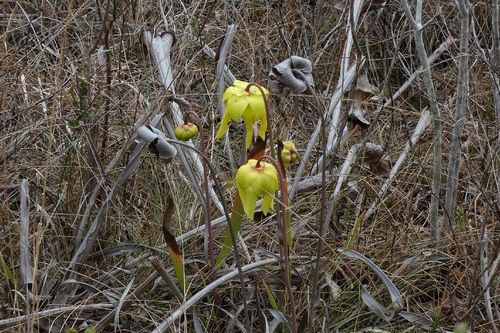
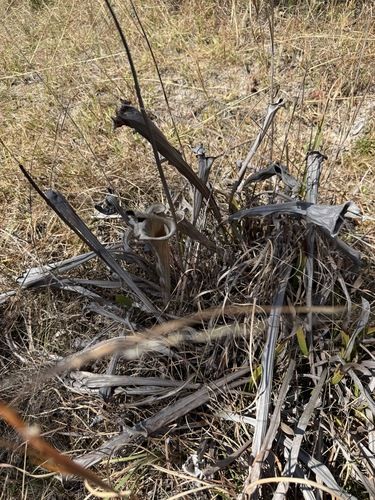
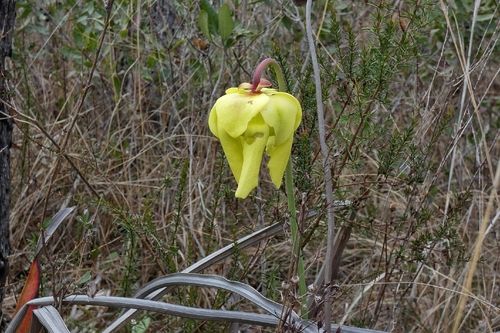
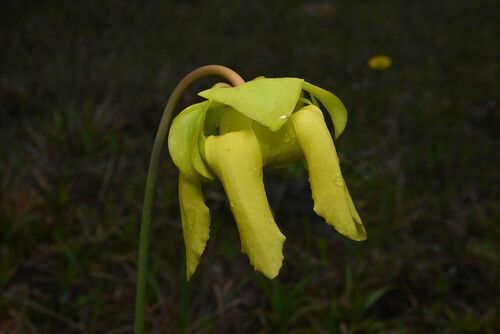
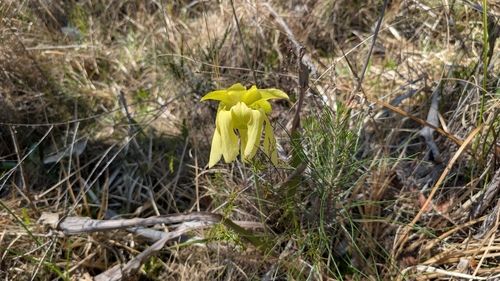
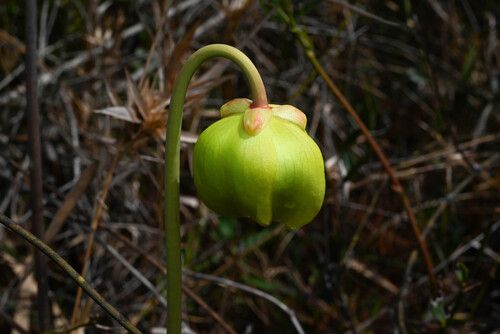
Etymology
- Sarracenia: the genus honours Michel Sarrazin de l'Étang (1659-1734), the king's physician in New France (see the genus sheet).
- flava: a Latin word meaning “pale yellow” or “yellowish”. It refers to the colour of its large yellow flowers, not to the plant itself.
- Its English folk names are delightful: fly-catchers and fly-traps, trumpets, or dumbwatches.
History of the description
S. flava is one of the very first carnivorous plants to be given a scientific name. Linnaeus described it in 1753 in his Species Plantarum, the work that marks the start of modern botanical nomenclature, at the same time as S. purpurea.
Description (how to recognise it)
- Habit: dense clumps, on rhizomes 1 to 2.5 cm in diameter.
- Pitchers:
- upright, thick and firm, 25 to 90 cm (up to 100 cm);
- yellow-green, often with large dark red blotches on the “neck”, red veins on the top of the tube and the lid, or a tube entirely washed with bronze or purplish red;
- no white spots;
- narrow wing, 0.5 to 1 cm;
- a single flush of pitchers a year, from spring to early summer, after the first flowers.
- Mouth: broadly oval, 2 to 7 cm, with a flared green rim that often forms a small beak above the wing.
- Lid: very large, 3 to 10 cm long by 5 to 14 cm wide, rounded and kidney-shaped. Its two basal lobes fold back and almost touch. It is joined to the pitcher by a narrowed neck, 1 to 3 cm, and ends in a point (the apiculus) of 3 to 12 mm, sometimes 18 mm: the longest in the genus.
- Phyllodes: 2 to 4 (up to 5) flat, upright, blade-like leaves, 12 to 30 cm, produced after the pitchers.
- Flowers:
- scapes of 15 to 60 cm, shorter than the pitchers;
- strong, unpleasant smell;
- large yellow petals of 5 to 8.5 cm;
- yellow-green style “umbrella”, 6 to 8 cm.
- Fruits: capsules of 1.4 to 2 cm, seeds of 1.8 to 2.5 mm.
- Chromosomes: 2n = 26.
Distribution
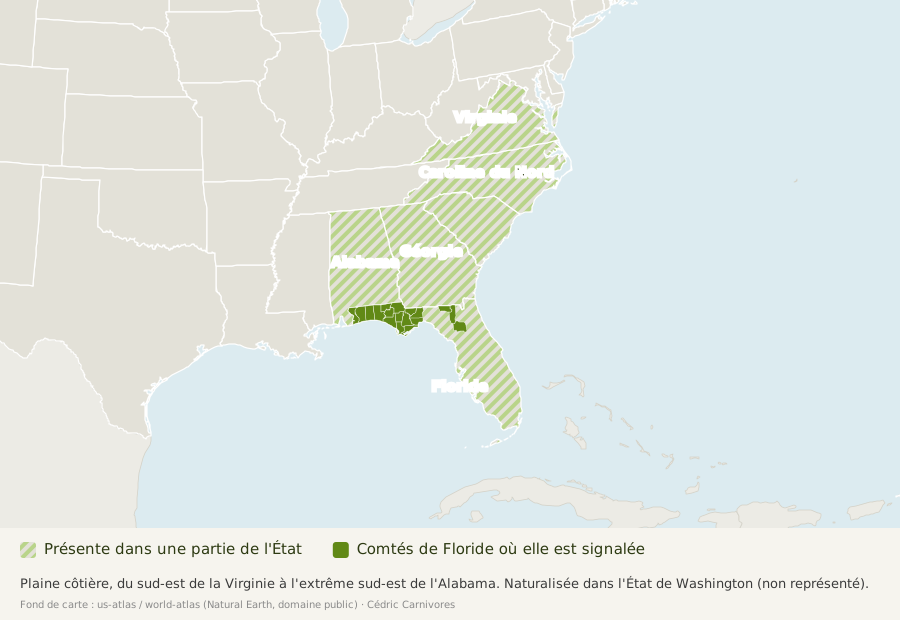
- Virginia: south-eastern coastal plain. Formerly 17 populations in 8 counties; today a single natural population, plus restored sites where the species has been reintroduced.
- North Carolina: coastal plain, plus a few isolated sites in the Piedmont.
- South Carolina and Georgia: coastal plain.
- Florida: the western Panhandle, mainly near and west of the Ochlockonee River, plus a few isolated sites in the north-east of the state.
- Alabama: only the far south-east.
- Naturalised in Skagit County, in Washington State. An introduced population is also reported in California, in Mendocino County (not confirmed).
Habitat
- Wet pine savannas and open wet pine forests;
- peat-bottomed “Carolina bays”: oval depressions typical of the Carolinas' coastal plain;
- bald cypress swamps (pond-cypress);
- bogs and seepage slopes under pines;
- edges of stream heads;
- baygalls and titi thickets, swamp shrubs.
Altitude: from sea level to 300 m.
Ecology
- An intoxicating nectar: the swelling on the rim of the pitcher secretes a sweet nectar that contains coniine, an alkaloid, the same poison as in hemlock. It is thought to stun insects, which then fall in more easily.
- A funnel trap: downward-pointing hairs guide the insect towards the bottom, then a smooth, waxy wall makes it slide into the digestive fluid.
- Prey: mainly flying insects (wasps, bees, flies, moths). Large wasps sometimes escape by chewing through the wall.
- The pitcher plant moth: the caterpillar of the moth Exyra ridingsii lives and feeds in the pitchers of S. flava.
- Fire: like all south-eastern pitcher plants, it needs fires, which keep the habitat open.
Varieties
The species is very variable in its veins and blotches. At least seven varieties have been formally named (D. E. Schnell, 2002). In the field, many plants are intermediate.
| Variety | Distinguishing feature |
|---|---|
| var. flava | Yellow-green tube, red patch in the throat formed by dense veins |
| var. rugelii | Large dark red blotch at the base of the lid (“cut throat”) |
| var. ornata | Very marked red veins on the lid and the top of the tube |
| var. cuprea | Lid with coppery or reddish sheen, green tube; mainly in the Carolinas |
| var. rubricorpora | Red tube, lid staying yellow-green; described in 1998 with cuprea |
| var. atropurpurea | Pitcher entirely dark red; rare, mainly in the Carolinas |
| var. maxima | Very tall pitchers, entirely yellow-green, without red markings |
| f. viridescens | Plant completely lacking red pigment |
(The precise ranges of each variety; reliable sources are scarce, not confirmed)
Natural hybrids
| Hybrid | Other parent |
|---|---|
| S. × alava | S. alata |
| S. × catesbaei | S. purpurea |
| S. × harperi | S. minor |
| S. × moorei | S. leucophylla |
| S. × popei | S. rubra |
Full list of the genus's hybrids: see “Genus Sarracenia: complete list of taxa”.
Threats and protection
- Globally, the species is not threatened (“least concern” for the IUCN, G5 for NatureServe). It is listed in CITES Appendix II, like all pitcher plants.
- It once formed large stands, but it has become much rarer with drainage and changes in land use.
- In Virginia, only one natural population remains.
- It is estimated that less than 3% of the original pitcher plant habitats remain on the Gulf coastal plain.
- Threats: drainage for pine plantations or urban development, fire suppression, invasive plants, collecting of plants and seeds, roadside herbicides.
Did you know?
- Its coniine is the same substance as in hemlock, the poison that killed Socrates.
- Its lid bears the longest point in the genus, up to 18 mm.
- In Virginia, the plant was saved just in time thanks to bog restoration and reintroductions.
In Florida
Based on the Atlas of Florida Plants and specimens from the University of South Florida herbarium.
- Herbarium: the University of South Florida herbarium holds 41 collections made between 1964 and 2017 in 14 Florida counties: Bay, Calhoun, Escambia, Franklin, Gulf, Holmes, Jackson, Leon, Liberty, Okaloosa, Santa Rosa, Wakulla, Walton and Washington.
- Habitats noted on the labels: slope bogs and stream-head bogs in longleaf pine savannas, often burned, wet pine savannas, edges of pinewoods and grassy roadsides, sometimes with S. rosea. The Atlas classes it among “obligate wetland” plants.
Sources
- Flora of North America, vol. 8, p. 355, Sarracenia flava (T. L. Mellichamp and F. W. Case), floranorthamerica.org/Sarracenia_flava: full description, English names, flowering, habitats, altitude, precise range, naturalisation in Washington State, seven varieties.
- Wikipedia (English), Sarracenia flava: coniine (Mody et al. 1976), hybrids, statuses.
- UF/IFAS Extension, publication UW378: threats, less than 3% of habitats remaining.
- The Sarraceniaceae of Virginia (pitcherplant.org): Virginia populations.
- Carnivorous Plant FAQ (B. Rice) and Carnivorous Plant Newsletter (Schnell, 1998): varieties.
- Environmental Entomology, Exyra ridingsii on S. flava.
- Atlas of Florida Plants (University of South Florida), Sarracenia flava, and its herbarium specimens: status in Florida, counties, habitats, flowering.