Sarracenia jonesii Wherry
Species sheet, 29/10/2026, based on the Flora of North America.
At a glance
| Scientific name | Sarracenia jonesii Wherry, Journal of the Washington Academy of Sciences 19: 385, 1929 |
| Other name | Sarracenia rubra subsp. jonesii (Wherry) Wherry |
| Family | Sarraceniaceae |
| Common names | Mountain sweet pitcher plant; in French sarracénie des montagnes |
| Distribution | Mountains of south-western North Carolina and north-western South Carolina |
| Habitat | Mountain seepage bogs, from 300 to 600 m above sea level |
| Flowering | May |
| Status | Endangered under US federal law (since 1988); CITES Appendix I; part of the Center for Plant Conservation's national collection of endangered plants |
Photos in the wild
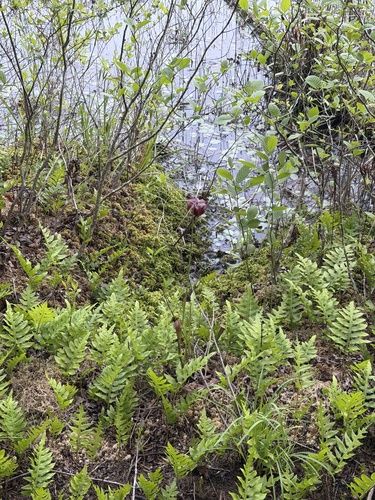
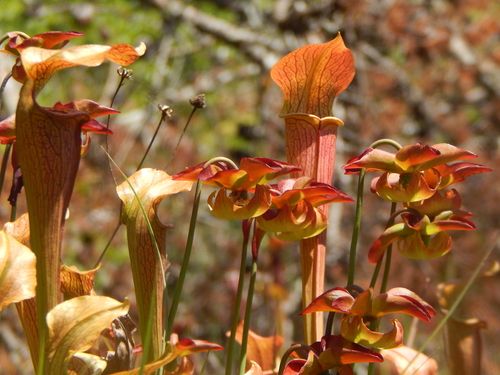
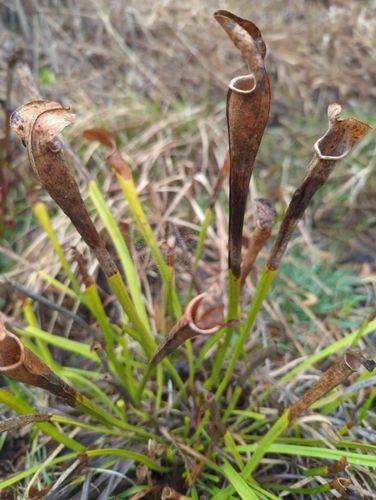
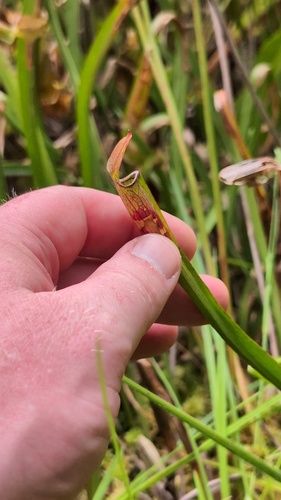
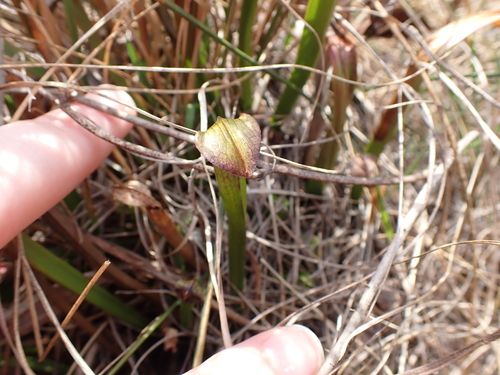
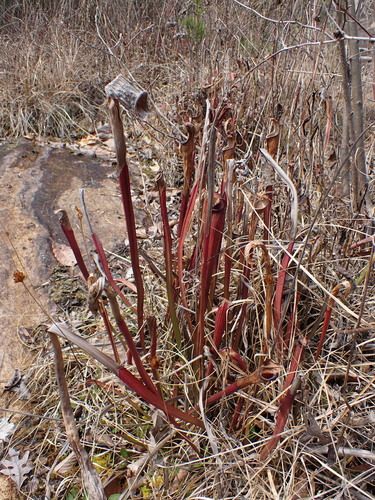
Etymology
- Sarracenia: the genus honours Michel Sarrazin de l'Étang (1659-1734), the king's physician in New France (see the genus sheet).
- jonesii: the species is dedicated to a person named Jones (identity uncertain).
History of the description
Edgar T. Wherry described it in 1929 as a species, Sarracenia jonesii. He later placed it himself under S. rubra, as a subspecies. The Flora of North America once again treats it as a separate species (see the sheet of S. rubra, “the rubra complex”).
Description (how to recognise it)
- Habit: dense clumps, up to 50 cm across in meadow-like bogs, on rhizomes 0.5 to 1.5 cm thick.
- Pitchers:
- upright, firm and waxy, 21 to 73 cm tall;
- a long “petiole”: the lower quarter or third of the pitcher is solid, with no cavity. Higher up the tube becomes hollow, then swells clearly in its last quarter;
- green, usually veined with red or purple, rarely flushed with purplish maroon;
- no white spots; narrow wing, 0.2 to 1 cm;
- they appear with the flowers, then keep being produced all summer and stay green in winter.
- Mouth: oval, 1 to 4 cm, with a maroon rim, often forming a clearly visible beak above the wing.
- Hood: arching over the mouth, purplish red, veined with purplish red on both sides. Broadly oval, wavy, 2.4 to 6.5 cm.
- No phyllodes.
- Flowers:
- one or two scapes 32 to 70 cm tall, about as tall as the pitchers;
- moderate scent;
- maroon sepals and petals, petals 2.5 to 4 cm with finely toothed edges;
- green style “umbrella”, 2.5 to 4 cm.
- Fruits: capsules 0.6 to 1.2 cm, seeds 1.2 to 1.5 mm.
- Chromosomes: 2n = 26.
Telling it apart from S. rubra: S. jonesii has a much longer solid “petiole”, and scapes about as tall as the pitchers, whereas those of S. rubra rise well above them. Some plants can look like other members of the rubra complex, or even like S. alata hybrids: always look at the largest well-formed pitchers, and at the flowers.
Distribution
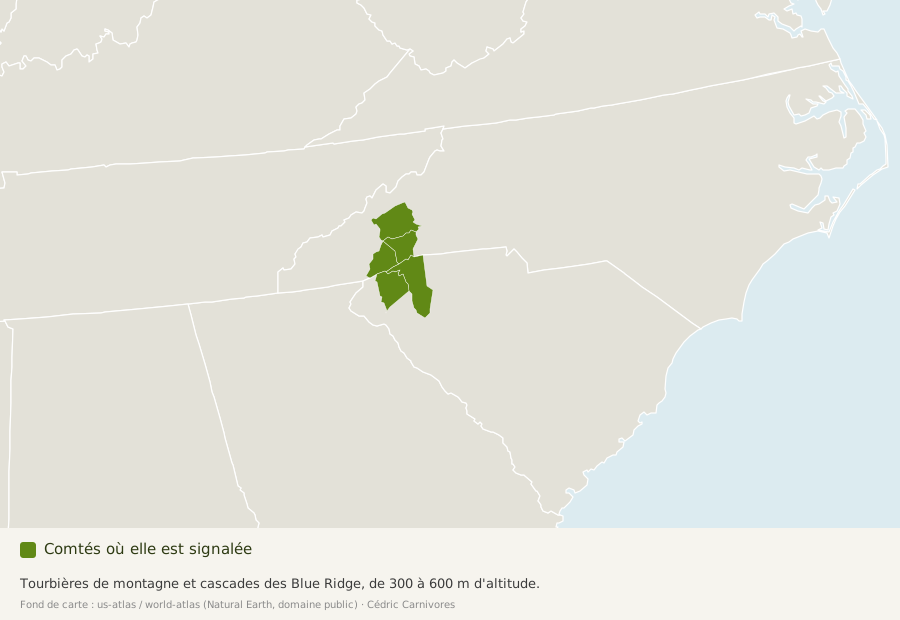
- North Carolina: seepage bogs in the low mountains of the south-west, in Buncombe, Henderson and Transylvania counties.
- South Carolina: seeps along gentle waterfalls, on the Blue Ridge escarpment, in Greenville and Pickens counties.
- Within this range, some populations have also been introduced and have become naturalised.
According to the U.S. Fish and Wildlife Service (1988), 26 populations were once known, of which only 10 remained.
Habitat
- Mountain seepage bogs, often shaped like small wet meadows;
- seeps along waterfalls.
Altitude: 300 to 600 m.
Remarkable forms
Plants without red pigment, with yellowish-green flowers and pitchers, are known in the wild.
Threats and protection
- Rare and vulnerable: most of its best sites have disappeared since 1950, because of urban development.
- Listing: “endangered” species under US federal law since 31 October 1988; recovery plan since 1990; CITES Appendix I.
- Threats noted in 1988: drainage, impoundments, grazing and farming, encroachment by vegetation, commercial and scientific collecting, urban development.
- It is part of the Center for Plant Conservation's national collection of endangered plants.
Did you know?
- It grows along waterfalls, on the Blue Ridge escarpment: a very unusual habitat for a pitcher plant.
Sources
- Flora of North America, vol. 8, p. 356, Sarracenia jonesii (T. L. Mellichamp and F. W. Case), floranorthamerica.org/Sarracenia_jonesii: publication, full description, flowering, habitat, altitude, counties, naturalisations, decline since 1950, forms without red, distinction from S. rubra.
- U.S. Fish and Wildlife Service, Federal Register 1988 (archive): listing, 26 and 10 populations, threats.
- Recovery plan, 1990 (NC State Herbarium).