Sarracenia leucophylla Raf.
Species sheet, 29/10/2026, supplemented with the Flora of North America. Points marked “(not confirmed)” rest on a single, not very reliable source.
At a glance
| Scientific name | Sarracenia leucophylla Rafinesque, Florula Ludoviciana: 14, 1817 |
| Family | Sarraceniaceae |
| Common names | White-top pitcher plant, crimson pitcher plant, white trumpet; in French sarracénie à feuilles blanches |
| Former name | Sarracenia drummondii H. B. Croom (synonym) |
| Distribution | Gulf of Mexico coastal plain: western Florida Panhandle, southern Alabama, south-eastern Mississippi |
| Habitat | Bogs, wet pine savannas, marsh edges, from 0 to 90 m above sea level |
| Flowering | March-April |
| Status | Vulnerable (IUCN, 2000 assessment); G3 (NatureServe); CITES Appendix II; “endangered” in the State of Florida |
Photos in the wild
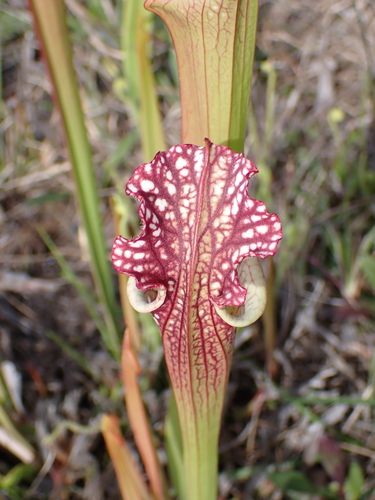
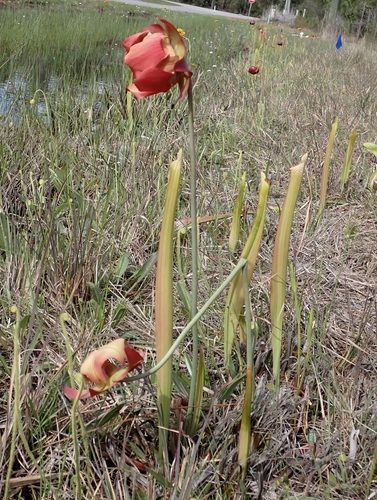
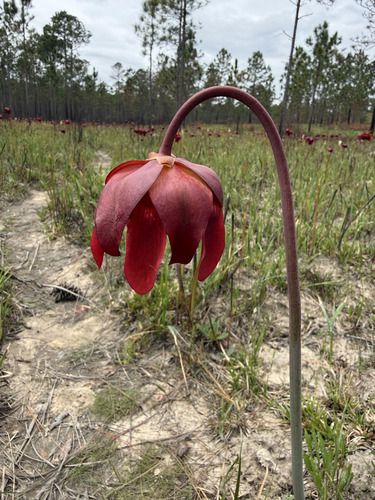
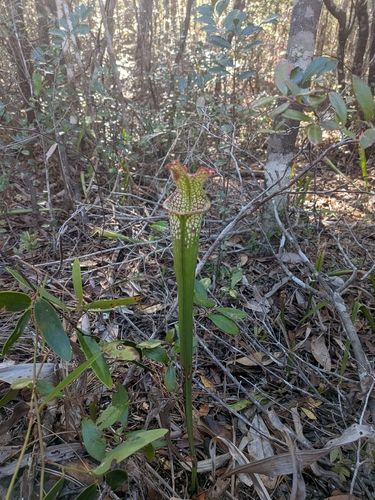
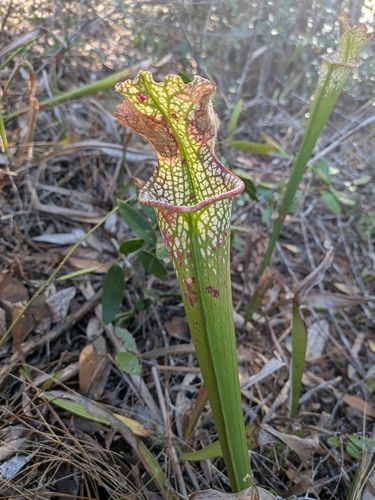
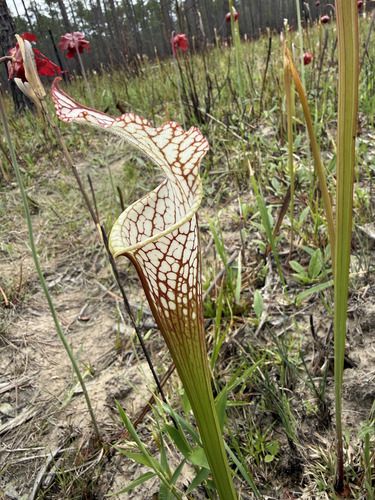
Etymology
- Sarracenia: the genus honours Michel Sarrazin de l'Étang (1659-1734), the king's physician in New France (see the genus sheet).
- leucophylla: from the Greek leukós, “white”, and phýllon, “leaf”. The pitchers are modified leaves, and their upper part is white: this is the feature that gave the species its name.
History of the description
The species was described in 1817 by Constantine Samuel Rafinesque, a naturalist of French-German origin who settled in the United States, on page 14 of his Florula Ludoviciana, a flora of Louisiana as it was then. The botanist H. B. Croom also named it Sarracenia drummondii, a name no longer accepted today.
Description (how to recognise it)
- Habit: dense clumps, on rhizomes 1 to 2.5 cm in diameter.
- Pitchers:
- upright, thick and firm, 25 to 100 cm tall;
- green at the base; the top of the tube is entirely covered with white patches (the areoles), crossed by very visible green, pink or red veins;
- the wing, on the front, is 0.5 to 1.5 cm wide (up to 2 cm);
- they wither in winter but stay on the plant.
- Mouth: oval, 2 to 6 cm (up to 8 cm). Its rim, white, green or reddish, flares out and often forms a small beak above the wing.
- Hood: arching, held well above the mouth, which it covers. It is dominated by the white patches, edged with white, green or red veins. Rounded and kidney-shaped, wavy, 2.5 to 6.5 cm, it is longer than wide. Its inner face is covered with stiff hairs, up to 1.5 mm.
- Two flushes a year: a first set of pitchers in spring, just after or during flowering; then a second, sturdier set at the end of summer. The spring pitchers are fewer and less vigorous.
- Phyllodes: 5 to 6 (up to 8) flat, upright, blade-like leaves, 15 to 50 cm by 2 to 3 cm.
- Flowers:
- scapes 30 to 80 cm tall, shorter than the pitchers;
- lightly scented flowers;
- maroon sepals; maroon to red petals, 4 to 5 cm;
- reddish-pink style “umbrella”, 6 to 7 cm.
- Fruits: capsules 1.5 to 2 cm, seeds 1.5 to 2.1 mm.
- Chromosomes: 2n = 26.
A capsule unique in its family
In S. leucophylla, the capsule opens from the bottom upwards. In all the other species of the Sarraceniaceae family, it opens from the top downwards. G. W. and D. R. Folkerts (1989) proposed an explanation: this way the seeds fall more easily, without getting trapped under the style “umbrella”, which persists on the fruit.
Distribution
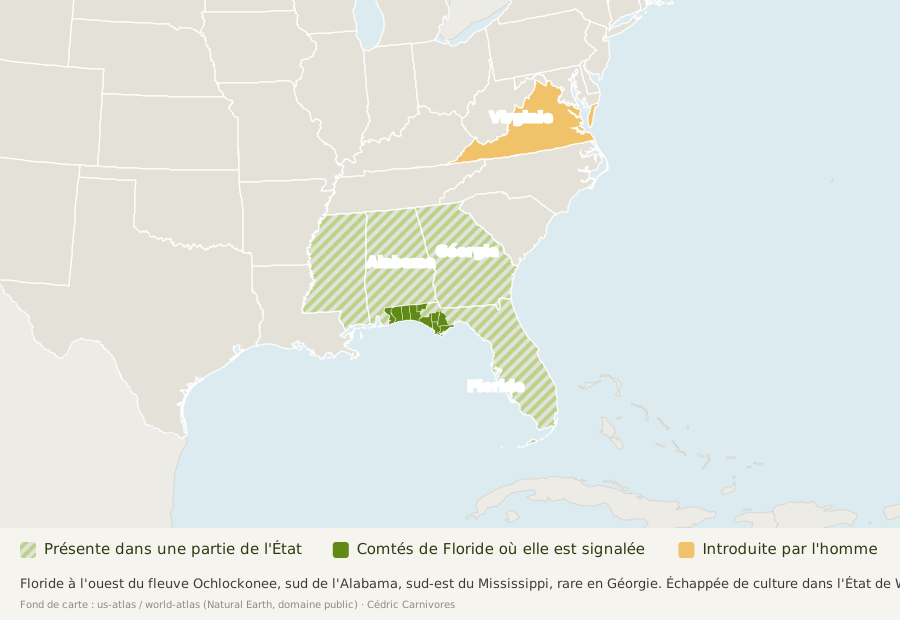
- Florida: coastal plain of the Panhandle, west of the Ochlockonee River. Counties cited by the University of Florida Extension: Bay, Calhoun, Escambia, Franklin, Gulf, Holmes, Liberty, Okaloosa, Santa Rosa and Walton.
- Alabama: the whole south of the state. For example, a herbarium specimen from Baldwin County describes a large field of several hundred plants. A famous population of almost entirely white plants comes from Hurricane Creek.
- Mississippi: the south-east of the state.
- Georgia: rare, in the south-west.
- Introduced: established in south-eastern Virginia; a plant escaped from cultivation was found in Skagit County, in Washington State.
Habitat
- Bogs;
- wet pine savannas and wet open pine woods;
- swampy edges of small wooded swamps and cypress depressions;
- edges of baygalls (wooded swamps with magnolias and bay trees);
- shrub and herb thickets in tidal freshwater areas.
It forms very extensive, almost continuous stands in open wet meadows, seepage slopes and open pine woods of the Gulf Coast. It can be spotted from far away. Altitude: 0 to 90 m.
Ecology
- Fire, an ally: these savannas burned naturally, because of lightning. S. leucophylla responds very well to winter fires, with abundant growth the following spring. Without fire, the habitat closes in and the species gradually disappears.
- Moths: the large late-summer pitchers are especially attractive to moths.
- Prey: mainly flying insects (bees, wasps, flies, butterflies and moths), attracted by the nectar on the rim of the pitcher. They slip and then drown at the bottom.
- The role of the white areoles: they are thought to act as a visual lure, but this has been little studied so far. In S. minor, an experiment showed that they attract prey only under certain light conditions.
- Pollination: by bees, especially bumblebees, according to observations made on the genus in general.
- Pitcher guests: the caterpillar of the moth Exyra semicrocea feeds only on pitcher plants and completes its whole life cycle in the pitchers.
Remarkable forms
- Entirely white pitchers, without coloured veins, with red petals.
- Forms without red pigment (without anthocyanins): green and white pitchers, yellow petals.
- The almost white plants from Hurricane Creek (Alabama) gave rise to the cultivar group 'Hurricane Creek White'.
- A dwarf form, about 30 cm tall, is said to be unique to Garcon Point, in Santa Rosa County (Florida) (not confirmed).
Natural hybrids
| Hybrid | Other parent |
|---|---|
| S. × areolata | S. alata |
| S. × excellens | S. minor |
| S. × farnhamii | S. rubra |
| S. × mitchelliana | S. purpurea |
| S. × moorei | S. flava |
| S. × readii | S. rubra |
| S. × wrigleyana | S. psittacina |
Complete list of the genus's hybrids: see “Genus Sarracenia: complete list of taxa”.
Threats and protection
- Listing: “vulnerable” on the IUCN Red List (old assessment, from 2000); G3, “vulnerable”, for NatureServe; CITES Appendix II; “endangered” in the State of Florida.
- Decline: the number of populations has fallen sharply because of urban development and fire suppression.
- Other threats: drainage, invasive plants, collecting from the wild.
- “Cut flowers”: at some managed sites, the pitchers are harvested in moderation and sold fresh or dried to florists.
Did you know?
- Its white pitchers end up at florists: at some managed sites, they are harvested to make bouquets.
- It is the only member of its family whose capsule opens from the bottom upwards.
In Florida
Based on the Atlas of Florida Plants and the specimens of the University of South Florida herbarium.
- Status: endangered (Endangered) on the State of Florida list.
- Herbarium: the University of South Florida herbarium holds 19 collections made between 1966 and 2017 in 6 counties of Florida: Calhoun, Escambia, Leon, Liberty, Okaloosa and Santa Rosa.
- Habitats noted on the labels: hillside bogs on deep organic muck, floating peat mats along spring-fed streams, slash pine savannas with other pitcher plants, edges of beaver ponds with Drosera tracyi. The Atlas classes it among the “obligate wetland” plants.
Sources
- Flora of North America, vol. 8, p. 356, Sarracenia leucophylla (T. L. Mellichamp and F. W. Case), floranorthamerica.org/Sarracenia_leucophylla: full description, flowering, habitats, altitude, range, introductions, fire, moths, cut flowers, capsule (Folkerts & Folkerts 1989).
- UF/IFAS Extension, publication UW378: Florida counties.
- Wikipedia (English), Sarracenia leucophylla: IUCN, NatureServe and CITES statuses, forms.
- Plants of the World Online (Kew), S. × mitchelliana and Alabama Plant Atlas, S. × moorei: parents of the hybrids.
- McGregor et al. 2016: role of the areoles.
- Moore et al. 2008, Exyra semicrocea159[321:EOTPPM]2.0.CO;2/Effects-of-the-Pitcher-Plant-Mining-Moth-Exyra-semicrocea-on/10.1674/0003-0031(2008)159[321:EOTPPM]2.0.CO;2.full).
- US Botanic Garden (archive): threats.
- Atlas of Florida Plants (University of South Florida), Sarracenia leucophylla, and its herbarium specimens: status in Florida, counties, habitats, flowering.