Sarracenia minor Walter
Species sheet, 29/10/2026, supplemented with the Flora of North America. Points marked “(not confirmed)” rest on a single, not very reliable source.
At a glance
| Scientific name | Sarracenia minor Thomas Walter, Flora Caroliniana: 153, 1788 |
| Family | Sarraceniaceae |
| Common names | Hooded pitcher plant or spotted pitcher plant; in French sarracénie à capuchon |
| Former names | S. adunca, S. lacunosa, S. variolaris (synonyms) |
| Distribution | Coastal plain, from south-eastern North Carolina to Okeechobee County (Florida) |
| Habitat | Wet open pine woods, savannas, floating peat mats, from 0 to 90 m above sea level |
| Flowering | March to May |
| Status | Least concern (IUCN, 2000 assessment); G4 for NatureServe; CITES Appendix II |
Photos in the wild
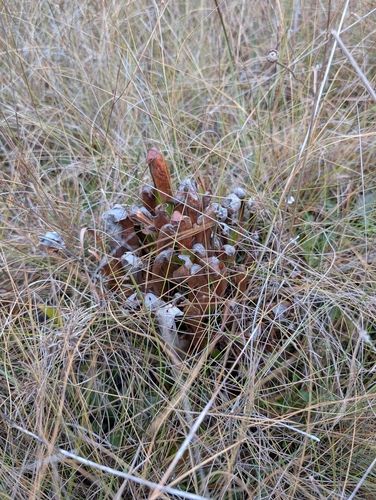
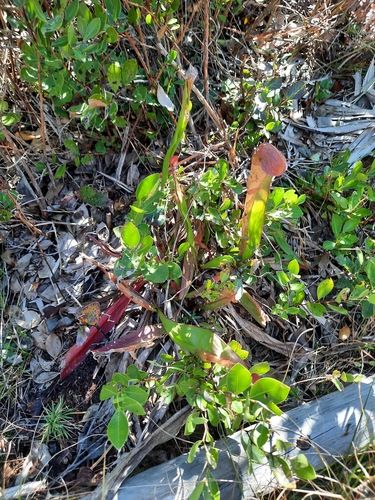
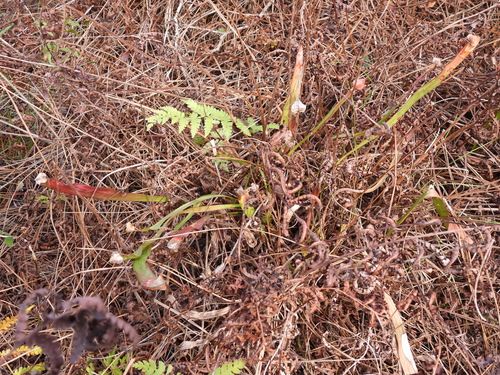
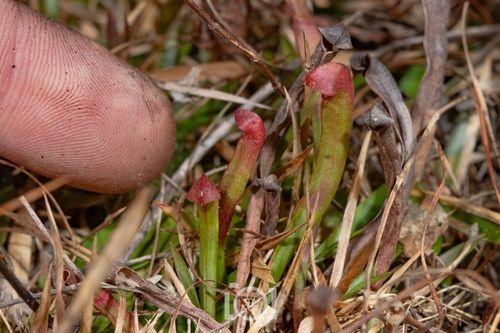
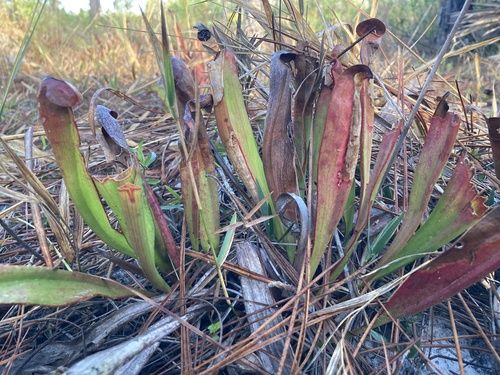
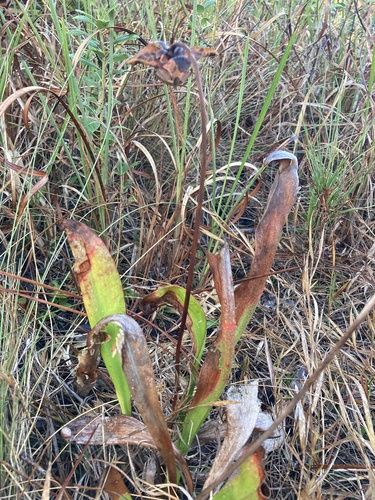
Etymology
- Sarracenia: the genus honours Michel Sarrazin (1659-1734), physician and naturalist of New France (Quebec).
- minor: a Latin word meaning “smaller”. Its pitchers are usually shorter than those of the other pitcher plants.
- The English names come from its two most visible features: hooded, for its lid closed over like a dome, and spotted, for its white spots.
History of the description
It was described in 1788 by Thomas Walter, an English-born botanist who settled in South Carolina, on page 153 of his Flora Caroliniana, one of the first floras written in North America.
According to the Flora of North America, it is the easiest species of the genus to recognise, thanks to its translucent spots and its strongly domed hood.
Description (how to recognise it)
- Habit: dense clumps, on rhizomes 1 to 2 cm in diameter.
- Pitchers:
- upright, thick and firm, 12 to 45 cm, exceptionally up to 100 cm;
- green or tinged with red;
- they appear well before the flowers and keep being produced in the same form all summer;
- the wing, the ridge running down the front of the pitcher, is 1 to 3 cm wide.
- The “windows”: the top of the pitcher, opposite the mouth, bears round, translucent white spots, the areoles, often surrounded by a reddish halo. They let light through. Only S. psittacina shares this feature within the genus.
- Mouth: clearly triangular, 1 to 3 cm, with a red rim strongly rolled outwards.
- The hood: strongly domed and arching, it covers the mouth almost completely. It is green, flushed or streaked with bronze red, and has no windows. It measures 1.2 to 6 cm, about as long as wide, and continues directly from the tube, without a “neck”.
- No phyllodes: unlike S. flava or S. oreophila, it does not produce flat leaves in summer.
- Flowers:
- scapes 12 to 55 cm, shorter than the largest pitchers;
- flowers scentless or very lightly scented;
- yellowish-green sepals; yellow petals, 3 to 5 cm;
- the pale yellow style “umbrella” measures 2.5 to 4.5 cm.
- Fruits: capsules 0.8 to 1.8 cm, seeds 1.1 to 1.3 mm.
- Chromosomes: 2n = 26, like the other pitcher plants.
Distribution
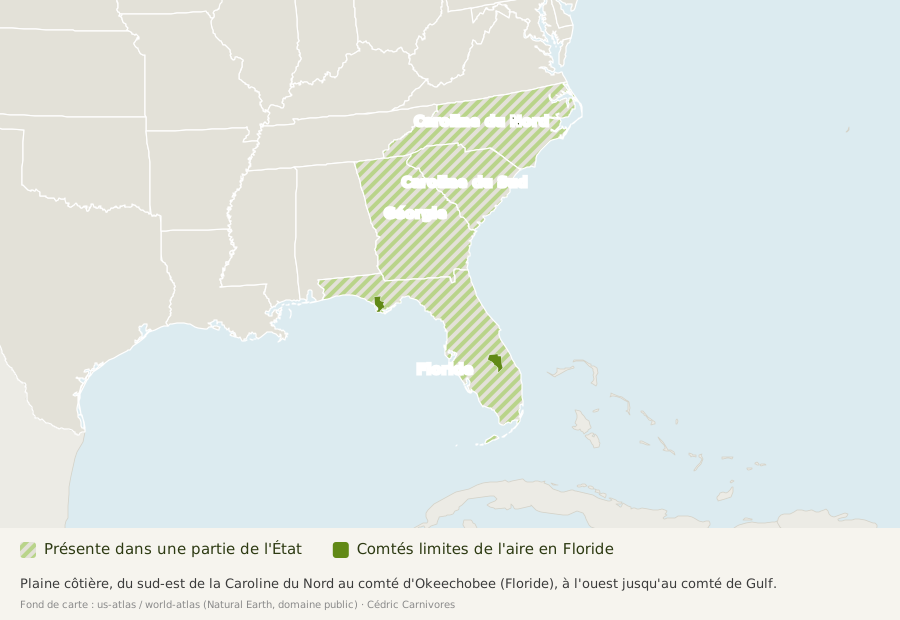
- On the coastal plain, from south-eastern North Carolina to Okeechobee County, in south-central Florida.
- Westwards, as far as south-eastern Georgia and Gulf County, in the Florida Panhandle.
- States: North Carolina, South Carolina, Georgia, Florida.
- It is the pitcher plant that reaches furthest south.
Habitat
- Wet open pine woods (flatwoods) and savannas, from moist to waterlogged;
- roadsides crossing these habitats;
- floating peat mats.
It lives in the driest as well as the wettest habitats used by pitcher plants. It tolerates shade better than most species of the genus. Altitude: from sea level to 90 m.
Ecology
- An ant eater: ants are often its only prey (study by D. Fish, 1976).
- They climb up the wing to reach the nectar on the rim of the mouth.
- Drawn inside by the light from the windows, they fall into the tube.
- The species also catches flying insects.
- The light trap: an insect that has entered the pitcher heads for the light coming through the windows, bumps into them and falls to the bottom. Darlingtonia californica uses the same method. A 2016 study showed that these windows really do attract prey, but mainly when the plant gets plenty of sun.
- Its enemies: the caterpillar of the moth Exyra semicrocea feeds on the pitchers. One study showed that it can seriously harm the plant, especially the largest individuals.
The giants of the Okefenokee
In the Okefenokee National Wildlife Refuge, in south-eastern Georgia, S. minor grows:
- on sphagnum mats along wet ditches;
- on floating vegetation islands, in the heart of the swamp.
These plants are much larger than normal:
- sturdy clumps, pitchers up to 120 cm;
- flowering about two weeks later;
- lower, wingless part of the pitcher 12 to 21 cm (17 cm on average), compared with 3 to 11 cm (6 cm on average) in ordinary plants.
It is not known whether this gigantism comes from their genes, their environment, or both. They have the normal number of chromosomes (2n = 26): so they are not plants with doubled chromosomes.
They can be distinguished under the name var. okefenokeensis (D. E. Schnell, 2002). The Flora of North America notes, however, that equally sturdy plants are found elsewhere in the species' range, without a distribution that would justify a separate distinction.
| Variety | Distinctive feature |
|---|---|
| var. minor | The common form, pitchers 12 to 45 cm |
| var. okefenokeensis Schnell, 2002 | Giant form from the Okefenokee Swamp, pitchers up to 120 cm |
Natural hybrids
| Hybrid | Other parent |
|---|---|
| S. × excellens | S. leucophylla |
| S. × formosa | S. psittacina |
| S. × harperi | S. flava |
| S. × rehderi | S. rubra |
| S. × swaniana | S. purpurea |
Complete list of the genus's hybrids: see “Genus Sarracenia: complete list of taxa”.
Threats and protection
- Listing: “least concern” for the IUCN; G4 for NatureServe; CITES Appendix II.
- Threats: drainage of wetlands, pine plantations, urban development, fire suppression, collecting from the wild.
Did you know?
- Its transparent windows make it a real light trap: the insect thinks it can fly away towards the sky and falls to the bottom.
- Ants are sometimes its only prey: they climb up to the trap on their own, drawn by the nectar.
In Florida
Based on the Atlas of Florida Plants and the specimens of the University of South Florida herbarium.
- Status: threatened (Threatened) on the State of Florida list.
- Herbarium: the University of South Florida herbarium holds 90 collections made between 1939 and 2016 in 26 counties of Florida: Alachua, Baker, Bradford, Clay, Columbia, Duval, Flagler, Hamilton, Hardee, Highlands, Hillsborough, Leon, Levy, Madison, Nassau, Okeechobee, Orange, Osceola, Pasco, Polk, Putnam, Seminole, St. Johns, Sumter, Union and Volusia.
- Habitats noted on the labels: wet savannas and pine woods of pond pine or slash pine with saw palmettos, often burned, grassy edges between pine woods and cypress swamps, seepage slopes, wet meadows on former pine woods. The Atlas classes it among the “obligate wetland” plants.
- Flowering in Florida: in April and May.
Sources
- Flora of North America, vol. 8, p. 357, Sarracenia minor (T. L. Mellichamp and F. W. Case), floranorthamerica.org/Sarracenia_minor: full description, flowering, habitats, altitude, precise range, ants (Fish 1976), Okefenokee plants.
- Wikipedia (English), Sarracenia minor: synonyms, statuses.
- McGregor, Moon & Rossi 2016, role of the areoles: effect of the windows depending on light.
- Moore et al. 2008, Exyra semicrocea on S. minor159[321:EOTPPM]2.0.CO;2/Effects-of-the-Pitcher-Plant-Mining-Moth-Exyra-semicrocea-on/10.1674/0003-0031(2008)159[321:EOTPPM]2.0.CO;2.full): effects of the moth.
- Atlas of Florida Plants (University of South Florida), Sarracenia minor, and its herbarium specimens: status in Florida, counties, habitats, flowering.