Sarracenia oreophila (Kearney) Wherry
Species sheet, 29/10/2026, supplemented with the Flora of North America. Points marked “(not confirmed)” rest on a single, not very reliable source.
At a glance
| Scientific name | Sarracenia oreophila (Kearney) Wherry, Bartonia 15: 8, plate 1, 1933 |
| Family | Sarraceniaceae |
| Common names | Green pitcher plant; in French sarracénie des montagnes, sarracénie verte |
| Distribution | Central and north-eastern Alabama, neighbouring Georgia, mountains of North Carolina |
| Habitat | Seepage bogs, stream banks, river sandbars, from 200 to 300 m above sea level |
| Flowering | April to June |
| Status | Critically endangered (IUCN, 2000); first pitcher plant protected as “endangered” in the United States, in 1979; CITES Appendix I |
Photos in the wild
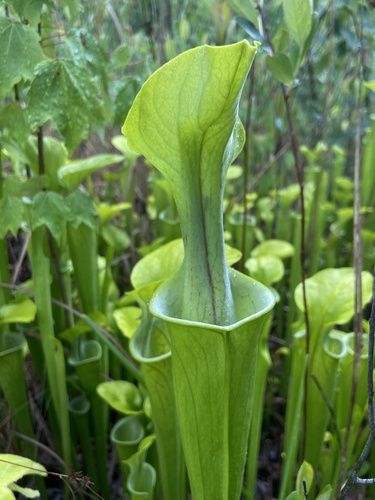
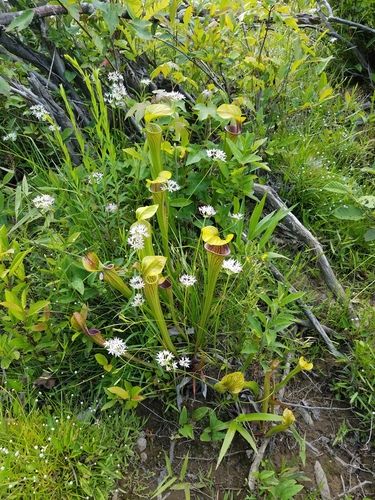
Etymology
- Sarracenia: the genus honours Michel Sarrazin de l'Étang (1659-1734), the king's physician in New France (see the genus sheet).
- oreophila: from the Greek óros, “mountain”, and phílos, “loving”: “mountain-loving”. It is the only south-eastern pitcher plant that lives far from the coastal plain, on the plateaus of the southern Appalachians.
History of the description
Thomas Kearney described it in 1900 as a mere variety of the yellow pitcher plant, Sarracenia flava var. oreophila. In 1933, the botanist Edgar T. Wherry raised it to species rank in the journal Bartonia.
Description (how to recognise it)
- Habit: medium-sized clumps, on rhizomes 1 to 1.5 cm in diameter.
- Pitchers:
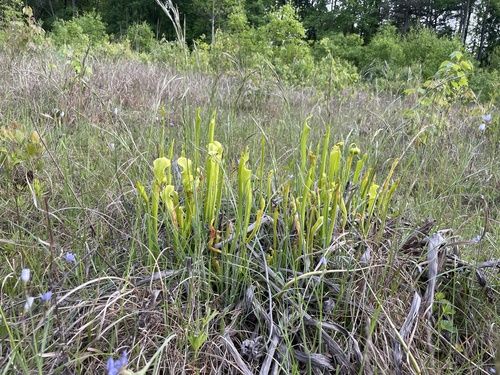
- upright and firm, 18 to 75 cm;
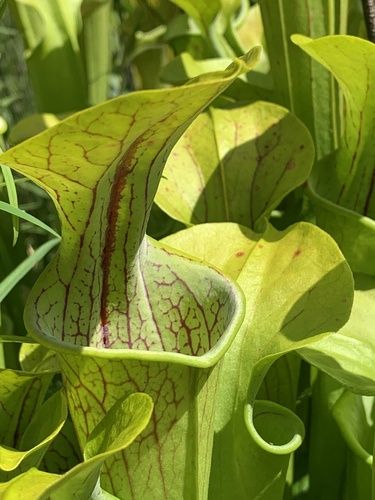
- green to yellowish green, sometimes veined or flushed with purple;
- no white spots; narrow wing, 0.5 to 1 cm;
- a single flush, with the flowers or just before. The pitchers wither from midsummer onwards and usually disappear completely by mid-July. No other pitcher plant loses its pitchers so early.
- Mouth: oval, 2 to 4.5 cm, with a flared green to red rim.
- Hood: arching over the mouth, yellowish green, rarely flushed with purple, sometimes with a purple blotch at the neck. Broad, 2 to 8 cm, slightly wavy, joined to the pitcher by a narrowed neck 1 to 2 cm long.
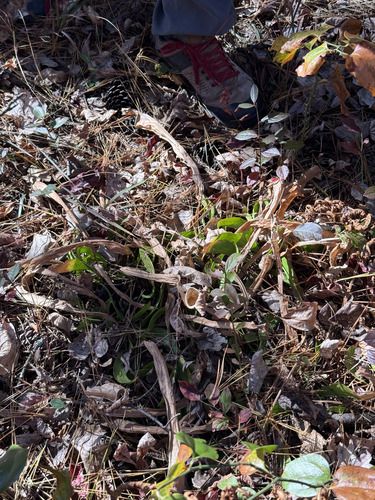
- Phyllodes: 3 to 5, often more numerous than the pitchers. Lying flat to upright, curved like a sickle, 5 to 18 cm. They are what remains visible in summer, after the pitchers have disappeared.
- Flowers:
- scapes 45 to 70 cm, shorter than the pitchers; yellowish bracts;
- faint unpleasant smell;
- yellow sepals and petals, petals 4 to 5.5 cm;
- yellowish-green style “umbrella”, 5 to 8.5 cm.
- Fruits: capsules 1.5 to 1.8 cm, seeds 1.8 to 2 mm.
- Chromosomes: 2n = 26.
Distribution
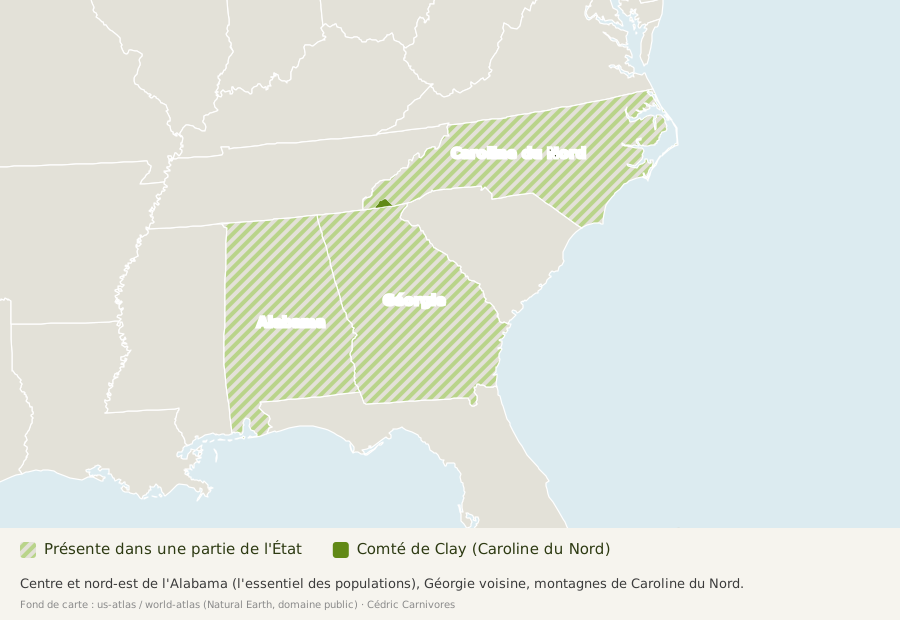
- Alabama: the centre and north-east of the state, on the Cumberland Plateau and in the Ridge and Valley region. Most of the populations are found here (32 out of 35 in 1994).
- Georgia: the area bordering Alabama.
- North Carolina: in the mountains, Clay County.
- Tennessee: old records exist, but no herbarium specimen confirms them.
In 1994, 35 natural populations were known: 32 in Alabama, 1 in Georgia and 2 in North Carolina. About 34 remain, most with fewer than 50 plants.
Habitat
- Seepage bogs, where water emerges from the slope;
- wet thickets;
- swampy stream banks;
- wet sands on riverbanks: it is the only pitcher plant that grows in rocky and sandy deposits along a large river, in north-eastern Alabama;
- seeps in rich oak woods.
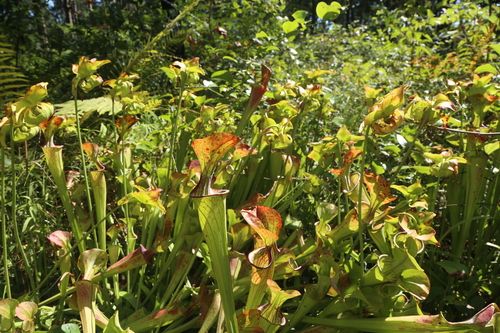
It forms isolated colonies, in full sun in open wetlands, or in the shade of woods where fire or grazing have not removed the vegetation. In open, wet sites, it forms impressive stands. Altitude: 200 to 300 m.
Ecology
- Drought-tolerant: it copes with lack of water better than all the other pitcher plants. This is probably linked to its life cycle: it loses its pitchers in midsummer and keeps only its phyllodes.
- Cross-pollination: as in the other pitcher plants, the umbrella-shaped style forces the insect to enter and leave by different routes.
- Fire and open habitat: without fire or grazing, shrubs and trees invade the bogs.
Remarkable forms
Several cultivars are registered, including 'Sand Mountain' and 'Heavily Veined'. Another, 'Don Schnell', has been lost: its only plant died in a greenhouse accident.
Natural hybrids
| Hybrid | Other parent |
|---|---|
| S. × pureophila | S. purpurea |
Complete list of the genus's hybrids: see “Genus Sarracenia: complete list of taxa”.
Threats and protection
- Listing:
- “critically endangered” for the IUCN;
- first pitcher plant listed as an “endangered” species under US federal law, on 21 October 1979;
- CITES Appendix I. Collecting it is prohibited in the United States.
- Threats:
- fire suppression and drainage of land;
- housing construction and land clearing;
- flooding of sites by impoundments;
- collecting for the horticultural trade;
- trampling by livestock;
- encroachment by shrubs and trees.
- Rescue:
- the species is part of the Center for Plant Conservation's national collection of endangered plants;
- a recovery plan has existed since 1994;
- seeds are stored at the US Department of Agriculture's national seed laboratory, in Fort Collins (Colorado);
- the Atlanta Botanical Garden propagates plants for reintroductions.
Did you know?
- It is the only pitcher plant that “disappears” in midsummer: its pitchers die around mid-July, and only its sickle-shaped phyllodes remain visible.
- It was the very first pitcher plant protected by US federal law.
Sources
- Flora of North America, vol. 8, p. 358, Sarracenia oreophila (T. L. Mellichamp and F. W. Case), floranorthamerica.org/Sarracenia_oreophila: full description, flowering, habitats, altitude, range (Clay County), Tennessee not confirmed, drought, pitchers withered in July, first protected species, Center for Plant Conservation.
- Wikipedia (English), Sarracenia oreophila: Kearney 1900, statuses, cultivars, conservation.
- U.S. Fish and Wildlife Service, 1994 recovery plan (archive): 35 populations, threats.
- Five-year review (NC State Herbarium) and USDA Forest Service: regions, 1979 listing.