Sarracenia psittacina Michx.
Species sheet, 29/10/2026, supplemented with the Flora of North America. Points marked “(not confirmed)” rest on a single, not very reliable source.
At a glance
| Scientific name | Sarracenia psittacina André Michaux, Flora Boreali-Americana 1: 311, 1803 (spelled psyttacina) |
| Family | Sarraceniaceae |
| Common names | Parrot pitcher plant; in French sarracénie perroquet |
| Former names | S. calceolata, S. pulchella (synonyms) |
| Distribution | Coastal plain, from eastern Georgia to south-eastern Louisiana |
| Habitat | Very wet savannas, bogs, ditches, seeps, from 0 to 60 m above sea level |
| Flowering | March to June: the latest in the genus |
| Status | Least concern (IUCN, 2000); G4 for NatureServe; CITES Appendix II |
Photos in the wild
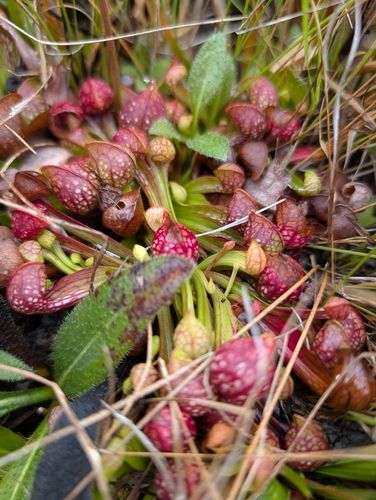
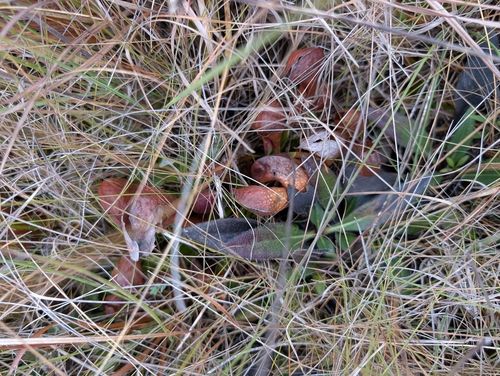
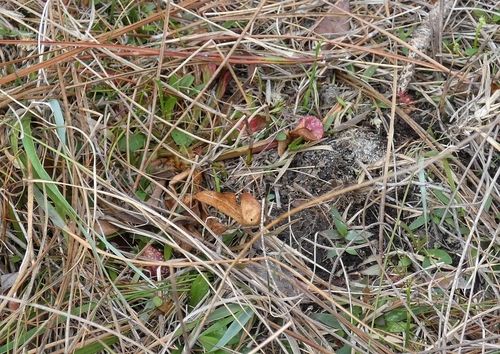
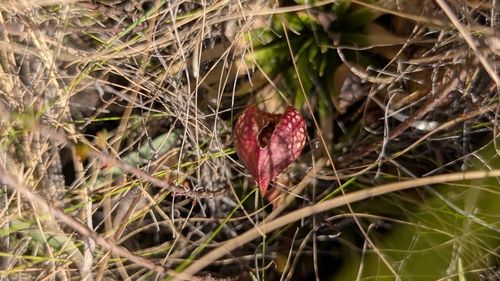
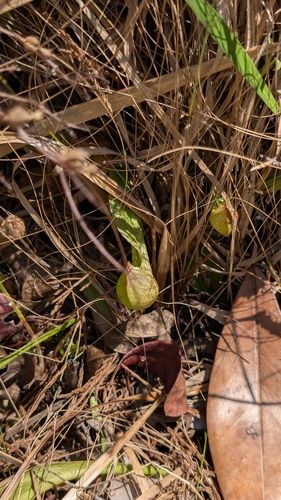
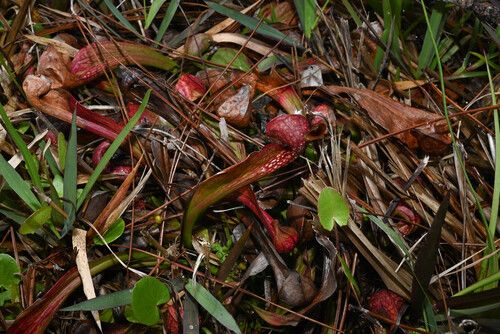
Etymology
- Sarracenia: the genus honours Michel Sarrazin de l'Étang (1659-1734), the king's physician in New France (see the genus sheet).
- psittacina: from the Latin psittacus, “parrot”, borrowed from Greek. The rounded, curved hood of the pitcher looks like a parrot's head with its beak.
History of the description
The French botanist and explorer André Michaux described it in 1803 in his Flora Boreali-Americana, the result of his travels in North America on behalf of the King of France. He first spelled it psyttacina, a spelling that was later corrected.
Description (how to recognise it)
- Habit: dense clumps or mats, on slender rhizomes 0.3 to 1 cm thick. The clumps sometimes form small mounds, when several buds grow pressed against each other.
- Reclining pitchers:
- they form radiating rosettes, often lying flat on the ground;
- 8 to 30 cm, up to 40 cm; firm and smooth;
- network of purplish-red veins; the upper half is covered with white spots;
- broad wing, 1 to 4 cm;
- they appear before the flowers and keep being produced in the same form all summer.
- A parrot's head: the hood curves round into an almost spherical head, 2 to 4 cm, which surrounds the mouth. It is dominated by white spots, edged with green to purplish red.
- The mouth: round and tiny, 0.5 to 1 cm, on the side, under the hood. Its green rim is turned inwards and forms a one-way entrance. It is the only pitcher plant whose mouth is not at the top of the pitcher.
- No phyllodes.
- Flowers:
- scapes 15 to 35 cm, usually taller than the pitchers;
- lightly scented flowers;
- maroon sepals; maroon-red petals, 2 to 4.5 cm;
- yellowish-green style “umbrella” edged with red, 2 to 3 cm.
- Fruits: capsules about 1 cm, seeds 1.5 to 2 mm.
- Chromosomes: 2n = 26.
Distribution
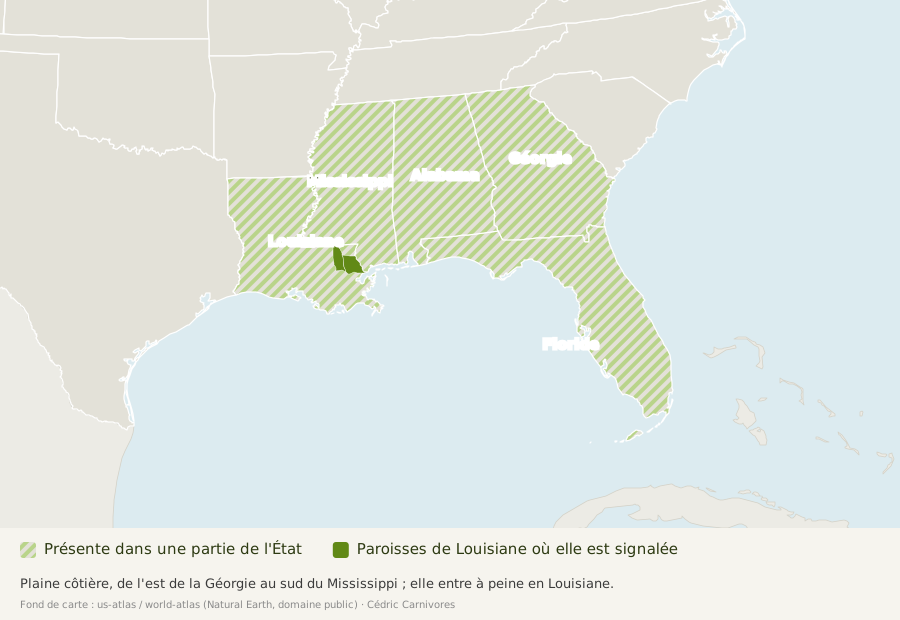
On the coastal plain:
- from eastern Georgia to the far north-east of Florida;
- westwards, from south-western Georgia, across the Florida Panhandle, to southern Alabama (the southern third of the state) and southern Mississippi;
- it barely enters south-eastern Louisiana (Tangipahoa and St. Tammany parishes).
A form with pitchers reaching 40 cm lives in the wettest parts of the Okefenokee Swamp, in south-eastern Georgia, alongside the giants of S. minor var. okefenokeensis.
Habitat
- Wet pine savannas and wet open pine woods;
- very wet, open bogs;
- bogs and swamps with titi (a swamp shrub);
- swampy roadsides and ditches;
- seepage slopes under pines.
It grows in some of the wettest habitats used by pitcher plants and is often under water for long periods. In dense vegetation its pitchers easily go unnoticed: only its flowering scapes, poking through the grass, give it away. Altitude: 0 to 60 m.
Ecology: a lobster trap
- The principle: the trap works like a lobster pot. The insect enters through the small opening, attracted by the nectar.
- The light lure: once inside, it sees the light through the windows of the hood and heads towards it, thinking it has found the way out.
- The hairs: the inner wall of the tube is lined with a network of downward-pointing hairs, up to 4 mm. They push the prey ever further into the tube, where enzymes digest it. This is a feature unique to this species.
- Land and water prey: on land, mainly crawling insects. When flooded, it probably traps small aquatic animals, and even tadpoles.
- Darlingtonia californica uses the same method, at the other end of the United States: a fine example of convergent evolution.
Natural hybrids
| Hybrid | Other parent |
|---|---|
| S. × courtii | S. purpurea |
| S. × formosa | S. minor |
| S. × gilpinii | S. rubra |
| S. × wrigleyana | S. leucophylla |
Complete list of the genus's hybrids: see “Genus Sarracenia: complete list of taxa”.
Threats and protection
- Listing: “least concern” for the IUCN; G4 for NatureServe; CITES Appendix II.
- Threats: those of all Gulf Coast pitcher plants: drainage, pine plantations, urban development, fire suppression.
Did you know?
- It is the last pitcher plant to flower: its flowering can last until June.
- When its swamp is flooded, it keeps on hunting under water.
In Florida
Based on the Atlas of Florida Plants and the specimens of the University of South Florida herbarium.
- Status: threatened (Threatened) on the State of Florida list.
- Herbarium: the University of South Florida herbarium holds 27 collections made between 1898 and 2018 in 14 counties of Florida: Bay, Calhoun, Escambia, Franklin, Gadsden, Gulf, Holmes, Jackson, Liberty, Nassau, Okaloosa, Santa Rosa, Walton and Washington.
- Habitats noted on the labels: open bogs and hillside bogs, seeps above cypress and pine depressions, wet pine savannas (even those planted with slash pine), wet roadsides. The Atlas classes it among the “obligate wetland” plants.
Sources
- Flora of North America, vol. 8, p. 358, Sarracenia psittacina (T. L. Mellichamp and F. W. Case), floranorthamerica.org/Sarracenia_psittacina: publication, full description, late flowering, habitats, altitude, precise range, Okefenokee form, internal hairs.
- Wikipedia (English), Sarracenia psittacina: synonyms, trap principle, statuses.
- Alabama Plant Atlas, S. psittacina: southern third of Alabama, survival under water.
- Atlas of Florida Plants (University of South Florida), Sarracenia psittacina, and its herbarium specimens: status in Florida, counties, habitats, flowering.