Sarracenia purpurea L.
Species sheet, 29/10/2026, supplemented with the Flora of North America. Points marked “(not confirmed)” rest on a single, not very reliable source.
At a glance
| Scientific name | Sarracenia purpurea Linnaeus, Species Plantarum 1: 510, 1753 (conserved name) |
| Family | Sarraceniaceae |
| Common names | Purple pitcher plant, sidesaddle-flower, frog's-britches, huntsman's-horns, turtle socks; in French sarracénie pourpre |
| Distribution | By far the largest in the genus: the eastern half of the United States, the Great Lakes region and almost all of Canada |
| Habitat | Acid, nutrient-poor bogs |
| Status | G5, “secure”, for NatureServe; CITES Appendix II; threatened in much of the south of its range |
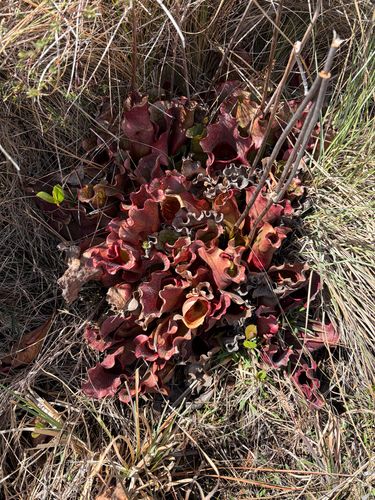
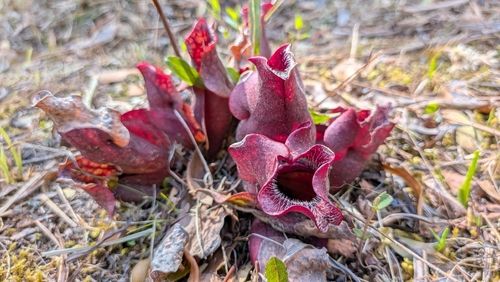
Photos in the wild
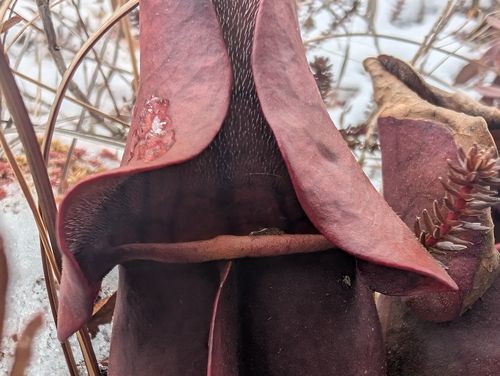
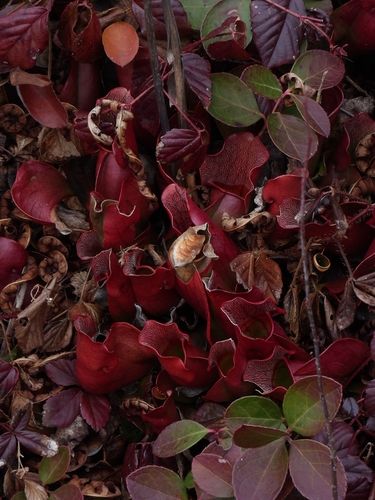
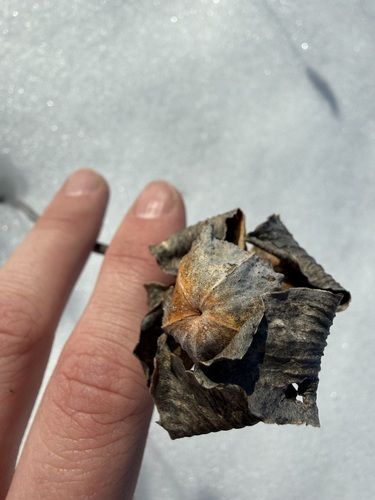
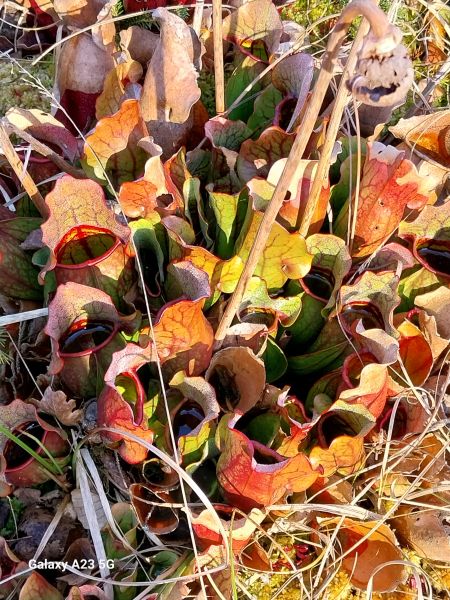
Etymology
- Sarracenia: the genus honours Michel Sarrazin de l'Étang (1659-1734), the king's physician in New France. It was precisely this species that he sent to the French botanist Tournefort, who created the genus name in his honour (see the genus sheet).
- purpurea: a Latin word meaning “purple”. It refers to the colour of the pitchers and flowers.
- The English name huntsman's-horns comes from the shape of the pitcher, curved in an S like a hunting horn.
History: the first pitcher plant known in Europe
- 1601: the oldest known illustration of the species appears in the Rariorum plantarum historia of the Flemish botanist Charles de l'Écluse (Clusius).
- 1672: John Josselyn draws it under the name “hollow-leaved lavender” in his New England Rarities.
- 1700: Tournefort creates the genus name Sarracena in honour of Michel Sarrazin, who had sent him a specimen from Quebec.
- 1753: Linnaeus names it Sarracenia purpurea in his Species Plantarum. The name was later officially “conserved” under the rules of botanical nomenclature, which protects it from any change.
It is the pitcher plant known for the longest time, the one that gave its name to the whole genus, and probably the best known to the general public.
Description (how to recognise it)
- Habit: dense clumps, on slender rhizomes 0.3 to 1.5 cm thick.
- Pitchers:
- short and pot-bellied, jug-shaped, gently curved in an S like a hunting horn;
- 5 to 25 cm, up to 45 cm; swollen above the middle, where they are 3 to 6 cm wide;
- lying down or spreading, sometimes upright;
- almost green with more or less marked red or purple veins, or flushed with red, up to almost entirely purplish red;
- no white spots; broad wing, 1 to 3 cm (up to 4 cm);
- they appear with or after the flowers, then non-stop all summer, and stay green in winter.
- Mouth: round to oval, 1.4 to 3.6 cm, wide open: the pitcher fills with rainwater. Its rim is thick and flared.
- Hood: upright, does not cover the mouth. Kidney-shaped, wider than long (2 to 5 cm by 3 to 7 cm), it is attached at the sides of the pitcher rim, without a neck, and notched at the top, without a point. Its inner face bears stiff downward-pointing hairs, 0.6 to 1.8 mm.
- No phyllodes.
- Flowers:
- scapes 22 to 79 cm, much taller than the pitchers;
- moderately pleasant scent, or a mix of pleasant and unpleasant;
- purplish-red sepals; red to maroon petals, 3.3 to 5.3 cm;
- green style “umbrella”, 4 to 5 cm.
- Fruits: capsules 1 to 2 cm, seeds 1.7 to 2 mm.
- Chromosomes: 2n = 26.
Subspecies
The Flora of North America recognises two subspecies. Several botanists reject them (Bell in 1949, McDaniel in 1971, Ellison and colleagues in 2004), because their characters overlap a great deal. The authors of the Flora keep them: plants of the two subspecies, grown side by side under the same conditions, remain different.
| subsp. purpurea (northern form) | subsp. venosa (southern form) | |
|---|---|---|
| Rhizome | Usually vertical | Usually horizontal |
| Pitchers per rosette | 6 to 10 | 4 to 5 |
| Pitcher shape | More slender: length more than 3.5 times the diameter | Shorter and more pot-bellied: length up to 3.5 times the diameter |
| Outer surface | Smooth or almost | Clearly downy |
| Hood hairs | 0.6 to 1.2 mm (up to 2.2) | 1.1 to 1.8 mm (up to 3), larger hood |
| Colour | More uniform shades | Green with red veins |
| Flowering | March to August | March-April |
| Altitude | 0 to 1,000 m | 0 to 200 m |
| Range | Canada (including Newfoundland and Labrador), Saint Pierre and Miquelon, north-east and Great Lakes, down to the mountains of the southern Appalachians | Georgia, North Carolina, South Carolina |
subsp. purpurea, the northern form
- Synonyms: it has received several other names, including S. purpurea subsp. gibbosa and S. purpurea var. terrae-novae, La Pylaie's “Newfoundland variety”.
- Very varied habitats, a sign of its great adaptability:
- bogs, raised bogs, alkaline fens;
- mountain seepage bogs;
- wooded swamps with red maple, tamarack, black spruce or Atlantic white cedar;
- boreal conifer forests;
- wet hollows between dunes;
- shores of lakes and ponds of glacial origin;
- wet pitch pine woods.
- Saint Pierre and Miquelon: it also grows in this French archipelago, off Newfoundland.
- Introduced in California and Washington State, in the British Isles and Switzerland, and as far as Japan.
- A science star: widely grown for ornament and for teaching, it is the subject of much research on the micro-organisms and invertebrates in its pitchers, especially the larvae of the mosquito Wyeomyia.
- The yellow form (forma heterophylla): a mutant plant that has lost the ability to make red pigment. It is entirely bright green to yellowish green. It stays true in cultivation: its seeds, self-pollinated or crossed with other yellow plants, give yellow plants. It flowers in June-July, in bogs and sandy, peaty hollows of the north-east: Massachusetts, Michigan, New Jersey, New York, Vermont, New Brunswick, Newfoundland, Nova Scotia, Ontario and Quebec.
- In the southern mountains: a variety montana was described for plants from northern Georgia (Rabun County), north-western South Carolina (Greenville and Pickens counties) and the mountains and western Piedmont of North Carolina (Alexander, Buncombe, Henderson, Iredell, Jackson, Macon and Transylvania counties). For the authors of the Flora, its characters (hood edges folded towards each other, hairs 0.9 to 1 mm) are found everywhere in the north: it is simply the northern subspecies reaching south into the Blue Ridge Mountains.
- There it becomes extremely rare, in sphagnum bogs and seeps near waterfalls, sometimes with S. jonesii.
- Both plants suffer from urban development, drainage and encroachment by forest, while the region is becoming warmer and drier.
- Some plants from northern Georgia seem to be genetic dwarfs: they stay small even when grown under the best conditions.
subsp. venosa, the southern form
- Name: described by Rafinesque in 1840 as Sarazina venosa, then placed under S. purpurea as a subspecies by Wherry in 1933. Venosa means “veined”.
- Habit: tighter clumps of shorter, more pot-bellied pitchers, green with red veins.
- Habitat: open pine woods, savannas, seeps, pocosins (thickets of trees and shrubs on peat, at stream heads), seepage bogs, “bays”, ditches.
- In the shade: it tolerates shade, and its pitchers are often hidden under a carpet of vegetation. Only its flowering scapes give it away.
- Cold: its pitchers stay green in winter and tolerate frost, but not the long periods of freezing that the northern form goes through.
- A yellow-flowered variant from South Carolina exists, but has not been named.
The pink pitcher plant of the Gulf of Mexico, once placed under this species (S. purpurea var. burkii), is now a separate species: S. rosea (see its sheet).
Distribution
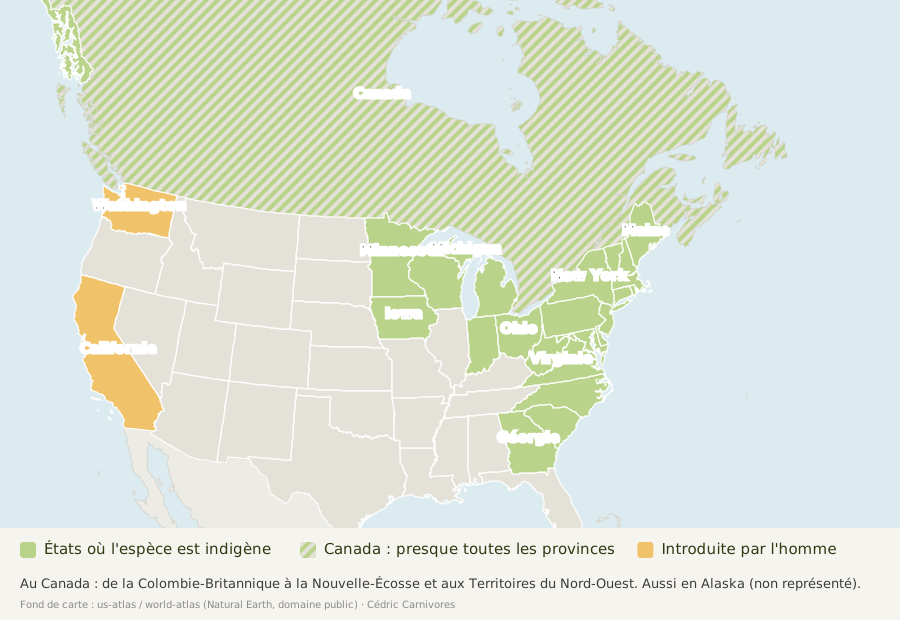
- Canada: Alberta, British Columbia, Manitoba, New Brunswick, Nova Scotia, Ontario, Prince Edward Island, Quebec, Saskatchewan, Newfoundland and Labrador and the Northwest Territories.
- France: the archipelago of Saint Pierre and Miquelon.
- United States: Alaska, Connecticut, Delaware, Georgia, Indiana, Iowa, Maine, Maryland, Massachusetts, Michigan, Minnesota, New Hampshire, New Jersey, New York, North Carolina, South Carolina, Ohio, Pennsylvania, Rhode Island, Vermont, Virginia, West Virginia and Wisconsin.
- Naturalised at least in northern California and the north-western United States (including Washington State), as well as in Europe (British Isles, Switzerland) and Asia (Japan). In Great Britain and Ireland, it was planted in heather bogs, but it has not spread beyond them, probably because the bogs there are too fragmented.
The conquest of the north: since the end of the last ice age, 10,000 to 12,000 years ago, the species has colonised the bogs of northern regions quickly and efficiently. This is a puzzle, because its seeds fall on average only 5 cm from the plant.
Habitat
- Acid sphagnum bogs, poor in nutrients;
- lake shores and floating mats in the north;
- wet savannas and seeps in the south.
Ecology: a miniature aquarium
- A rainwater trap: together with S. rosea, it is the only pitcher plant whose pitchers hold rainwater, which actually makes it atypical in its genus, even though to the general public it is the very image of a pitcher plant. The prey drown in this water. Capture is not very efficient: less than 1% of visiting insects end up in the pitcher.
- Digestion: young leaves produce their own enzymes. From the second year on, it is mainly bacteria, protozoa and rotifers (including Habrotrocha rosa) that break down the prey.
- Permanent residents: the water in the pitchers is home to a whole small community. It includes the mosquito Wyeomyia smithii and the midge Metriocnemus knabi, which live nowhere else. The mosquito benefits from the plant without harming it.
- Salamanders on the menu: in 2019, a study in Ontario found young salamanders (green newts) trapped in nearly 20% of the plants in one population. A single salamander can provide far more nutrients than dozens of insects.
- Cold: it is the only pitcher plant of cold climates. The northern subspecies withstands very harsh winters, under snow.
Natural hybrids
| Hybrid | Other parent |
|---|---|
| S. × catesbaei | S. flava |
| S. × chelsonii | S. rubra |
| S. × courtii | S. psittacina |
| S. × exornata | S. alata |
| S. × mitchelliana | S. leucophylla |
| S. × pureophila | S. oreophila |
| S. × swaniana | S. minor |
Complete list of the genus's hybrids: see “Genus Sarracenia: complete list of taxa”.
Pitcher plants and people
- Floral emblem of the Canadian province of Newfoundland and Labrador since 1954. Queen Victoria had already chosen it to decorate the province's one-cent coin, used until 1938.
- Medicinal plant: several Indigenous peoples (Algonquin, Cree, Haudenosaunee, Mi'kmaq) used it, mainly as a root infusion against smallpox. A 2012 study suggests that an extract slows, in the laboratory, the multiplication of viruses of this family.
- Against the Asian hornet? In Europe, researchers tested its pitchers for trapping the Asian hornet (Vespa velutina). They caught the hornets well, but also too many other insects.
Threats and protection
- Globally, the species is not threatened (G5). It is listed in CITES Appendix II.
- In the south of its range, it is endangered or vulnerable in many states, because of drainage and the loss of bogs.
Did you know?
- It is the plant that gave its name to the genus Sarracenia, and therefore to all pitcher plants of the genus.
- It also grows in France: on the archipelago of Saint Pierre and Miquelon, off Newfoundland.
- In barely 10,000 years, it has reconquered the bogs freed by the melting glaciers, as far as the Northwest Territories.
Sources
- Flora of North America, vol. 8, p. 359-360, Sarracenia purpurea subsp. purpurea and subsp. venosa: differences, flowering times, altitudes, habitats, ranges, forma heterophylla, variety montana, introductions (British Isles, Switzerland, Japan), Saint Pierre and Miquelon.
- Flora of North America, vol. 8, p. 359, Sarracenia purpurea (T. L. Mellichamp and F. W. Case), floranorthamerica.org/Sarracenia_purpurea: conserved name, English names, full description, range by province and state, naturalisations, colonisation after the ice ages, rainwater, debate on the subspecies (Bell 1949, McDaniel 1971, Ellison et al. 2004, Wherry 1933).
- Wikipedia (English), Sarracenia purpurea: Clusius 1601, pitcher fauna, salamanders (2019), emblem, medicinal uses, Asian hornet, statuses.
- Carnivorous Plant FAQ (B. Rice), S. purpurea: Josselyn 1672, Tournefort 1700.