Sarracenia rosea Naczi
Species sheet, 29/10/2026, based on the Flora of North America.
At a glance
| Scientific name | Sarracenia rosea Naczi, Sida 18: 1188, 1999 |
| Former name | Sarracenia purpurea var. burkii D. E. Schnell (synonym) |
| Family | Sarraceniaceae |
| Common names | Pink pitcher plant; in French sarracénie rose |
| Distribution | Gulf coastal plain: south-western Georgia, Florida Panhandle, southern Alabama, south-eastern Mississippi |
| Habitat | Seepage bogs, savannas, wet open pine woods, from 0 to 100 m above sea level |
| Flowering | March-April |
Photos in the wild
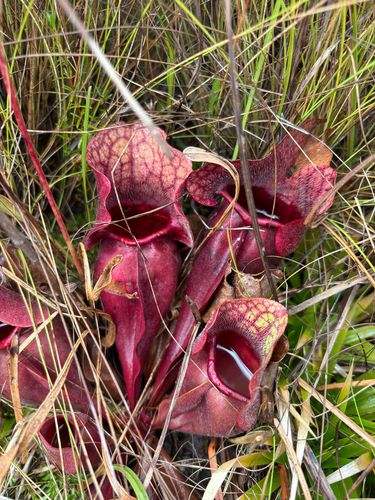
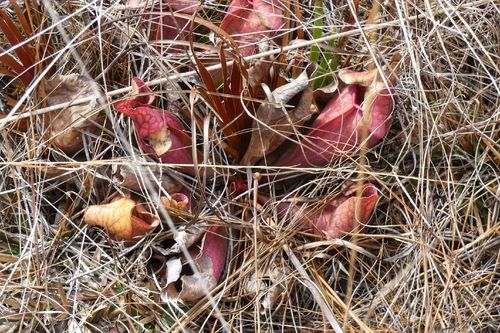
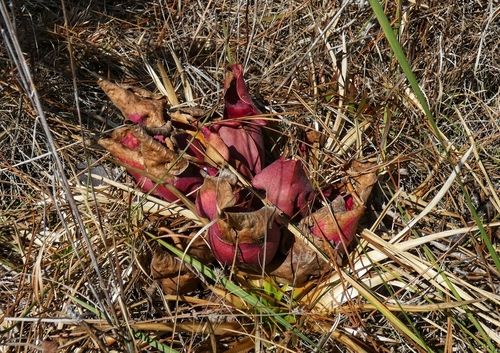
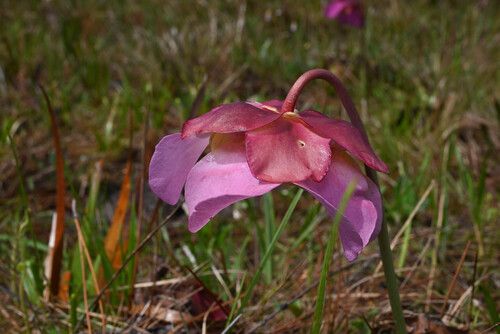
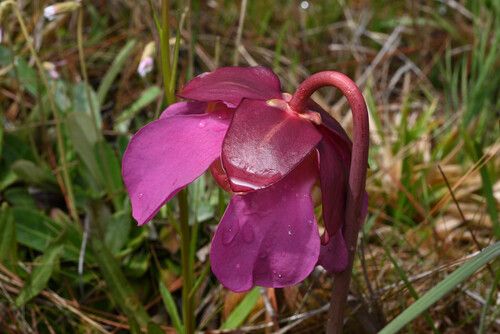
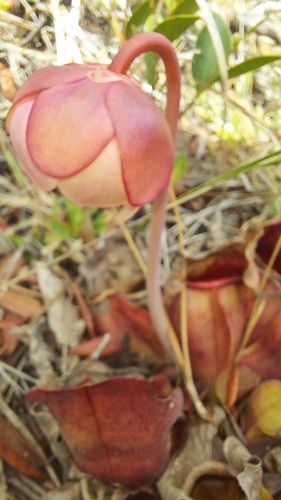
Etymology
- Sarracenia: the genus honours Michel Sarrazin de l'Étang (1659-1734), the king's physician in New France (see the genus sheet).
- rosea: a Latin word meaning “pink”. It refers to its pink petals, its most visible feature.
- Its former variety name, burkii, honoured a person named Burk (identity, not confirmed).
History of the description
Donald Schnell had described it as a variety of the purple pitcher plant: S. purpurea var. burkii. In 1999, the botanist Robert Naczi raised it to species rank in the journal Sida (possible co-authors, not confirmed). Enthusiasts debated it for a long time, but the Flora of North America accepts the species: its own characters and its separate range justify keeping it distinct.
Description (how to recognise it)
- Habit: dense clumps, on rhizomes 0.8 to 1.8 cm thick.
- Pitchers:
- pot-bellied, jug-shaped, gently curved in an S, as in S. purpurea;
- 6 to 28 cm, swollen at the top, where they are 2 to 7 cm wide;
- lying to upright; thick, firm, densely downy on the outside;
- pale green flushed with dull purplish red, often with a network of darker red veins;
- no white spots; very broad wing, 0.6 to 5 cm (up to 6 cm);
- they keep being produced in the same form all summer and stay green in winter.
- Mouth: round to oval, wide open, 2 to 5 cm, with a red to maroon rim, thick (2.6 to 7.5 mm) and flared. As in S. purpurea, the pitcher fills with rainwater.
- Hood: upright, kidney-shaped, much wider than long (2 to 6 cm by 3 to 13 cm), the same colours as the pitcher, without a neck or point. Its inner face bears stiff downward-pointing hairs, 1 to 2 mm.
- No phyllodes.
- Flowers:
- scapes 16 to 35 cm, taller than the pitchers, but shorter than in S. purpurea;
- mixed scent, both pleasant and unpleasant;
- dark purplish-red sepals;
- pale pink to bright pink, or almost white petals, 5 to 6.5 cm;
- pale green to almost white style “umbrella”, 4.8 to 7.4 cm.
- Fruits: capsules 1.5 to 2 cm, seeds 1.8 to 2.3 mm.
Telling it apart from S. purpurea:
- above all its pink to almost white petals and its shorter scapes;
- flowers larger on average;
- pitchers with a thicker, more deeply grooved rim, longer hairs on the hood, a wider hood and an often thinner wall.
Distribution
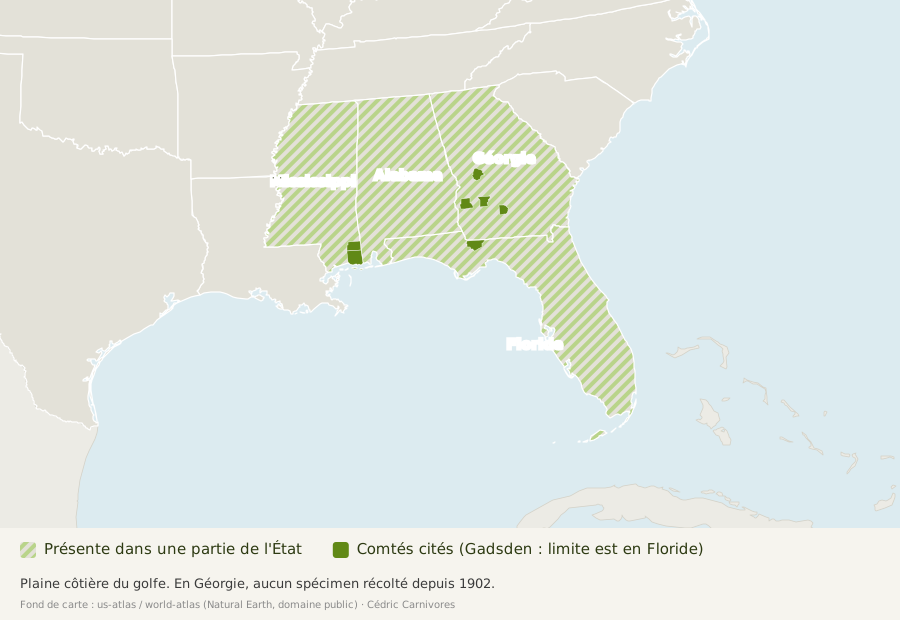
On the Gulf coastal plain:
- Georgia: south-west, Lee, Randolph, Taylor and Tift counties. Reportedly no specimen has been collected in Georgia since 1902.
- Florida: the Panhandle, from Gadsden County westwards.
- Alabama: the south of the state.
- Mississippi: the south-east, George and Jackson counties.
Habitat
- Wet, open seepage bogs;
- savannas and wet open pine woods;
- stream banks;
- old hollows between dunes;
- ditches, thickets and marshes.
Altitude: 0 to 100 m.
Ecology
- A rainwater trap: together with S. purpurea, it is the only pitcher plant whose open pitchers hold rainwater, in which the prey drown.
Remarkable forms
A yellow-flowered variant has been named S. rosea forma luteola.
Threats and protection
- It suffers from the loss of its habitats throughout its range.
Did you know?
- It is one of the few pitcher plants with pink flowers, sometimes almost white.
- In Georgia, reportedly no one has collected a specimen of it since 1902.
In Florida
Based on the Atlas of Florida Plants and the specimens of the University of South Florida herbarium.
- Status: threatened (Threatened) on the State of Florida list.
- Herbarium: the University of South Florida herbarium holds 11 collections made between 1978 and 2014 in 6 counties of Florida: Bay, Escambia, Liberty, Okaloosa, Santa Rosa and Walton.
- Habitats noted on the labels: slash pine and Pleea savannas with other pitcher plants, hillside bogs, edges of small streams, low pine woods and wet roadside ditches, sometimes with S. flava. The Atlas classes it among the “obligate wetland” plants.
Sources
- Flora of North America, vol. 8, p. 360, Sarracenia rosea (T. L. Mellichamp and F. W. Case), floranorthamerica.org/Sarracenia_rosea: publication, synonym, full description, flowering, habitats, altitude, counties, differences from S. purpurea, forma luteola, threats.
- Wikipedia (English), Sarracenia purpurea: 1999 separation.
- Atlas of Florida Plants (University of South Florida), Sarracenia rosea, and its herbarium specimens: status in Florida, counties, habitats, flowering.