Sarracenia rubra Walter
Species sheet, 29/10/2026, supplemented with the Flora of North America. Points marked “(not confirmed)” rest on a single, not very reliable source.
At a glance
| Scientific name | Sarracenia rubra Thomas Walter, Flora Caroliniana: 152, 1788 |
| Family | Sarraceniaceae |
| Common names | Sweet pitcher plant, red pitcher plant; in French sarracénie rouge, sarracénie parfumée |
| Distribution | Coastal plains of the Carolinas and Georgia; western Florida Panhandle and neighbouring Alabama |
| Habitat | Wet savannas, seepage bogs, stream banks |
| Status | “Vulnerable” for NatureServe; CITES Appendix II |
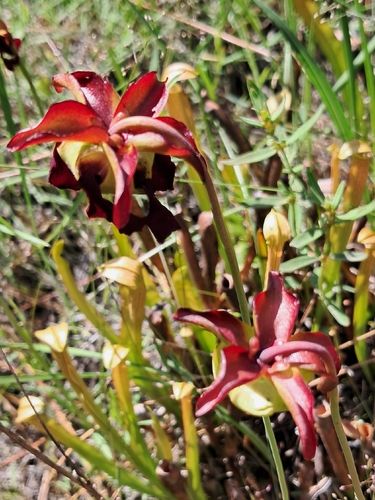
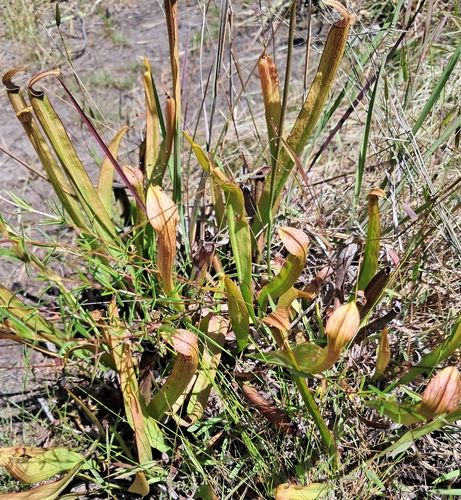
Photos in the wild
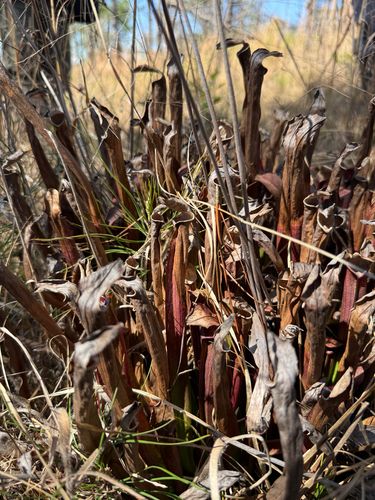
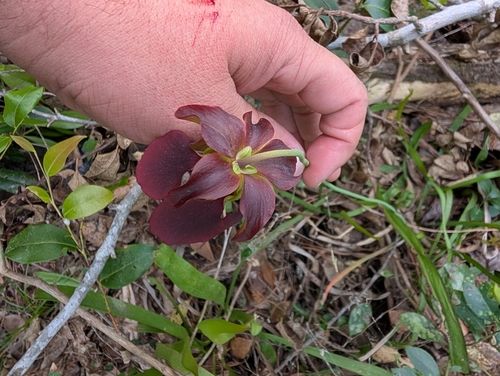
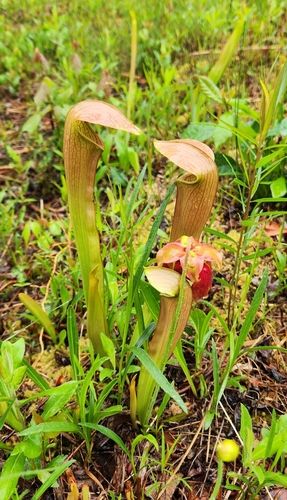
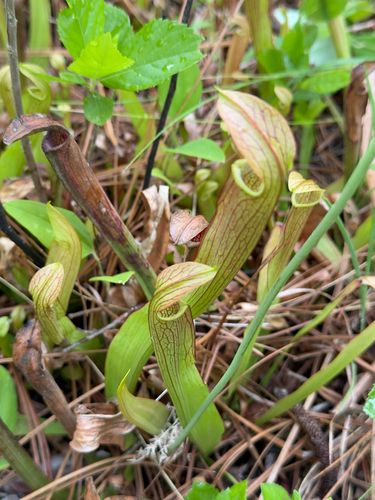
Etymology
- Sarracenia: the genus honours Michel Sarrazin de l'Étang (1659-1734), the king's physician in New France (see the genus sheet).
- rubra: a Latin word meaning “red”. It refers to its maroon-red flowers and the network of dark red veins on its pitchers.
- Its English name sweet pitcher plant comes from the strong scent of its flowers.
History of the description
It was described in 1788 by Thomas Walter, on page 152 of his Flora Caroliniana, one page before S. minor.
A debated group of species: the “rubra complex”
S. rubra is at the centre of a small group of very closely related plants, whose classification is disputed:
- McDaniel (1971) saw a single species, with four regional forms that intergrade.
- Frederick and Roberta Case (1976) distinguish four plants: S. alabamensis subsp. alabamensis, S. alabamensis subsp. wherryi, S. jonesii and S. rubra.
- Donald Schnell (1977) recognises the same plants, but all as subspecies of S. rubra. He later describes one more subspecies, gulfensis.
- The Flora of North America accepts three species: S. rubra (with two subspecies), S. alabamensis (with two subspecies) and S. jonesii. Other authors still prefer a single species, S. rubra, with five subspecies.
The five plants have almost identical flowers. Each lives in a different region, and they never grow together. See the sheets of S. alabamensis and S. jonesii, which also tell the story of the group's evolution.
Description (how to recognise it)
- Habit: dense clumps, on rhizomes 0.5 to 1.5 cm thick.
- Pitchers:
- upright, firm and waxy, 10 to 52 cm (6 to 57 cm at most);
- green to flushed with red, or entirely maroon, often veined with red or purple near the top. The main veins and their branches are dark maroon red, inside as well as outside;
- no white spots; wing 0.5 to 2 cm;
- a short “petiole”: the solid base of the pitcher, with no cavity, is no more than a quarter of its length. This is what distinguishes it from S. jonesii;
- they appear with the flowers, then non-stop all summer. They stay green in winter, but die if they freeze.
- Mouth: oval, 0.5 to 3.5 cm, with a green to maroon, tightly rolled rim, sometimes forming a small beak.
- Hood: arching over the mouth, green to maroon, more or less veined with red. Oval, 0.7 to 4.5 cm, longer than wide, barely narrowed at the base.
- No phyllodes.
- Flowers:
- one or two scapes from the same bud, 12 to 75 cm, usually 1.5 to 2 times (up to 3 times) taller than the pitchers;
- strong scent;
- maroon sepals, clearly bent backwards after flowering;
- maroon to red petals, 2.5 to 4 cm, with finely toothed edges;
- greenish style “umbrella”, 2 to 3.5 cm.
- Fruits: capsules 0.5 to 1.5 cm, seeds 1.2 to 1.5 mm.
- Chromosomes: 2n = 26.
The two subspecies
| Subspecies | Pitchers | Mouth | Scapes | Range |
|---|---|---|---|---|
| subsp. rubra | 12 to 30 cm (6 to 50), widening evenly | 0.5 to 2.5 cm | 12 to 66 cm | South-central Georgia, eastern North Carolina, eastern South Carolina |
| subsp. gulfensis | 25 to 52 cm (20 to 57), slightly swollen at the top | 2.4 to 3.5 cm | 26 to 75 cm | Western Florida Panhandle, neighbouring Alabama, south-western Georgia |
The hood of subsp. rubra is clearly longer than wide (ratio 1 to 4.3); that of gulfensis is almost as wide as long (ratio 0.8 to 1.5). Some plants of subsp. rubra, on the South Carolina “fall line” (the boundary between the coastal plain and the Piedmont), can be as large and sturdy as S. jonesii.
Distribution
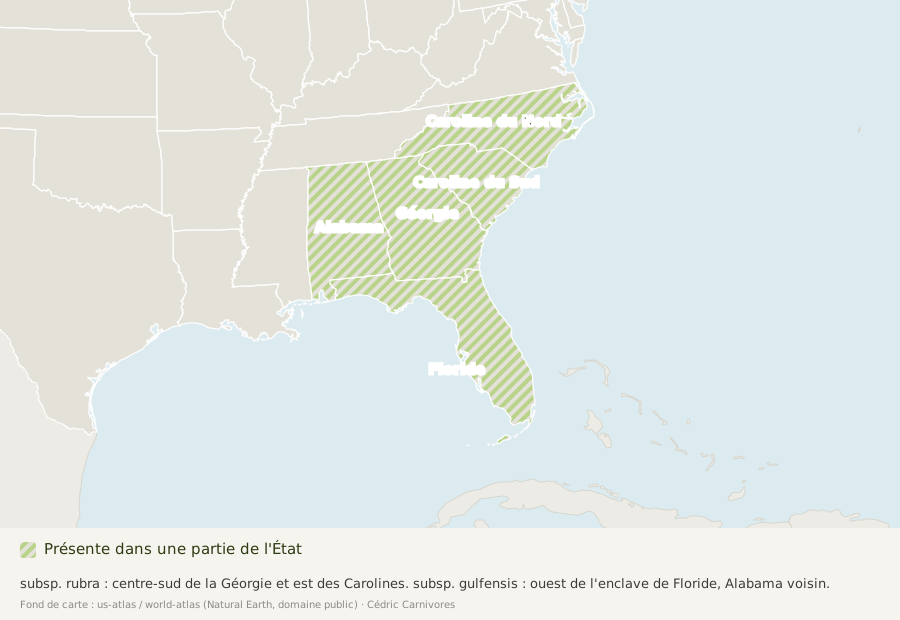
States: Alabama, Florida, Georgia, North Carolina, South Carolina (see the table of subspecies).
Habitat
- Wet pine savannas of the coastal plain;
- seepage bogs and stream banks.
Ecology
- The trap: nectar secreted on the rim of the pitcher attracts insects. Downward-pointing hairs guide them towards the mouth, then a waxy wall makes them slide into the digestive fluid. Large wasps sometimes escape by chewing through the wall.
- Fire: like the other pitcher plants, it needs open habitats, kept open by fires.
Natural hybrids
| Hybrid | Other parent |
|---|---|
| S. × ahlesii | S. alata |
| S. × chelsonii | S. purpurea |
| S. × farnhamii | S. leucophylla |
| S. × gilpinii | S. psittacina |
| S. × popei | S. flava |
| S. × readii | S. leucophylla |
| S. × rehderi | S. minor |
Complete list of the genus's hybrids: see “Genus Sarracenia: complete list of taxa”.
Threats and protection
- Listing: “vulnerable” for NatureServe; CITES Appendix II.
- Threats: drainage, impoundments, grazing, urban development, fire suppression and collecting.
Did you know?
- Its scent is so strong that it gave the plant its English name: the “sweet pitcher plant”.
- Its flowering scapes rise well above its pitchers, up to three times their height.
In Florida (subspecies gulfensis)
Based on the Atlas of Florida Plants and the specimens of the University of South Florida herbarium.
- Status: threatened (Threatened) on the State of Florida list (subspecies gulfensis).
- Herbarium: the University of South Florida herbarium holds 8 collections made between 1958 and 1994 in 3 counties of Florida: Okaloosa, Santa Rosa and Walton.
- Habitats noted on the labels: hillside bogs in pond pine savannas, often burned, bogs with St John's wort and Eriocaulon with sweetbay magnolias, peaty banks of small streams in cypress swamps, edges of titi thickets. The Atlas classes it among the “obligate wetland” plants.
Sources
- Flora of North America, vol. 8, p. 361, Sarracenia rubra (T. L. Mellichamp and F. W. Case), floranorthamerica.org/Sarracenia_rubra: publication, full description, two subspecies and their key, history of the complex (McDaniel 1971, Case & Case 1976, Schnell 1977).
- Wikipedia (English), Sarracenia rubra: names, pollination, statuses.
- Schnell, D. E. (1977). Infraspecific variation in Sarracenia rubra Walt. Castanea 42: 149-170.
- Atlas of Florida Plants (University of South Florida), Sarracenia rubra subsp. gulfensis, and its herbarium specimens: status in Florida, counties, habitats, flowering.