Triphyophyllum peltatum (Hutch. & Dalziel) Airy Shaw
Species sheet, updated on 29/10/2026.
At a glance
| Scientific name | Triphyophyllum peltatum (Hutchinson & Dalziel) Herbert Kenneth Airy Shaw, 1952 |
| First name | Dioncophyllum peltatum Hutch. & Dalziel, 1927 |
| Family | Dioncophyllaceae |
| Distribution | Guinea, Sierra Leone, Liberia, Ivory Coast |
| Habitat | Dry evergreen dense forest, primary or old secondary |
| Status | Near threatened (IUCN, 2025) |
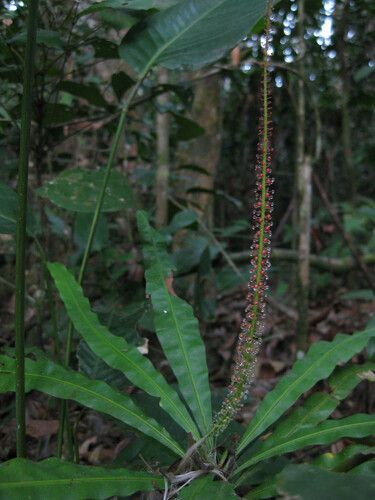
Photos in the wild
Etymology
- Triphyophyllum: from the Greek, “with three kinds of leaves”, for its three life stages.
- peltatum: from the Latin, “shield-shaped”, for its disc-shaped seeds.
History
- 1927: Hutchinson and Dalziel describe it under the name Dioncophyllum peltatum.
- 1952: Airy Shaw places it in a genus of its own.
- 1979: it is finally discovered to be carnivorous, more than 50 years after its description.
A life in three acts
- The rosette: young, simple, lance-shaped leaves about 18 cm long, with wavy edges, like a Dracaena.
- The carnivorous stage: when the soil lacks phosphorus, the plant produces one to three long, thin, glandular leaves, up to 35 cm, which look like those of Drosophyllum and catch insects.
- The liana: as an adult, it climbs by hooking on with two hooks at the tip of its leaves, and no longer feeds on prey.
So it is a part-time carnivorous plant (a “facultative” carnivore).
Description (how to recognise it)
- The largest known carnivorous plant: its liana stem can reach 50 m in length and 10 cm in thickness.
- Flowers fragrant, white to pink, short-lived.
- Seeds: only one per fruit, winged, a papery disc, carried by the wind. It grows mostly outside the fruit.
Distribution
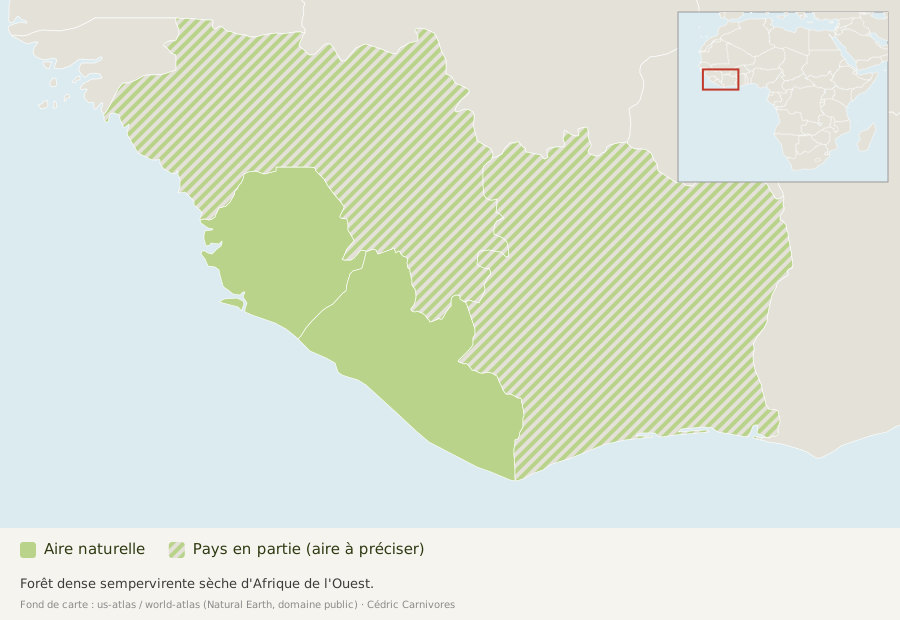
West Africa: Guinea, Sierra Leone, Liberia and Ivory Coast.
Habitat
Dry evergreen dense forest, primary or old secondary, with a dry season of 6 to 7 months and thin, acidic, poor soils.
Chemistry and uses
- It produces many active substances, some of which have strong activity against malaria, and others against tumours.
- It is traditionally used against elephantiasis and malaria; its stems are used as ties.
Relationships
Close to Drosophyllum from Portugal and to the Ancistrocladaceae.
Threats and protection
“Near threatened” for the IUCN (2025): its population is declining, mainly because of logging and mining. It is grown in a few botanical gardens (Würzburg, Hanover, Abidjan, Bonn, Cambridge).
Sources
- Wikipedia (English), Triphyophyllum: authors 1927 and 1952, etymology, discovery of carnivory in 1979, three stages, record size, flowers, seeds, range, habitat, chemistry, uses, status, gardens.
- Wikipedia (English), Drosophyllum: relationships.