Utricularia barkeri R. W. Jobson
Species sheet, updated on 30/10/2026.
At a glance
| Scientific name | Utricularia barkeri Richard W. Jobson, Telopea 15: 131, 2013 |
| Family | Lentibulariaceae |
| Distribution | Southeastern Australia (Victoria, South Australia, Tasmania) |
| Habitat | Seasonal sedge marshes and wet heaths on deep sand, near the coast |
| Status | not threatened: wide range, several populations in national parks |
Photos in the wild
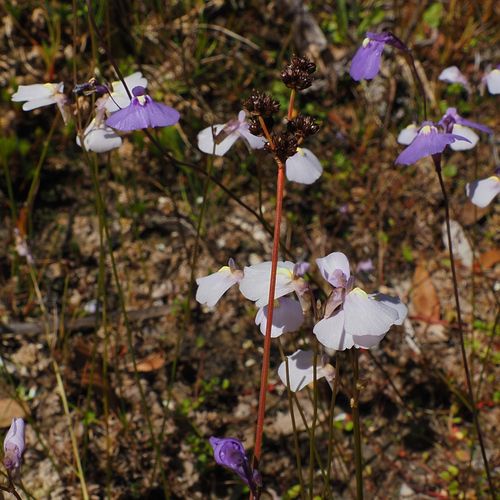
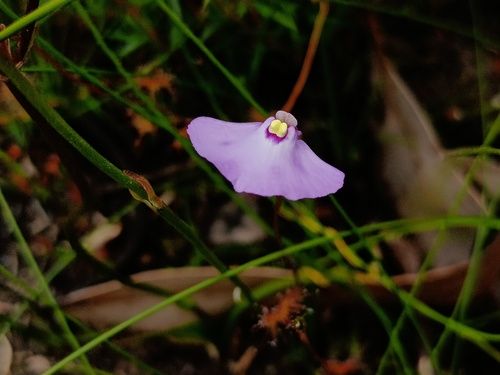
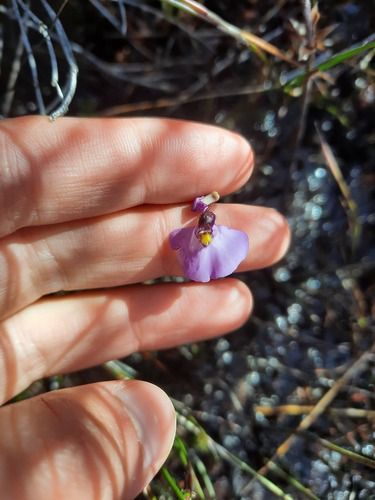
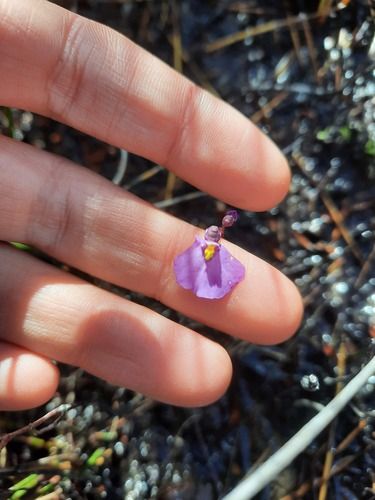
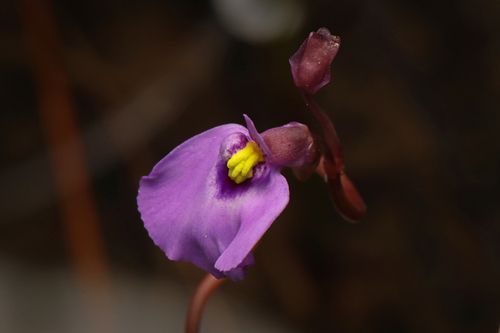
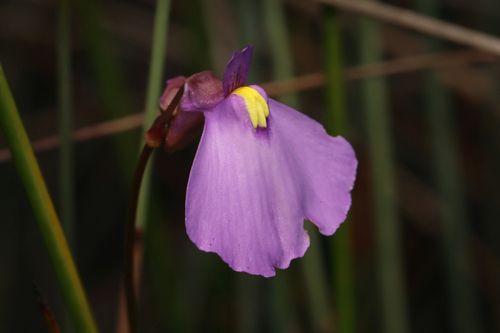
Etymology
- Utricularia: see the genus sheet.
- barkeri: in honour of Dr William (Bill) R. Barker, former chief botanist of the State Herbarium of South Australia, a specialist in the Scrophulariaceae of Australasia; hence its English name, “Bill's Bladderwort”.
Description (how to recognise it)
- A perennial terrestrial bladderwort, small to medium-sized.
- Scape 8 to 28 cm, usually bearing two opposite flowers (sometimes one or three), pale mauve; the lower lip bears two yellow ridges, edged by a thick purple band; upper lip very pale mauve, speckled with purple.
- It differs from U. dichotoma in its bracts and its speckling.
- Flowers and fruits from October to January; the flowers do not seem to be scented.
Distribution
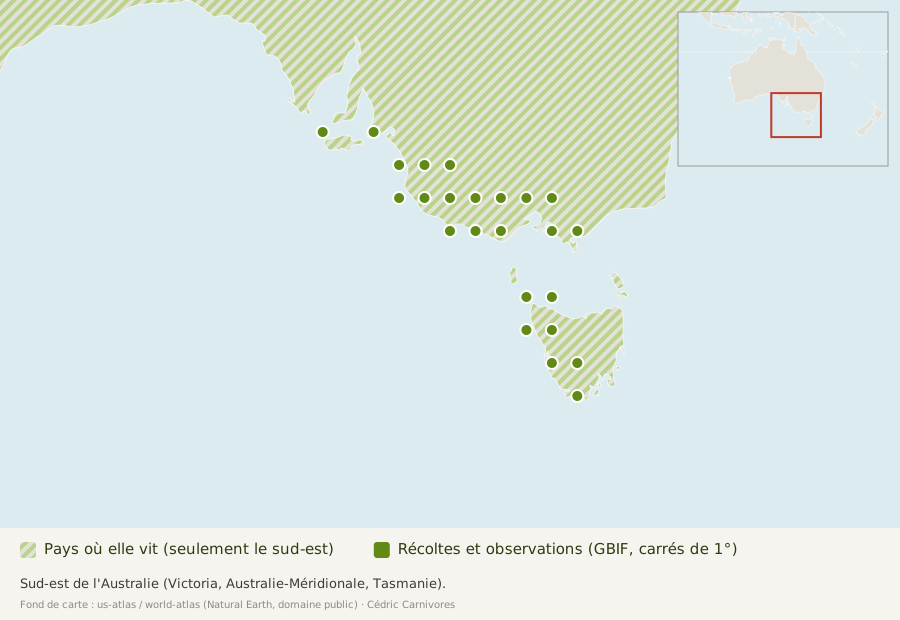
Endemic to Australia: coastal plains of South Australia, Victoria and the west coast of Tasmania, generally at sea level. On Kangaroo Island, Flinders Island and in the Grampians (Gariwerd), it climbs to 150-250 m.
Habitat
Seasonal sedge marshes and wet heaths on deep sand, near the coast. It often grows with U. oppositiflora or U. beaugleholei, with which it seems to hybridise.
Threats and protection
Not threatened: its range is wide and several populations are protected (Flinders Chase National Park on Kangaroo Island, forest reserves near Mount Gambier, Grampians and Lower Glenelg national parks, Arthur Pieman Conservation Area in Tasmania).
Did you know?
A 2020 genetic study places it next to U. grampiana, the Grampians bladderwort.
Sources
- Flora of Australia (ABRS), Utricularia barkeri, R. W. Jobson (CC BY licence): etymology, English name, description, flowering, range, altitude, habitat, associated plants, protection.
- GBIF, Utricularia barkeri: author, original publication, countries and localities of herbarium specimens and observations.