Utricularia bidentata R. W. Jobson & Baleeiro
Species sheet, updated on 30/10/2026.
At a glance
| Scientific name | Utricularia bidentata Richard W. Jobson & Paulo C. Baleeiro, Telopea 21: 59, 2018 |
| Family | Lentibulariaceae |
| Distribution | Australia |
| Status | data deficient (status proposed in Western Australia and the Northern Territory) |
Etymology
- Utricularia: see the genus sheet.
- bidentata: from the Latin bi- (“two”) and dentatus (“toothed”): the two very prominent white ridges that project onto the lower lip of the flower look like two pointed teeth.
History of the description
- 2018: described by Richard Jobson and Paulo Baleeiro. Until then it had been confused with U. kimberleyensis, which has a yellow-orange spot on the throat (cream in U. bidentata) and only slightly raised ridges.
Description (how to recognise it)
- Its two central white ridges, longer than the two outer ridges, and its scape, slightly papillose at the base, distinguish it from U. kimberleyensis.
- Flowers and fruits from March to June.
Distribution
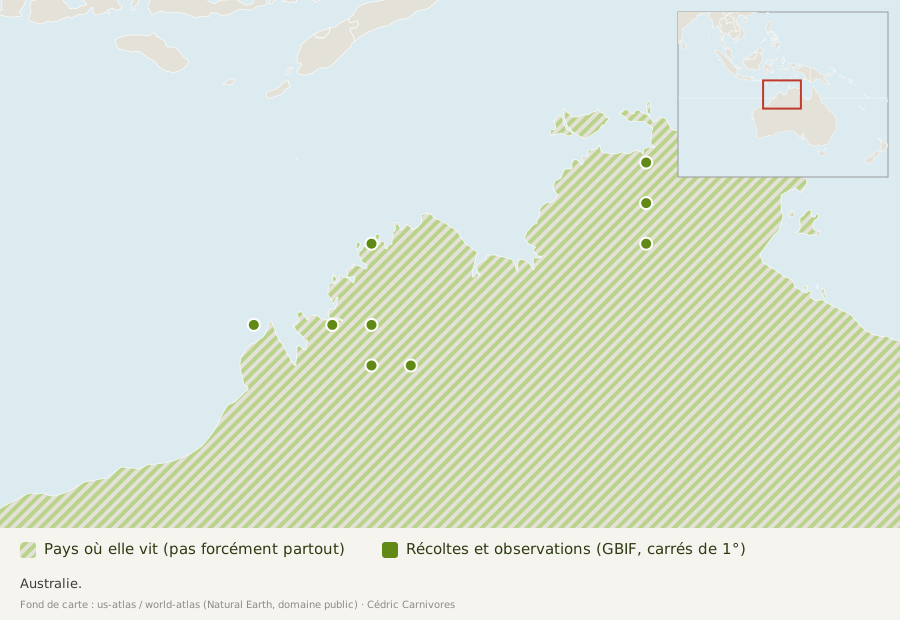
Endemic to Australia: widespread in the Kimberley (Western Australia), from Broome to the Mitchell Plateau, with a few isolated sites at Nitmiluk (Northern Territory), about 800 km away.
Habitat
Uncommon, along rocky or sandy creeks, among grasses and sedges, often on clay-rich soils, including clay plains that crack in the dry season. U. kimberleyensis prefers loams over sands derived from sandstone.
Threats and protection
Although widespread in the Kimberley, it is uncommon everywhere; in the Northern Territory, it is known only from small patches along unprotected creeks. Jobson proposes listing it as “data deficient”.
Sources
- Kew, World Checklist of Vascular Plants (via GBIF): natural distribution.
- Flora of Australia (ABRS), Utricularia bidentata, R. W. Jobson (CC BY licence): etymology, history, distinguishing features, flowering, range, habitat, proposed status.
- GBIF, Utricularia bidentata: author, original publication, countries and localities of herbarium specimens and observations.