Utricularia blanchetii A. DC.
Species sheet, updated on 30/10/2026.
At a glance
| Scientific name | Utricularia blanchetii Alphonse de Candolle, Prodromus 8: 13, 1844 |
| Family | Lentibulariaceae |
| Distribution | Central Bahia State (Brazil) |
| Habitat | Damp sandy soils between rocks or along streams, from 850 to 1 750 m |
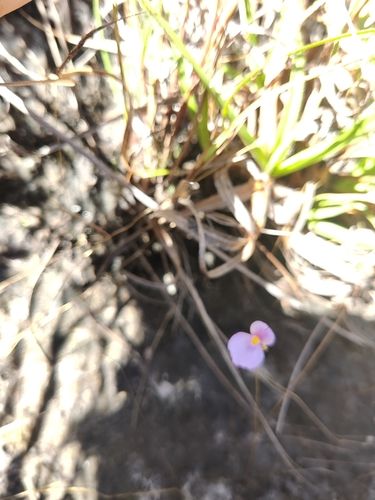
Photos in the wild
Etymology
- Utricularia: see the genus sheet.
- blanchetii: probably in honour of Jacques Samuel Blanchet, who collected many plants in Bahia (not confirmed).
Description (how to recognise it)
- A small bladderwort, probably annual, terrestrial or growing on rock.
- According to Benjamin (1847): linear-oblong leaves; scaly scape bearing 1 or 2 flowers; calyx lobes fringed and toothed; spur pointing downwards, slightly curved, long-conical and pointed, sometimes with two teeth at the tip.
Distribution
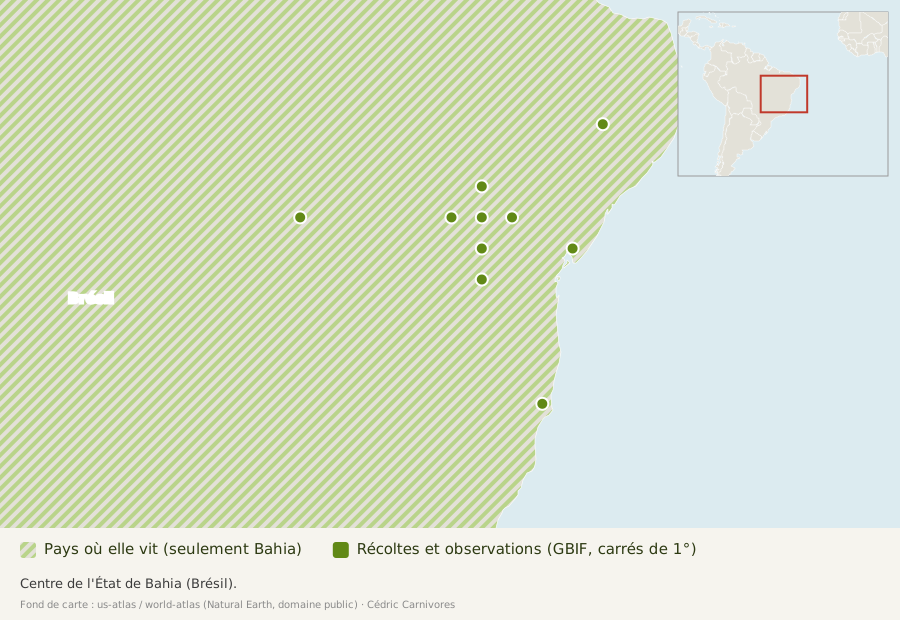
Endemic to Brazil: known only from central Bahia State (Chapada Diamantina). According to Kew's world plant list (WCVP), it is native to this single region: northeastern Brazil. According to the Flora do Brasil (official list of the plants of Brazil), it is endemic to Brazil and grows in these states: Bahia and Pernambuco. Major biomes: Caatinga and Cerrado.
Habitat
Damp sandy soils among rocks or along streams, from 850 to 1 750 m. According to the Flora do Brasil: a terrestrial or rock-dwelling plant, in campos rupestres (rocky mountain grasslands), cerrado (savanna) and rock-outcrop vegetation. Benjamin (1847) cites collections by Blanchet in Bahia State, near the São Francisco River and in the Serra do Açuruá.
Sources
- Wikipedia (English), Utricularia blanchetii: author, year, range, altitude, habitat.
- Kew, World Checklist of Vascular Plants (via GBIF): natural distribution.
- Flora e Funga do Brasil, official list (via GBIF): states, biomes, endemism, life form and vegetation types in Brazil.
- Benjamin, Flora Brasiliensis X: Lentibulariae, 1847 (archive.org): description, localities and habitats (translated from Latin).
- GBIF, Utricularia blanchetii: author, original publication, countries and localities of herbarium specimens and observations.