Utricularia bremii Heer ex Kölliker
Species sheet, updated on 30/10/2026.
At a glance
| Scientific name | Utricularia bremii named by Oswald Heer, published by Rudolf Albert von Kölliker, Verzeichniss der phanerogamischen Gewächse des Kantons Zürich: 142, 1839 |
| Family | Lentibulariaceae |
| Distribution | Central and Western Europe |
Photos in the wild
Etymology
- Utricularia: see the genus sheet.
- bremii: in honour of Jacob Bremi, a Swiss naturalist.
Description (how to recognise it)
- A small perennial aquatic bladderwort, free-floating or anchored.
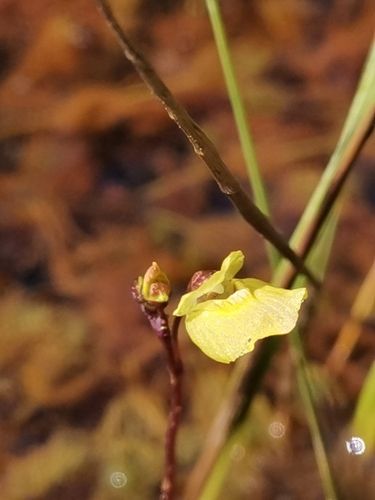
- Very close to U. minor, of which it was long considered a variety or subspecies; according to Krajewski and Płachno (2015), it differs in its almost round lower lip (sometimes broader than long) with edges not turned down, and in its largely malformed pollen: it generally produces no viable seeds, and a hybrid origin is suspected (U. minor × U. intermedia), not yet confirmed.
Distribution
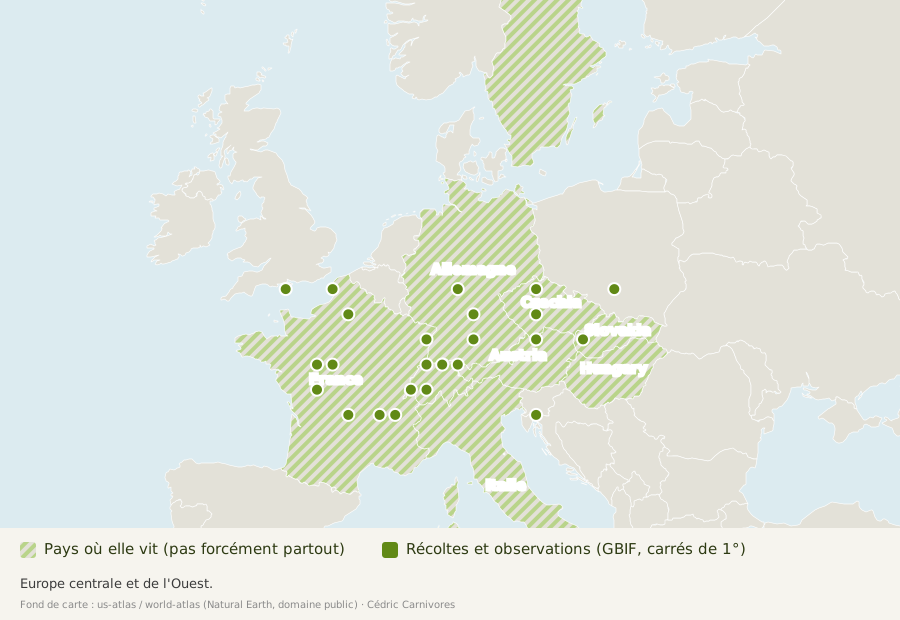
Central and Western Europe: mainly Switzerland, France and Germany (more than 1 300 records in GBIF), also Czechia, Austria, Sweden, Italy, Hungary, Slovakia… According to Kew's world plant list (WCVP), it is native to the following regions: Belgium, Czechia and Slovakia, Denmark, France, Germany, Great Britain, Hungary, Italy, Poland, Switzerland and Ukraine.
Habitat
Krajewski and Płachno (2015) describe it as very rarely recorded in Western and Southern Europe, and extremely rarely in Central Europe; it prefers intermittently flooded places with very shallow water, over an organic and mineral bottom. In Poland, they found it in great abundance in the shallow, nutrient-poor ditches and pools of a former sand pit (Dąbrowa Górnicza), in flower in July.
Sources
- Wikipedia (English), Utricularia bremii: authors, range, life form, etymology.
- Kew, World Checklist of Vascular Plants (via GBIF): natural distribution.
- Krajewski and Płachno, Polish Botanical Journal 60(1), 2015 (archive.org): distinction from U. minor, fertility, habitat.
- GBIF, Utricularia bremii: author, original publication, countries and localities of herbarium specimens and observations.