Utricularia costata P. Taylor
Species sheet, updated on 30/10/2026.
At a glance
| Scientific name | Utricularia costata Peter Taylor, Kew Bulletin 41(1), 1986: 7 |
| Family | Lentibulariaceae |
| Distribution | Brazil and Venezuela (also French Guiana according to GBIF) |
| Habitat | Damp soils among rocks, in savannas |
Etymology
- Utricularia: see the genus sheet.
- costata: from the Latin, “ribbed”.
Description (how to recognise it)
- A small bladderwort, probably annual, terrestrial or growing on rock.
- Terrestrial or at the water's edge; sepals with prominent veins (hence its name, “ribbed”), the lower sepal becoming boat-shaped in fruit; lilac corolla with a white and yellow palate, lower lip slightly three-lobed; straight spur, twice as long as the lower lip. It resembles U. rostrata.
Distribution
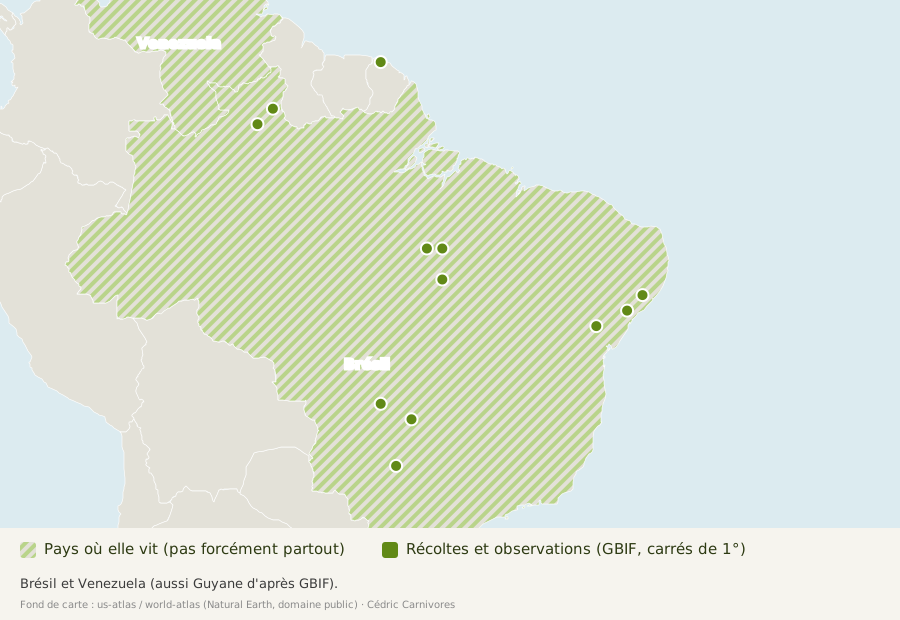
Brazil and Venezuela (Wikipedia); GBIF also has records from French Guiana. According to Kew's world checklist of plants (WCVP), it is native to the following regions: north-east Brazil, north Brazil, west-central Brazil and Venezuela. According to the Flora do Brasil (the official list of Brazilian plants), it grows in these Brazilian states: Alagoas, Bahia, Goiás, Mato Grosso, Pará, Roraima and Sergipe. Major biomes: Amazon, Cerrado and Atlantic Forest.
Habitat
Damp soils among rocks, in savannas. According to the Flora do Brasil: a terrestrial or rock-dwelling plant, in campinarana (white-sand savanna of the Amazon), cerrado (savanna), seasonal semi-deciduous forest, rainforest, Amazonian savanna and rock-outcrop vegetation.
Sources
- Wikipedia (English), Utricularia costata: author, year, range, habitat.
- Kew, World Checklist of Vascular Plants (via GBIF): native distribution.
- Flora e Funga do Brasil, official list (via GBIF): states, biomes, endemism, life form and vegetation types in Brazil.
- “Diversity and distribution of Lentibulariaceae in Bahia state, Brazil” (Plazi text, public domain, via GBIF): description, possible confusions, habitats in Bahia.
- GBIF, Utricularia costata: author, original publication, countries and localities of herbarium specimens and observations.