Utricularia cymbantha Welw. ex Oliv.
Species sheet, updated on 30/10/2026.
At a glance
| Scientific name | Utricularia cymbantha named by Friedrich Welwitsch, described by Daniel Oliver, Journal of the Linnean Society, Botany 9: 147, 1867 |
| Family | Lentibulariaceae |
| Distribution | Tropical and southern Africa, Madagascar |
Etymology
- Utricularia: see the genus sheet.
- cymbantha: from the Greek, “boat-shaped flower”.
Description (how to recognise it)
- A very small, annual, free-floating aquatic bladderwort.
- According to Stapf (1906): a tiny herb, floating or creeping on mud; branched, tangled, hair-like stems; leaves forked from the base, in hair-like segments 1 to 3 mm long, with a trap in place of one segment.
- Scapes very short, up to 8 mm, upright at flowering then bending over; yellowish corolla about 2 mm, with a wide-open throat and a very short, sac-shaped spur; lens-shaped seeds edged with a wing.
Distribution
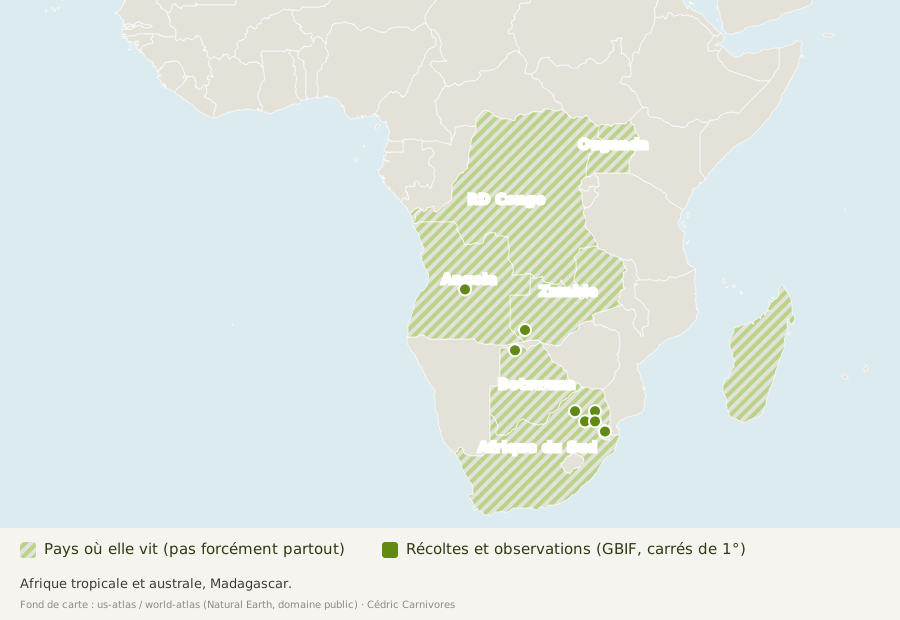
Tropical and southern Africa: Angola, Zambia, South Africa, Botswana, DR Congo, Uganda… and Madagascar (GBIF). According to Kew's world checklist of plants (WCVP), it is native to the following regions: Angola, Botswana, Congo, Ethiopia, Madagascar, Mozambique, the northern provinces of South Africa, Sudan and South Sudan, Uganda and Zambia.
Habitat
Stapf (1906) cites a collection by Welwitsch in shallow pools near Morro de Lopollo (Huíla, Angola), where it forms spongy masses together with algae.
Sources
- Wikipedia (English), Utricularia cymbantha: life form, range.
- Kew, World Checklist of Vascular Plants (via GBIF): native distribution.
- Stapf, Flora of Tropical Africa IV.2: Lentibulariaceae, 1906 (archive.org): description, localities and habitats of the specimens (translated from English).
- GBIF, Utricularia cymbantha: author, original publication, countries and localities of herbarium specimens and observations.