Utricularia geminiloba Benj.
Species sheet, updated on 30/10/2026.
At a glance
| Scientific name | Utricularia geminiloba Ludwig Benjamin, Flora Brasiliensis 10: 242, 1847 |
| Family | Lentibulariaceae |
| Distribution | Brazil |
Etymology
- Utricularia: see the genus sheet.
- geminiloba: from the Latin, “with twin lobes”: the two front lobes of the corolla are very distinct.
Description (how to recognise it)
- A medium-sized, perennial bladderwort, terrestrial or on rock.
- According to Benjamin (1847), who described it: a single leaf, broadly obovate, with a blade of about 4 cm by 1 cm on a slender petiole; scape erect and thread-like, bare or with one scale, bearing 1 to 6 widely spaced flowers.
- Corolla violet, 19 to 21 mm; lower lip divided into two equal, rounded lobes (hence geminiloba, “with twin lobes”); spur straight and cylindrical, longer than this lip.
Distribution
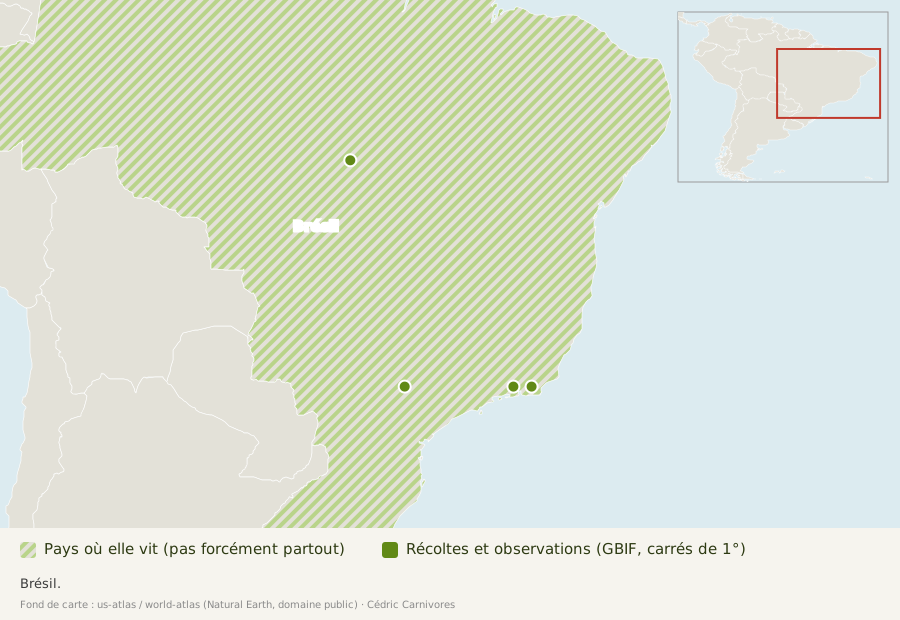
Endemic to Brazil (more than 150 records in GBIF, mostly in the southeast). According to Kew's world plant checklist (WCVP), it is native to this one region only: southeastern Brazil. According to the Flora do Brasil (the official list of Brazilian plants), it is endemic to Brazil and grows in this state: Rio de Janeiro. Major biomes: Atlantic Forest.
Habitat
According to the Flora do Brasil: a terrestrial or rock-dwelling plant, in high-altitude grasslands and rocky outcrop vegetation. Benjamin (1847) cites only Gardner's collection (no. 591), in eastern Brazil.
Sources
- Wikipedia (English), Utricularia geminiloba: author, year, range, etymology.
- Kew, World Checklist of Vascular Plants (via GBIF): natural distribution.
- Flora e Funga do Brasil, official list (via GBIF): states, biomes, endemism, way of life and vegetation types in Brazil.
- Benjamin, Flora Brasiliensis X: Lentibulariae, 1847 (archive.org): description, localities and habitats (translated from Latin).
- GBIF, Utricularia geminiloba: author, original publication, countries and localities of herbarium specimens and observations.