Utricularia linearis Wakabayashi
Species sheet, updated on 30/10/2026.
At a glance
| Scientific name | Utricularia linearis Hiroshi Wakabayashi, Journal of Insectivorous Plant Society 61(4), 2010 |
| Family | Lentibulariaceae |
| Distribution | Northern Territory (Australia): Howard Springs, Litchfield, Limmen |
| Habitat | Shallow swamps and pools with Melaleuca |
| Status | not assessed in the Northern Territory; very restricted range |
Etymology
- Utricularia: see the genus sheet.
- linearis: from the Latin, “linear”: its leaves are narrow and elongated.
History of the description
- 2010: described by the Japanese botanist Hiroshi Wakabayashi, from plants from Howard Springs, south-east of Darwin.
- The Flora of Australia (R. W. Jobson) accepts it as a species in its own right; GBIF still places it under U. fistulosa. A genetic study (2017) places it close to U. blackmanii (Queensland) and U. fistulosa (Western Australia), with which it shares its aquatic way of life, but their ranges do not meet.
Description (how to recognise it)
- Probably perennial bladderwort, aquatic and anchored to the bottom, close to U. dichotoma but with long, linear leaves.
- Flowers from March to May.
Distribution
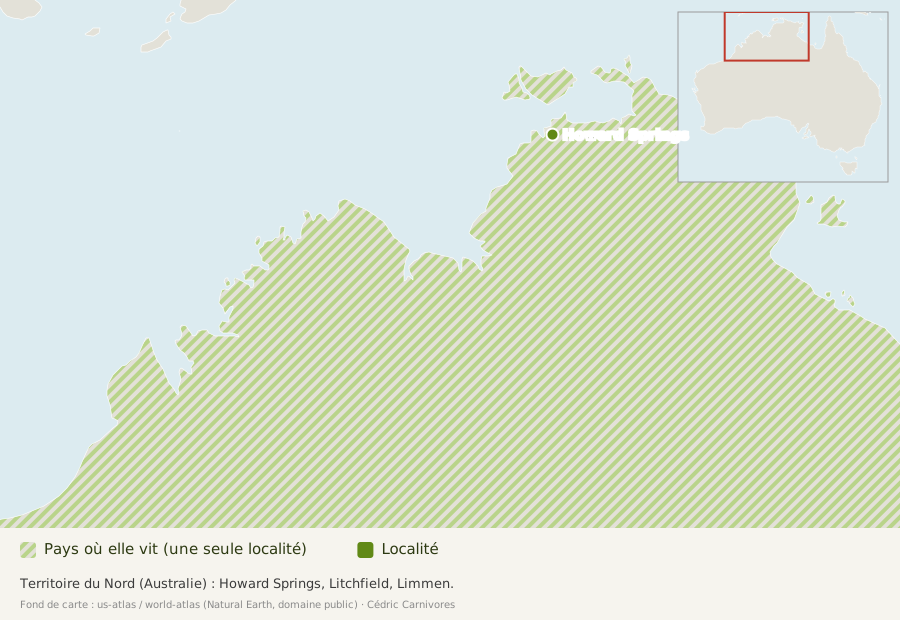
Endemic to the Northern Territory (Australia): several sites around Howard Springs, one site in Litchfield National Park and one collection north of Borroloola, at Limmen.
Habitat
Shallow water (10 to 40 cm after the monsoon) in low-altitude swamps and pools, in wetlands dominated by Melaleuca viridiflora. Locally uncommon, sometimes frequent.
Threats and protection
A very localised species, not assessed in the Northern Territory.
Sources
- Wikipedia (English), Utricularia linearis: author, locality.
- List of Utricularia: name only mentioned under “See also”.
- Flora of Australia (ABRS), Utricularia linearis, R. W. Jobson (CC BY licence): original publication, etymology, species status, relationships, life form, flowering, sites, habitat.
- GBIF, Utricularia linearis: author, original publication, countries and localities of herbarium specimens and observations.