Utricularia lloydii Merl ex F. E. Lloyd
Species sheet, updated on 30/10/2026. Short sheet: sources on this species are still scarce.
At a glance
| Scientific name | Utricularia lloydii named by E. M. Merl, described by Francis Ernest Lloyd, 1932 (Bulletin of the Torrey Botanical Club 61: 370, 1934 according to GBIF) |
| Family | Lentibulariaceae |
| Distribution | Central and South America: Bolivia, Brazil, Panama, Suriname, Venezuela |
| Habitat | Moist sandy soils in savannas, up to 600 m |
Etymology
- Utricularia: see the genus sheet.
- lloydii: in honour of Francis Ernest Lloyd, a great specialist of carnivorous plants, by Merl.
Description (how to recognise it)
- Small or very small annual terrestrial bladderwort.
Distribution
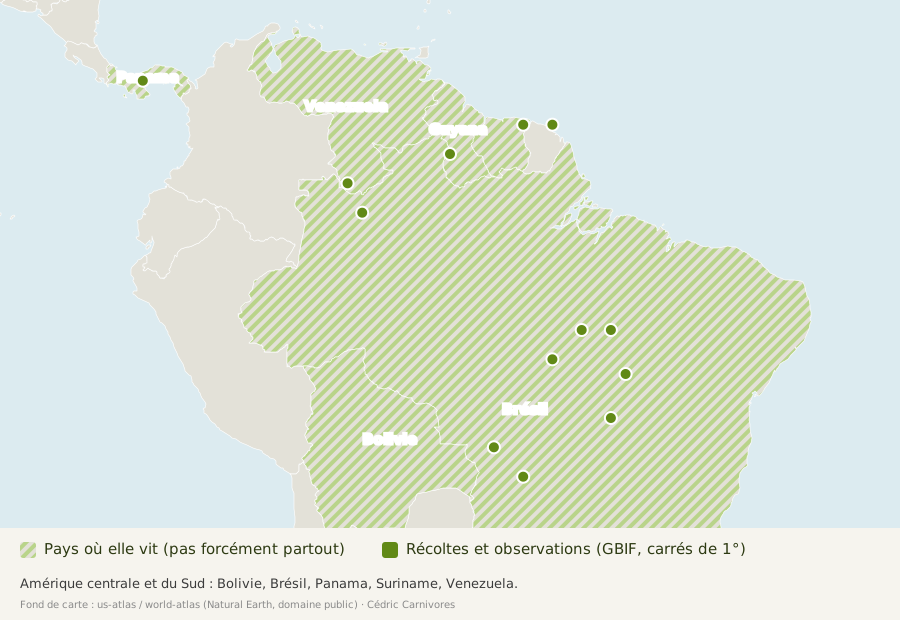
Widespread but known from few collections: Bolivia, Brazil, Panama, Suriname, Venezuela; GBIF adds French Guiana and Guyana. According to Kew's world list of plants (WCVP), it is native to the following regions: Bolivia, Northeast Brazil, North Brazil, West-Central Brazil, Panama, Suriname and Venezuela. According to the Flora do Brasil (the official list of Brazilian plants), it grows in these Brazilian states: Acre, Amazonas, Goiás, Mato Grosso, Pará and Tocantins. Major biomes: Amazon, Cerrado and Pantanal.
Habitat
Moist sandy soils in savannas, from sea level to 600 m. According to the Flora do Brasil: terrestrial plant, in campinarana (Amazonian savanna on white sand), open grasslands, cerrado (savanna), restinga (vegetation on coastal sands) and Amazonian savanna.
Sources
- Wikipedia (English), Utricularia lloydii: authors, year, range, collections, habitat, altitude, etymology.
- Kew, World Checklist of Vascular Plants (via GBIF): natural distribution.
- Flora e Funga do Brasil, official list (via GBIF): states, biomes, endemism, life form and vegetation types in Brazil.
- GBIF, Utricularia lloydii: author, original publication, countries and localities of herbarium specimens and observations.