Utricularia olivacea C. Wright ex Griseb.
Species sheet, updated on 30/10/2026.
At a glance
| Scientific name | Utricularia olivacea named by Charles Wright, described by August Grisebach, Catalogus Plantarum Cubensium : 161, 1866 |
| Family | Lentibulariaceae |
| Distribution | Eastern United States, West Indies, Central and South America |
Etymology
- Utricularia: see the genus sheet.
- olivacea: from the Latin, “olive green”.
Description (how to recognise it)
- Very small, annual, free-floating aquatic bladderwort.
- According to Anderson (2000): its stems look like strands of algae and its flowers measure only 2 to 2.5 mm; Small called it “one of the smallest flowering plants, perhaps the smallest by weight”. Flowers pale white, almost translucent, with fine yellow veins, anthers often purple; often a single flower per scape.
Distribution
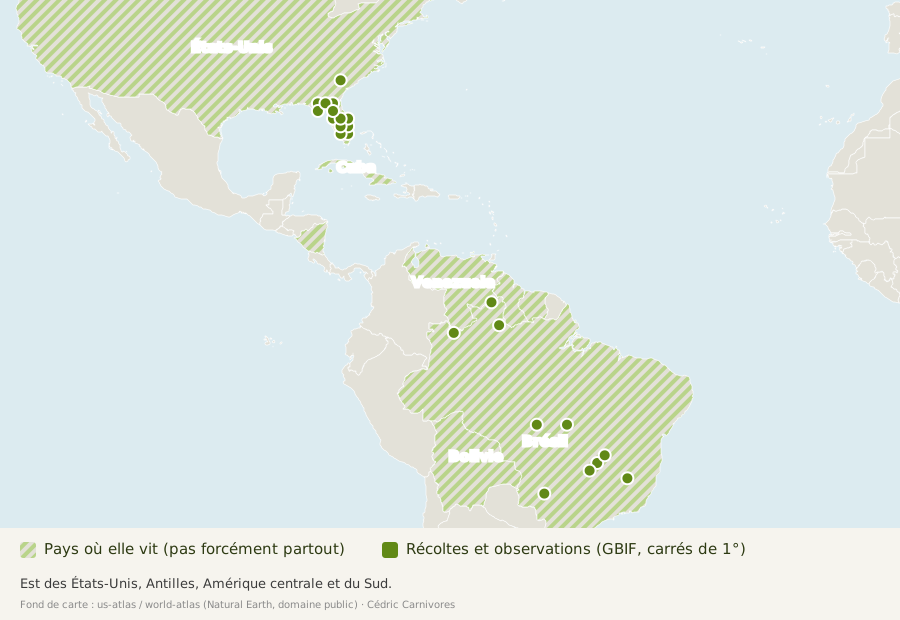
Central America, South America, West Indies and eastern United States (coastal plain, from Mississippi to New Jersey). According to Kew's world plant list (WCVP), it is native to 20 regions of the world (see the map and the Kew source). According to the Flora do Brasil (the official list of Brazilian plants), it grows in these Brazilian states: Goiás, Minas Gerais, Mato Grosso, Paraná, Rio de Janeiro, Roraima, Rio Grande do Sul, Sergipe and São Paulo. Major biomes: Amazon, Cerrado and Atlantic Forest. In Florida, the University of South Florida herbarium holds 5 collections made between 1976 and 2015 in 4 Florida counties: Brevard, Highlands, Hillsborough and Leon.
Habitat
According to the Flora do Brasil: aquatic plant, in campinarana (white-sand savanna of the Amazon), open grasslands, cerrado (savanna), rainforest, restinga (coastal sand vegetation) and aquatic vegetation. Anderson (2000) describes it floating underwater in shallow water, sometimes at the surface of ponds 6 m deep; it flowers mainly when it is left stranded on the mud as the water drops: in Florida he saw it on the muddy bottom of a drying water-lily pond and in extensive mats on the clayey sand exposed along the edges of ditches. Rare and easily overlooked. In Florida, according to herbarium labels: floating mats of vegetation rooted in peat, and a temporary pool dug in a sand pine scrub (Pinus clausa). The Atlas classes it among the “obligate wetland” plants.
Did you know?
Its English name is “piedmont bladderwort”.
Sources
- Wikipedia (English), Utricularia olivacea: authors, range, way of life, English name.
- Kew, World Checklist of Vascular Plants (via GBIF): natural distribution.
- Flora e Funga do Brasil, official list (via GBIF): states, biomes, endemism, way of life and vegetation types in Brazil.
- Anderson, “Stalking the pygmy bladderwort”, Carnivorous Plant Newsletter 29, 2000 (archive.org): description, habitat (Florida).
- Atlas of Florida Plants (University of South Florida), Utricularia olivacea, and its herbarium specimens: status in Florida, counties, habitats, flowering.
- GBIF, Utricularia olivacea: author, original publication, countries and localities of herbarium specimens and observations.