Utricularia tortilis Welw. ex Oliv.
Species sheet, updated on 30/10/2026.
At a glance
| Scientific name | Utricularia tortilis named by Friedrich Welwitsch, described by Daniel Oliver, Journal of the Linnean Society, Botany 9: 150, 1865 (1867 according to GBIF) |
| Family | Lentibulariaceae |
| Distribution | Tropical Africa |
| Habitat | Marshes, peaty or sandy soils, up to 1,860 m |
Photos in the wild
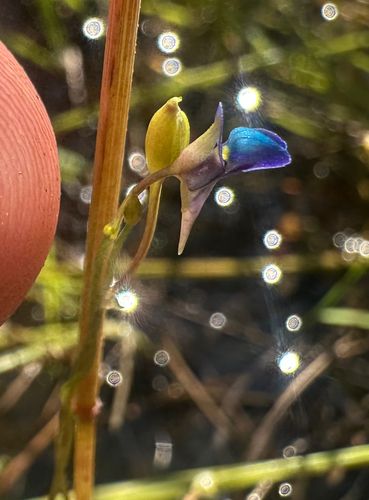
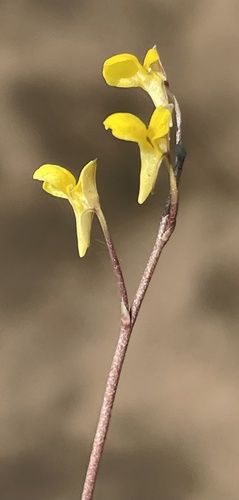
Etymology
- Utricularia: see the genus sheet.
- tortilis: from the Latin, “twisted”.
Description (how to recognise it)
- Annual bladderwort, small to medium-sized.
- According to Stapf (1906): small terrestrial annual; leaves already gone at flowering time; traps with two narrow horns; twining scape about 12 cm long, most often with a single flower (up to 4); yellowish corolla 5 to 6 mm, upper lip streaked with purple, palate bright yellow.
Distribution
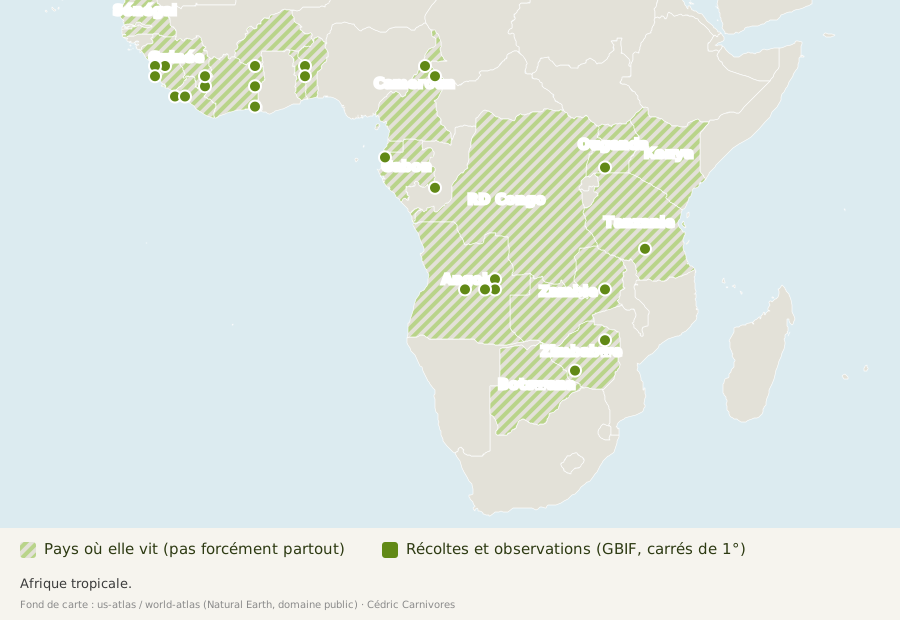
Tropical Africa: twenty-one countries, from Senegal to Kenya and from Guinea to Zimbabwe and Botswana. According to Kew's world plant list (WCVP), it is native in 24 regions of the world (see the map and the Kew source).
Habitat
Marshes, on peaty or sandy soils, from sea level to 1,860 m. Stapf (1906) cites only Welwitsch's specimen, collected near Morro de Lopollo (Huíla, Angola) in bogs, among low grasses and sedges, with mucilaginous algae, at about 1,680 m.
Sources
- Wikipedia (English), Utricularia tortilis: authors, range, habitat, altitude.
- Kew, World Checklist of Vascular Plants (via GBIF): natural distribution.
- Stapf, Flora of Tropical Africa IV.2: Lentibulariaceae, 1906 (archive.org): description, localities and habitats of the specimens (translated from English).
- GBIF, Utricularia tortilis: author, original publication, countries and localities of herbarium specimens and observations.