The genus Philcoxia
Genus sheet, updated on 29/10/2026.
At a glance
| Genus | Philcoxia P. Taylor & V. C. Souza, 2000 |
| Family | Plantaginaceae (tribe Gratioleae) |
| Number of species | 7 |
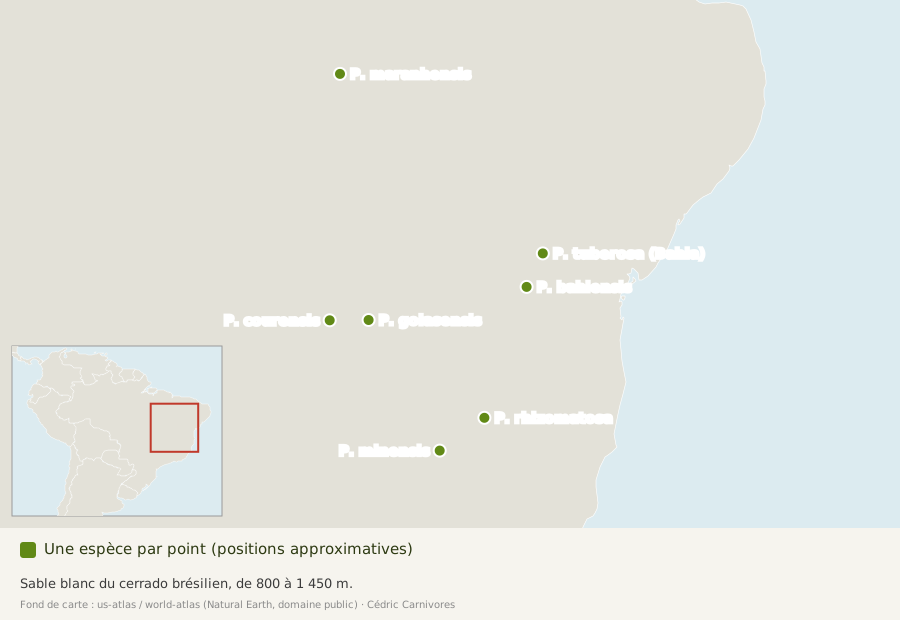
| Distribution | Brazil (Bahia, Goiás, Minas Gerais, Maranhão) |
| Habitat | Oases of deep white sand in the cerrado, from 800 to 1,450 m |
| Status | Rare species; P. courensis and P. maranhensis critically endangered |
Etymology
Philcoxia: in honour of David Philcox (1926-2003), a botanist at Kew Gardens, specialist in tropical Scrophulariaceae.
History
- 1966: a team from the New York Botanical Garden collected the future P. goiasensis near Posse (Goiás); its description would wait more than twenty years.
- 1981: collection of the future P. minensis in the Serra do Cabral (Minas Gerais); its site would not be found again until 2007.
- August 1992: Wilson Ganev collected P. bahiensis in the Serra do Atalho (Piatã, Bahia) and sent it to Kew.
- 1994: Ray Harley recognised that the 1966 plant belonged to the same genus.
- 2000: description of the genus, with three species.
- 2014-2017: four new species (P. tuberosa, P. rhizomatosa, P. courensis, P. maranhensis).
Description (how to recognise them)
- Tiny herbs, perennial or annual, up to 26 cm including the flower scape.
- Underground stems and 5 to 10 shield-shaped leaves, lying flat on the sand or buried beneath it, covered with sticky glands.
- Flowers pale blue to lilac (yellow tube in P. goiasensis), on zigzag, leafless racemes.
Ecology: traps under the sand
- 1996-2007: carnivory was suspected because of their resemblance to bladderworts and sundews, but neither prey nor enzymes were found.
- Phosphatases were then detected on the leaves.
- 2012: Pereira and colleagues fed P. minensis with nematodes labelled with nitrogen-15 and proved that it digests these microscopic worms and absorbs their nitrogen.
- All the species are assumed to be carnivorous, because they have the same structure.
- It is one of the rare cases of carnivorous plants that trap below the soil surface.
The species
| Species | Authors and year | Distribution | Sheet |
|---|---|---|---|
| P. bahiensis | 2000 (authors, not confirmed) | Serra do Atalho, Bahia | sheet |
| P. goiasensis | 2000 (authors, not confirmed) | near Posse, Goiás | sheet |
| P. minensis | 2000 (authors, not confirmed) | Serra do Cabral, Minas Gerais | sheet |
| P. tuberosa | Carvalho & Queiroz, 2014 | Bahia | sheet |
| P. rhizomatosa | Scatigna et al., 2015 | Botumirim, Minas Gerais | sheet |
| P. courensis | Scatigna et al., 2017 | Chapada dos Veadeiros, Goiás | sheet |
| P. maranhensis | Scatigna et al., 2017 | Chapada das Mesas, Maranhão | sheet |
Distribution
Classification
First placed in the Scrophularieae (1996), then near Gratiola (2000), the genus is now in the tribe Gratioleae, family Plantaginaceae (that of the plantain). In 2018, Scatigna and colleagues suggested that P. minensis may include several species.
Sources
- Wikipedia (English), Philcoxia: etymology, species, description, habitat, altitude, history of the collections, carnivory (Fritsch 2007, Pereira 2012, Scatigna 2018), classification.
- Scatigna et al. 2017, Systematic Botany 42(2): P. courensis and P. maranhensis, status.
- FAPESP, Philcoxia rhizomatosa: locality of P. rhizomatosa.