
 Français
 Español
 Deutsch
 Italiano



Growing guide: Cephalotus follicularis


Cephalotus follicularis
The Albany pitcher plant, a small and much sought-after carnivore from Western Australia, with stocky, colourful pitchers. Said to be difficult, it grows very well if you respect one crucial point: watering. Interactive guide based on the growing sheets and photographs of Cédric Azais (Cédric Carnivores).
A Year with a Cephalotus
Flat leaves in spring, pitchers in summer, small white flowers in late summer: follow its year, month by month.
Water Level & Saucer
Plant Status
📋 Grower's Tasks
An Ideal Day for Cephalotus
20-25°C by day, with a drop of 5 to 10°C at night
☀️ Very Bright Light
- • Ideal: direct morning sun.
- • Where: east-facing window; on a south-facing one, protect it from afternoon sun.
- • Outdoors: half shade, half sun.
💨 Humidity… but Fresh Air!
It prefers high humidity (50 to 70%), but good air circulation is crucial: an environment that is too closed encourages fungi and rot.
🌙 The Night-Time Drop
20 to 25°C by day; at night, a drop of 5 to 10°C is beneficial and encourages better pitcher colour.
Watering & Soil Workshop
This is the main cause of failure: Cephalotus cannot stand having wet feet all the time. The soil must be very airy and free-draining.
🧮 Mix Calculator
Mix Proportions
🚿 The Right Method
- No permanent saucer.
- Water from below, into the saucer, and let the excess evaporate.
- Let it dry for 1 to 2 days before watering again.
- Excess moisture causes fatal root rot.
🚿 Water Quality Tester
As for all carnivorous plants, pure water only. Test your water source:
Interactive Anatomy of Cephalotus
Click the 4 glowing dots or the buttons to discover the Albany pitcher plant.
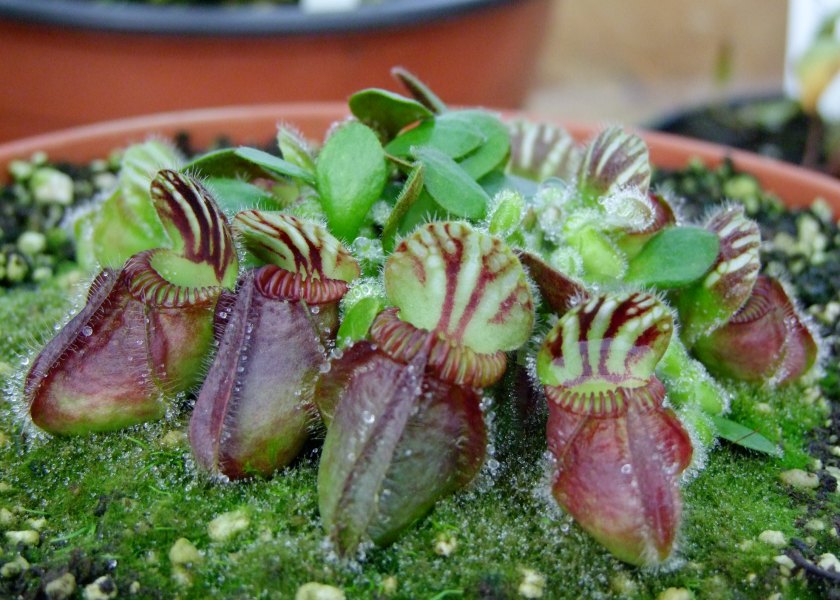
Photo: Cephalotus follicularis grown at the nursery.
© Photograph: Azais Cédric
🌍 A Plant Unique in the World
- • One of a kind: it is the only species in the Cephalotaceae family.
- • Western Australia: it grows wild only in a small corner of the south-west of Western Australia, around Albany.
- • Threatened species: it is listed as “Vulnerable” on the IUCN Red List. Only cultivated plants should be bought.
- • All our plants are nursery-grown.
Cephalotus from the Nursery
Just one species, but what a plant!
Propagating Cephalotus
Propagation is possible, but takes patience and a very gentle touch with the roots.
Leaf Cutting
Possible but very tricky.
- A leaf can give a new plant.
- A lot of patience is needed.
- Airy, free-draining soil.
Sowing
Possible but very tricky.
- Cephalotus flowers, but getting seeds is tricky.
- Pollination has to be done by hand.
- It never propagates from root cuttings.
Dividing the Clump
One of the few carnivores where it works.
- In spring, just before growth resumes.
- Without disturbing the roots too much.
- With the greatest care.
🚿 The Most Critical Point
⛔ The 4 Mistakes
Interactive Diagnosis
Select the symptom you see to display what to do:
The Secret of Cephalotus
“It is said to be difficult, but it is perfectly possible: morning sun, a very free-draining soil, and above all, never wet feet.”
Recommended products

Share this article:


