
 Français
 Español
 Deutsch
 Italiano




Growing guide: temperate sundews


Temperate Sundews
Hardy sundews adapted to cold winters: full sun in summer, a cool dormancy in winter. Interactive guide based on the growing sheets and photographs of Cédric Azais (Cédric Carnivores).
A Year with a Temperate Sundew
Like the Venus flytrap, temperate sundews follow the seasons: growth in the sun, then cold dormancy from November to March.
Water Level & Saucer
Plant Status
📋 Grower's Tasks
Summer in the Sun, Winter in the Cold
Dormancy between 0 and 10°C, from November to March
☀️ Sun: the Source of Life
- • Ideal: at least 6 hours of direct sun a day.
- • Where: balcony, terrace or garden.
- • Indoors: without a south-facing window and a grow light, the plant lacks vigour and makes little mucilage.
❄️ Dormancy: Vital
From November to March, between 0 and 10°C: outdoors, in a cold greenhouse or an unheated conservatory. The plant forms a hibernaculum, a small bud that protects its growing point from the cold.
🧭 Temperate ≠ Subtropical
Temperate species (rotundifolia, intermedia, filiformis) form a hibernaculum and spend winter outdoors in the frost. D. capensis and D. aliciae simply slow down between 5 and 12°C in a bright conservatory.
Soil & Watering Workshop
An acidic, poor soil: 70% blond sphagnum peat (no fertiliser) and 30% perlite, like our mix No. 1.
🧮 Mix Calculator
Mix Proportions
🪴 Repotting
- When: in early spring, just before growth resumes.
- How often: every 2 to 3 years.
- Bonus: the time to divide the clump.
❄️ Pot & Frost
To spend the winter outdoors in the frost, choose a pot at least 12 to 15 cm across. Below -8°C, insulate small pots with a winter fleece.
🚿 Water Quality Tester
Use pure water only. Test your water source:
Interactive Anatomy of a Temperate Sundew
Click the 4 glowing dots or the buttons to discover the plant, from summer to winter.
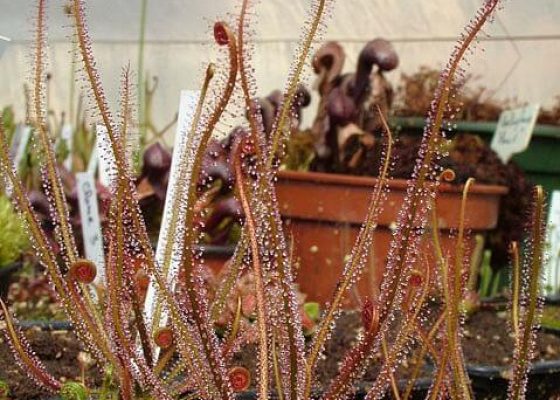
Photo: Drosera filiformis var. floridana grown at the nursery. In the sun, its thread-like leaves turn red.
© Photograph: Azais Cédric
🌍 From Bogs with Cold Winters
- • Temperate bogs: like Venus flytraps and Sarracenia, these sundews come from places with real winters, with frost and sometimes snow.
- • Atlantic coast of North America: D. filiformis grows on the coastal plain from Nova Scotia to Florida; the variety floridana, smaller and redder, comes from north-west Florida.
- • In France: D. rotundifolia and D. intermedia grow wild in bogs. They are protected nationwide: admire them, never pick them.
- • All our plants are nursery-grown.
Temperate Sundews from the Nursery
Hardy plants that can be grown outdoors all year round.
Propagating Temperate Sundews
Temperate sundews reproduce very easily, in three ways.
Seeds
The simplest.
- The seeds often self-sow.
- Sow on a blond peat + perlite mix kept moist.
- Place in the sun.
Leaf Cuttings
An effective technique.
- Take a healthy leaf.
- Lay it flat on moist dead sphagnum.
- New plantlets appear.
Dividing the Clump
In early spring.
- When repotting, every 2 to 3 years.
- Gently separate the rosettes.
- Repot each division in a fresh mix.
❄️ A Successful Dormancy
🚿 Watering Reminder
Interactive Diagnosis
Choose the season, then the symptom you see:
The Secret of Temperate Sundews
“Full sun in summer, feet in pure water, and a real cold rest in winter: that is all they need.”
Useful tools
Recommended products


Share this article:


