
 Français
 Español
 Deutsch
 Italiano



Growing guide: tropical bladderworts


Tropical Bladderworts
Carnivores with no visible traps: their microscopic traps work in the soil, while the plant offers flowers like little orchids. Interactive guide based on the growing sheets and photographs of Cédric Azais (Cédric Carnivores).
A Year with a Tropical Bladderwort
No dormancy: in a well-tuned indoor setup the plant grows and can flower all year. Just keep warmth, light and humidity constant.
Water Level & Saucer
Plant Status
📋 Grower's Tasks
Constant Tropical Warmth
Ideal: 20 to 28°C, never below 12°C
☀️ Bright but Gentle Light
- • Duration: 12 to 14 h of bright light a day.
- • Type: gentle morning or late-afternoon sun.
- • Where: filtered east or south-east window, or a bright terrarium.
💨 Humidity: 60 to 80%
Terrarium or mini greenhouse. Some species (U. sandersonii, U. livida) tolerate normal household humidity if the soil is moist enough.
🌡️ No Dormancy
20 to 28°C all year, no particular need for a night-time drop. Avoid going below 12°C.
Soil & Watering Workshop
A light, free-draining soil that is always moist: our mix No. 3, dead sphagnum (50%), coco mulch (30%) and perlite (20%).
🧮 Mix Calculator
Mix Proportions
🌳 Epiphytic Species
For epiphytes such as U. alpina or U. jamesoniana, use a more open mix: live sphagnum, fine pine bark and perlite.
🪴 Repotting
Every 1 to 2 years to refresh the soil. Division is easy: bladderworts spread quickly.
🚿 Water Quality Tester
Rainwater, demineralised or reverse osmosis water only. Test your water source:
Interactive Anatomy of a Bladderwort
Half of the plant is hidden in the soil. Click the 4 glowing dots or the buttons.
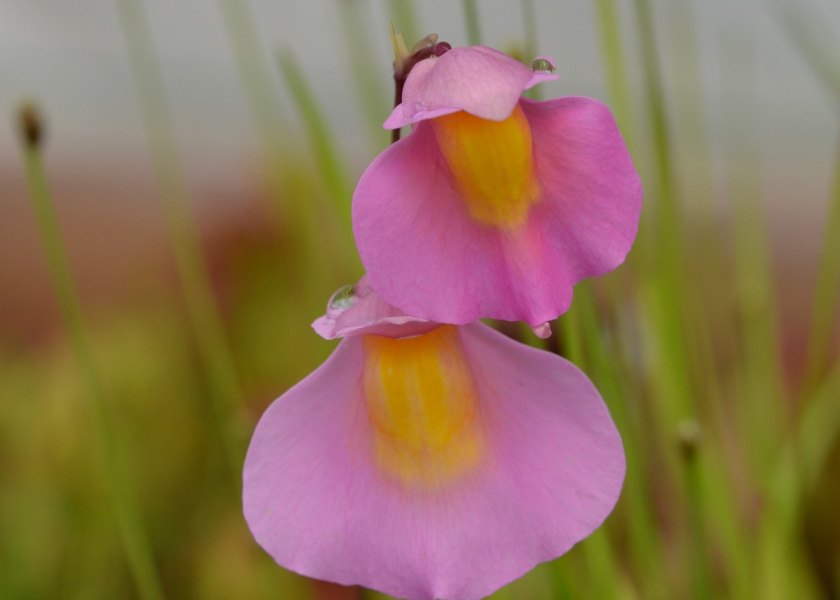
Photo: Utricularia reniformis grown at the nursery.
© Photograph: Azais Cédric
🌍 From the Tropics of South America
- • Terrestrial or epiphytic plants from tropical and subtropical regions.
- • Brazil: U. reniformis grows in the south-east and south of the country.
- • Highlands of Venezuela, Guyana and northern Brazil: U. humboldtii lives notably in the water held in the leaf axils of bromeliads (Brocchinia).
- • From the Antilles to northern Colombia and Brazil: U. alpina, a tuberous epiphyte that also grows on rocks.
- • All our plants are nursery-grown.
Bladderworts from the Nursery
For beginners, the growing sheet also recommends U. sandersonii, U. livida and U. longifolia: sturdy and generous with flowers.
Propagating Bladderworts
Bladderworts spread quickly: division is the simplest method, but sowing is also possible.
Division
The easiest method.
- Bladderworts quickly colonise their pot.
- Take a clump with leaves and stolons.
- Lay it on fresh, moist soil.
When Repotting
Every 1 to 2 years.
- Refresh the soil.
- Divide clumps that are too dense.
- Put straight back in a saucer of pure water.
Sowing
After flowering.
- Bladderworts can also be grown from seed.
- For many species, you have to pollinate the flowers yourself to get seeds.
- A slightly cramped pot flowers better.
🌸 Getting Bladderworts to Flower
🍽️ Feeding
Interactive Diagnosis
Select the symptom you see to display what to do:
The Secret of Bladderworts
“Gentle light, soil that is always moist, a slightly cramped pot: let them spread, and they will reward you with colourful, regular flowers.”
Recommended products

Share this article:


