
 Français
 Español
 Deutsch
 Italiano



Growing guide: the Venus flytrap (Dionaea muscipula)


The Venus Flytrap Tamed
The most famous carnivorous plant is far easier to grow than people think: full sun, pure water and a cool winter rest. Interactive guide based on the growing sheets and photographs of Cédric Azais (Cédric Carnivores).
The Venus Flytrap Year
Move the slider through the months to follow the plant, the water level to keep and the tasks of the moment.
Water Level & Saucer
Plant Status
📋 Grower's Tasks
Summer in the Sun, Winter in the Cold
Winter rest between 0 and 10°C, from November to March
☀️ Light: Full Sun
Sun is the second pillar of flytrap growing: these are full-light plants.
- • Ideal: 6 to 8 h of full direct sun a day, no shade.
- • Where: balcony, terrace, garden or greenhouse.
- • Good sign: compact growth, sturdy traps, often red inside.
- • Lack of light: green plant, long stems, small pale traps.
🧊 Hardiness
The flytrap tolerates short spells of light frost and withstands -7°C to -10°C in a large pot. For winter: outdoors, in an unheated conservatory or a cold greenhouse only.
🔥 The Fatal Mistake
Never leave your flytrap in a heated room in winter: it would not go dormant and would die of exhaustion.
Overwintering the Venus flytrap
As winter approaches, the Venus flytrap goes dormant. Cédric shows you how to clean it up for its winter rest. The video is in French.
Soil, Water & Repotting Workshop
The soil must be acidic and low in nutrients. Work out how much mix to prepare for your pots.
🧮 Mix Calculator
Mix Proportions
🌱 Repotting
- When: every 2 to 3 years, at the end of winter, before growth resumes.
- Pot: the same size or slightly larger.
- Soil: replace it completely with a fresh mix.
- Bonus: the ideal time to separate the new shoots around the mother plant.
🚿 Water Quality Tester
Watering is a science. Check whether your water suits a flytrap:
Interactive Anatomy of a Venus Flytrap
Click the 5 glowing dots on the diagram or the buttons. Touch the right-hand trap twice to watch it close.
👆 Touch the right-hand trap: 0 / 2 touches
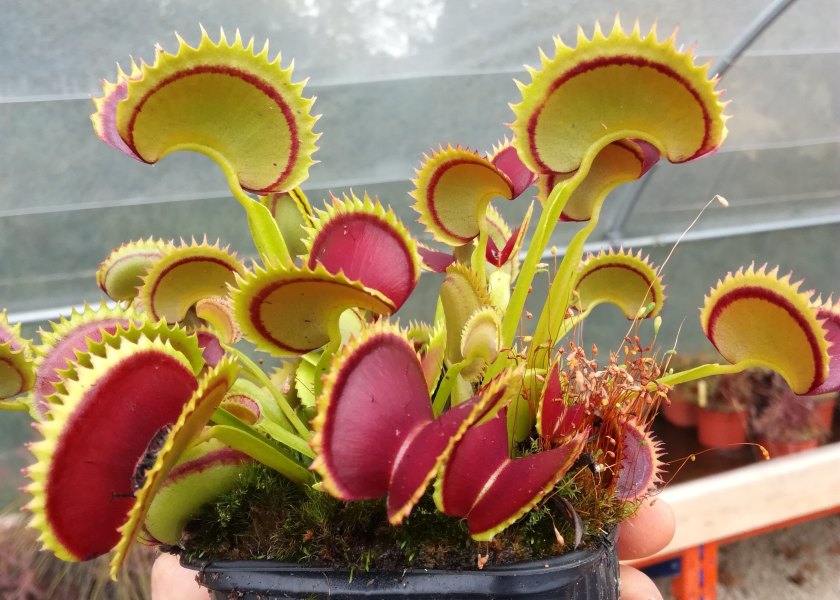
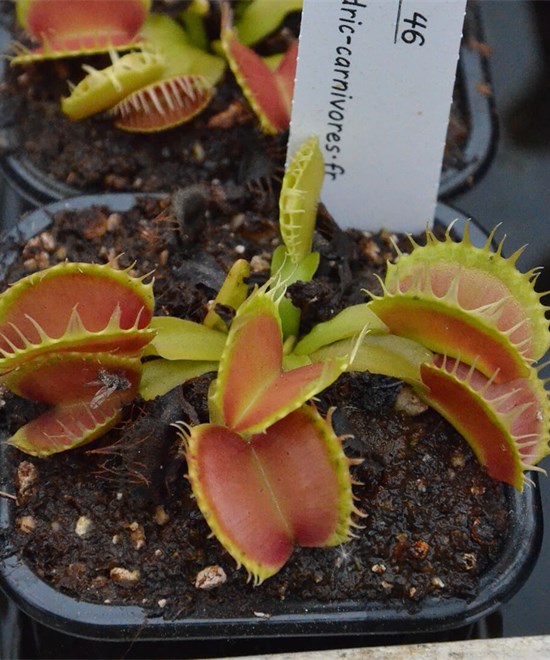
Photo: Dionaea 'Dentate Traps' at the nursery. In the sun, the inside of the traps turns pink to red.
© Photograph: Azais Cédric
🗺️ A Plant from the Carolinas
- • The Venus flytrap grows wild only in a narrow area of the coastal plain of North and South Carolina (USA), around the city of Wilmington.
- • Like Sarracenia, it lives in a temperate climate, hence its need for a winter rest.
- • In the wild it is threatened by poaching and habitat loss: in North Carolina, collecting wild plants has been a felony since 2014.
- • All our flytraps are nursery-grown.
Nursery Cultivars
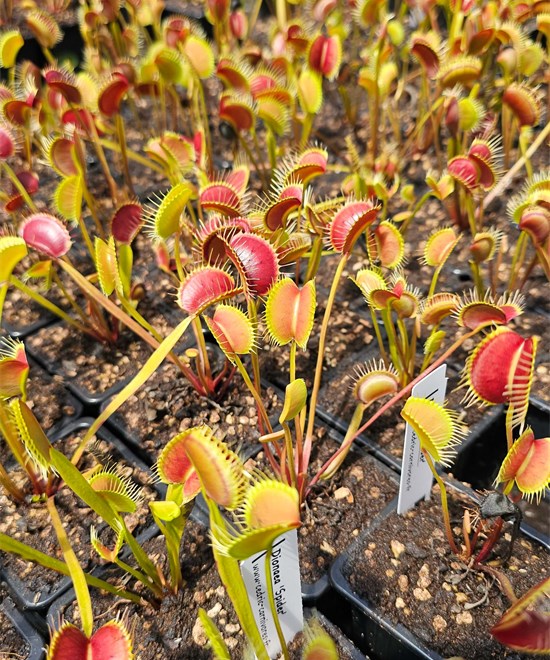
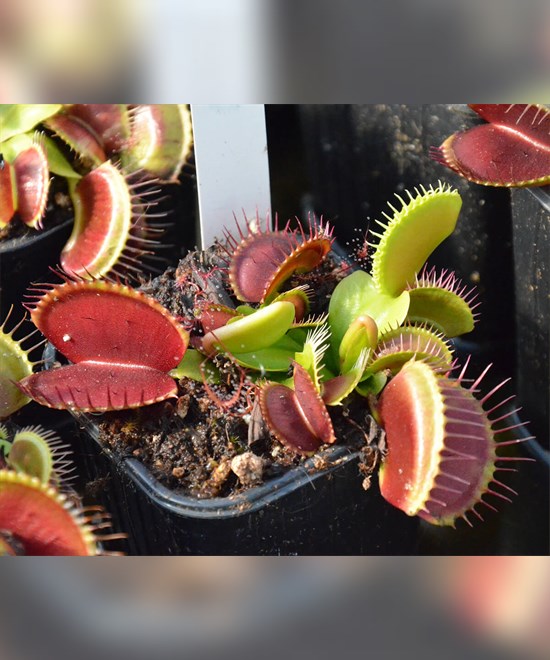
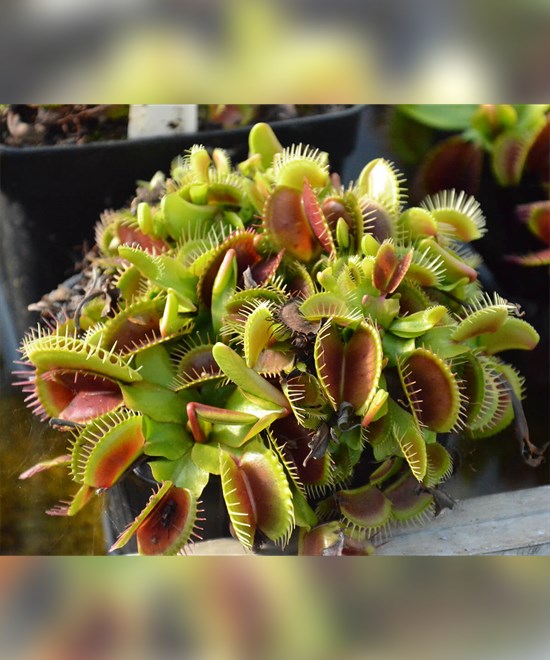
A single species, but many cultivars selected for the size, shape or colour of their traps.
Propagating Venus Flytraps
Three methods: division and leaf cuttings give true clones; seeds produce plants that are all different.
Division
The simplest method, when repotting.
- At the end of winter, before growth resumes.
- Separate the new shoots formed around the mother plant.
- Repot each division in our mix No. 1 (70% blond peat, 30% perlite).
Leaf Cutting
To clone a cultivar without waiting for it to divide.
- Preferably in early summer.
- Pull a leaf off downwards to keep its white base.
- Lay it on a moist peat / sand mix, covered (bag or terrarium) and in full light.
- Small plantlets appear at the base after a few weeks.
Seeds
Every seedling is unique: ideal for new forms.
- The white flowers open from late May to June; once pollinated they give capsules of small shiny black seeds (1 to 1.5 mm).
- Sow on the surface, without covering, on a very moist peat / sand mix.
- Keep covered and in full light: germination in a few weeks.
- Young plants take several years to flower.
✂️ Black Traps
🦟 Should you feed it?
Interactive Diagnosis
Choose the season, then the symptom you see:
Three Golden Rules
“Give your flytrap full sun, lime-free water and a winter dormancy, and you will have a healthy plant for many years.”
Useful tools
Recommended products



Share this article:


