
 Français
 Español
 Deutsch
 Italiano


- Out-of-Stock
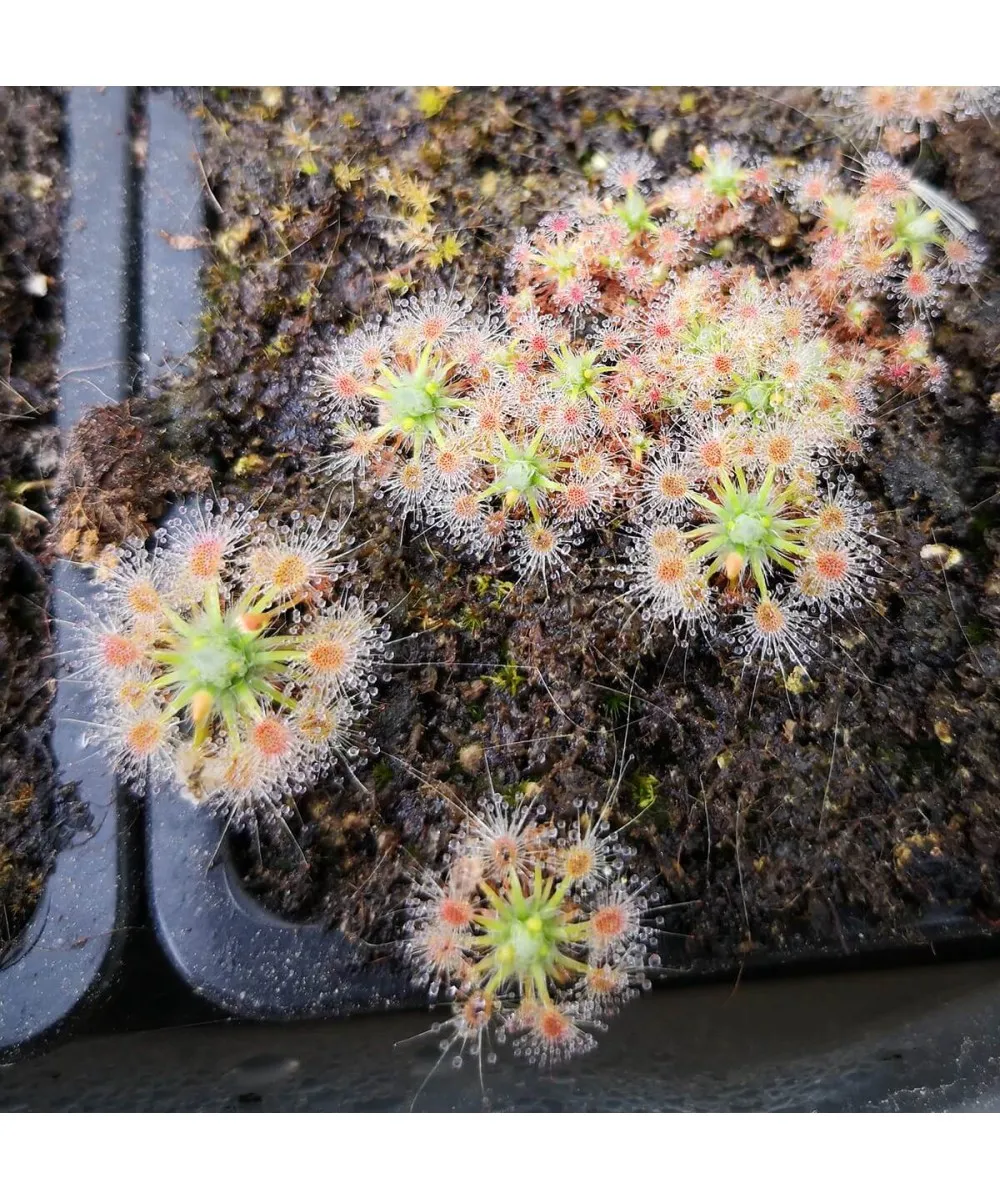
Photo of the mature mother plant: you receive a plant of the same clone, in the size you choose.

Photo of the mature mother plant: you receive a plant of the same clone, in the size you choose.
This plant is a cross between Drosera helodes and pulchella. It is a miniature Australian sundew that grows from autumn to spring and rests in summer.

Delivery policy

Minimum order: €18
Drosera (miniature or pygmy species) are tiny, fascinating carnivorous plants from Australia. They stand out for their small size (usually under 2 cm) and their unique way of reproducing by "gemmae" (a kind of cutting). They are very rewarding to grow, provided you understand their reversed life cycle.
Unlike most temperate carnivorous plants, which go dormant in winter, Drosera (pygmy species) go dormant in summer to survive the heat and drought.
*Growing period: Autumn, winter and spring. This is when the plant is active, produces its sticky leaves and feeds. Temperatures should be cool to mild (ideally 10 to 25 °C).
*Dormancy period: Summer. The plant rests to survive the heat. For most species in this group, its leaves die and it turns into a small, dry, compact bud. Gemmae are usually produced in November/December
*Care: During dormancy, watering must be greatly reduced. The substrate should be kept very slightly moist or even allowed to dry out, to mimic their natural habitat. The plant should be kept out of direct sun.
The mucilage production and beautiful colours of Drosera (pygmy species) depend directly on light intensity.
*Ideal: 12 to 16 hours of bright light per day. They love light.
*Location: Indoors, place them under powerful LED or fluorescent grow lights. They will not thrive on a simple windowsill. Direct sun exposure is usually too intense in summer and can force them into dormancy earlier.
*Signs: Good light shows in compact plants with strong colouring (red, orange, pink) and abundant mucilage.
*Type of water: Use only pure water (rainwater, demineralised water or reverse osmosis water).
*Growing period (autumn to spring): The pot should always stand in a little water (tray method). Leave it in 1 to 2 cm of water at all times.
*Dormancy period (summer): Remove the saucer and water only occasionally, , wetting only the surface of the substrate. The aim is to let the root ball dry out almost completely between waterings.
*Composition: A mix of two thirds blond sphagnum peat (without fertiliser) and one third pure quartz sand is excellent.
*Avoid: Never use potting compost.
Reproduction by gemmae is the most fascinating feature of these plants.
*What is a gemma? A gemma is a small vegetative bud that breaks away from the mother plant to form a clone. Gemmae look like tiny balls.
*Quand apparaissent-elles ? Gemmae are produced in large numbers from November to December.
*How to use them? Simply pick them gently and place them on the surface of a pot of fresh, moist substrate. Within a few days they will form roots and small leaves, giving rise to new plants. It is an extremely effective and fast way to propagate them.
*Fragility: Drosera (pygmy species) are very small and fragile. Handle them with care.
*Feeding: The plant naturally feeds on tiny insects. You do not need to feed it.
*Problem: Si vos Drosera (pygmy species) turn yellow or lose their mucilage during the growing period, it is usually a sign of insufficient light.
*Repotting: Repotting is not recommended for this type of Drosera. Gemmae are often a better way to rejuvenate your collection.
➜ Learn more about these species: Drosera helodes and Drosera pulchella, in our encyclopedia
Data sheet
Drosera paleacea ssp roseanna
Drosera dichrosepala is part of our Pygmy Drosera selection. It is a miniature Australian sundew that grows from autumn to spring and rests in summer.
This plant is a cross between Drosera ericksoniae and pulchella. It is a miniature Australian sundew that grows from autumn to spring and rests in summer.
Drosera pulchella 35b is part of our Pygmy Drosera selection. It is a miniature Australian sundew that grows from autumn to spring and rests in summer.
A question about this product or how to grow it? Ask it: the nursery answers, and the answer helps other growers too.
No questions yet: be the first to ask one!
Do you have this plant?
Share a photo of it from your My collection page: it will join our customers’ gallery.
This plant is a cross between Drosera helodes and pulchella. It is a miniature Australian sundew that grows from autumn to spring and rests in summer.


