
 Français
 Español
 Deutsch
 Italiano


Where to grow Sarracenia: pot, bog garden or greenhouse


Where to grow Sarracenia?
Pot, bog garden or greenhouse
Greenhouse, conservatory, terrace, doorstep, balcony: everyone can find a spot for Sarracenia. Here is what to know for each option.
This article comes from “Les sarracenia en images”, the book Cédric wrote from his experience at the nursery, and from our growing guide. All photos are ours.
In a pot, outdoors: go for volume
Outdoors, the size of the set-up matters a lot, especially in harsh winters: allow at least 20 L. A large volume has many advantages: fine, full clumps, cool roots in summer, less watering, and better frost resistance: depending on the size of the pot, down to -8 °C, and even below -12 °C in a large volume.
The bog garden
You have room in the garden and want to recreate an unusual habitat? A bog garden is ideal. An old pond or a made-to-measure installation will do, as long as it is watertight. Length and width are up to you; 40 to 50 cm deep is enough. In a bog garden, Sarracenia withstand down to -20 °C.
To design it and work out the substrate: our bog garden planner.
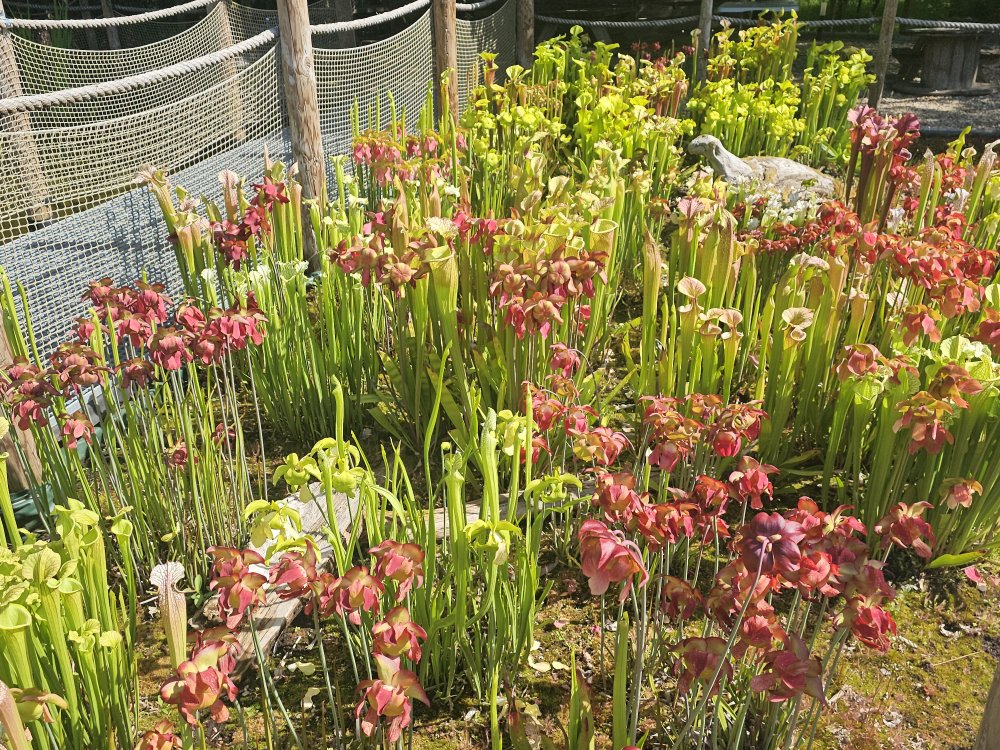
Our own bog garden, from its construction to its flowering, is told in The nursery bog garden: the build in photos.
In a greenhouse
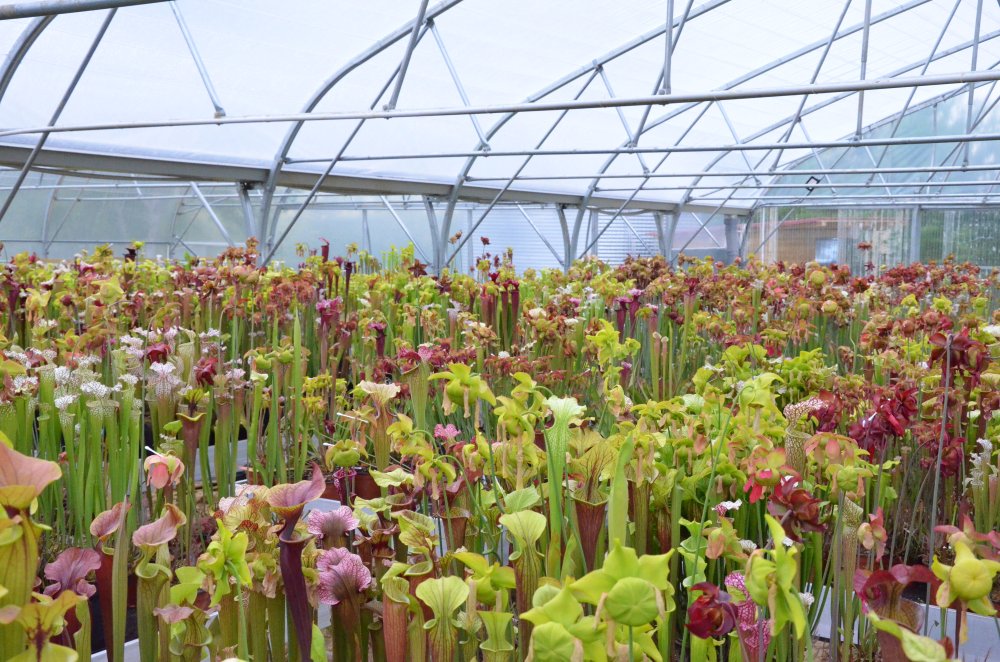
A greenhouse allows a bigger collection and an earlier season. Two rules: a shade cloth of 20% at most in high summer, depending on the exposure, and ventilation summer and winter, with a fan or by opening up, to avoid diseases in winter and heat stress in summer.
Everywhere: sun, pure water, good substrate
Wherever they are: full sun, rainwater, reverse-osmosis or demineralised water, and an acidic, nutrient-poor substrate like our No. 1 mix. To choose the right substrate, see Which substrate for my carnivorous plant? and discover our Sarracenia collection.
Our No. 1 mix contains 70% blond peat and 30% perlite. Choose a good-quality blond peat with a pH below 5: above that, the plants grow poorly. A light substrate helps rooting and lets the roots breathe; if it is too old or of poor quality, it can on the contrary trigger diseases.
You can add lime-free sand: the mix becomes softer, and small seedlings being pricked out particularly like it. As the destruction of natural peat bogs is an ecological disaster, alternative substrates are appearing (coconut fibre, dead sphagnum, wood chips): they can be added to the mix to reduce the amount of peat.
A question about your Sarracenia?
✉ Contact us© 2026 Cédric Carnivores - Carnivorous plant nursery since 2012
Share this article:


Similar posts

Sarracenia in winter: rest, frost and the big clean-up
Rest from October to March, watering, frost hardiness down to -20 °C, greenhouse ventilation and the end-of-winter clean-up: Sarracenia in winter.

Fertiliser for Nepenthes and Heliamphora: our advice
Yes, Nepenthes and Heliamphora need fertiliser, but not just any way: Osmocote, Liquid Ocean, doses and the right moments.