
 Français
 Español
 Deutsch
 Italiano



Choosing your first carnivorous plant: species and care


When you start out with a carnivorous plant, it is crucial to choose well among the available species and to follow the right care advice. The most common genera are Drosera, Dionaea, Sarracenia and Nepenthes, each with specific needs linked to its natural habitat. To plant your first purchase, use a light, acidic, very airy substrate, keep the humidity right and give plenty of light. Most carnivorous plants have deadly leaves coated with glue or forming passive traps that catch insects very effectively. Good care means mastering watering, never adding chemical fertiliser and letting prey decompose naturally in the traps. Understanding the specific needs of these unique plants, which come from marshes or tropical forests, is essential for their longevity.
Which carnivorous plants to choose as a beginner
To start your collection well, choose easy, sturdy species that adapt well to changing conditions. Carnivorous plants for beginners should be both spectacular and forgiving of small mistakes. Three main groups stand out for a successful first experience: sundews, the Venus flytrap and Sarracenia. They put on a fascinating show when they catch their prey.

Drosera capensis, the champion of tolerance
Drosera capensis, the Cape sundew, is a sticky-leaved (mucilage) carnivorous plant often seen as the undisputed champion for beginners. Its fast growth and high tolerance of changing light make it ideal for growing indoors behind a window. It catches insects with sticky tentacles that slowly curl around the prey to digest it.
It forms beautiful dense rosettes whose "dew" drops sparkle in the sun. Unlike more demanding species, capensis copes well with life in a flat. At Cédric Carnivores, you will discover how to grow Drosera successfully, a family of more than 190 species with amazing shapes.

Venus flytrap and Sarracenia, the garden giants
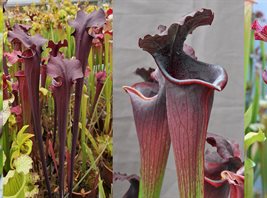
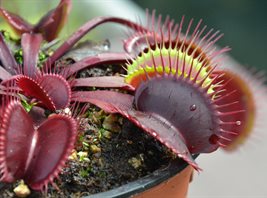
The Venus flytrap (Dionaea muscipula) remains the most famous plant thanks to its jaws, which snap shut in a fraction of a second. For a wilder, more graphic look, however, Sarracenia is a great ally. These trumpet pitcher plants come from the bogs of North America and are extremely hardy. Their leaves form long upright tubes (pitchers) that attract flies and especially wasps with intoxicating nectar on the peristome.
Sarracenia is a passive trap: once inside the pitcher, the insect cannot climb back up because of fine downward-pointing hairs, and it ends up falling into digestive fluid at the bottom of the tube. These plants are perfect outdoors, as they cope very well with winter frost, as long as they stay in substrate soaked with demineralised water.
| Criterion | Care advice |
|---|---|
| Essential winter rest | the Venus flytrap and Sarracenia must spend the winter somewhere cool (between 0 and 10°C) to stop growing and come back stronger in spring. |
| Light and sun | both genera need direct sun to colour their traps an intense red. |
| Water quality | use only rainwater or demineralised water. Tap water is fatal because of the lime. |

Nepenthes: the elegance of tropical vines
Nepenthes are the queens of tropical forests. Unlike Sarracenia, they often grow as vines and produce pitchers hanging from tendrils. They are exceptional plants for indoors or heated greenhouses. Here too the trap is passive, but the pitcher has a lid that stops rainwater from diluting the digestive enzymes at the bottom.
For a beginner, it is best to choose hybrids or so-called "intermediate" species such as Nepenthes x ventrata or Nepenthes x gaya. These plants need high humidity (at least 60-70%) to form pitchers properly. Without it, the plant will produce leaves but no traps. Explore our selection of Nepenthes to discover incredible pitcher shapes and sizes.
Essential care conditions for carnivorous plants
| Species | Substrate mix | Optimal pH |
|---|---|---|
| Drosera & Sarracenia | 70% blond peat + 30% perlite | 4,0-5,5 |
| Nepenthes | Sphagnum + pine bark + perlite | 5,5-6,5 |
| Venus flytrap | 70% blond peat + 30% perlite | 4,5-5,5 |
The ideal ready-to-use mix
No need to measure it out yourself! This professional mix (blond peat + perlite) is perfectly balanced to give your Venus flytraps, sundews and Sarracenia the drainage and acidity they need.
See the 3 L mix ➤Light and temperature: the keys to success
Once substrate and watering are under control, exposure becomes crucial. Lack of light is the number one reason carnivorous plants decline indoors. Without enough light, the traps turn green and soft and eventually disappear. For the Venus flytrap and Sarracenia, do not be afraid of direct sun: it is their main fuel.

Adapting exposure to each genus
Indoors, place your plants as close as possible to south-facing windows. If you grow Nepenthes, choose bright light filtered by a light curtain to avoid scorching the pitchers. Sundews love morning light, which makes their glue sparkle. If your home is dark, a full-spectrum horticultural LED bar is an excellent way to keep your plants healthy all year round.
The secret: patience, observation and the right choice
Growing carnivorous plants teaches patience. To be sure of success, choose your plant according to your environment:
- In a bright flat: choose Drosera capensis or Nepenthes hybrids. They adapt perfectly to the constant temperatures of our homes.
- On a balcony or in the garden: the Venus flytrap and Sarracenia rule. They need full sun in summer and winter cold to follow their natural cycle.
- In a humid room (bathroom with a window): Nepenthes will love it, thanks to the naturally higher humidity.
- If your home is dark: do not give up, but you must add suitable artificial lighting, otherwise no carnivorous plant can survive in the long term.
Follow the sacred trio: rainwater + direct sun + acidic peat.
Follow these simple rules and nature will do the rest, giving you a fascinating show year after year.
Frequently asked questions (FAQ)
Drosera capensis is without doubt the sturdiest. It copes better with changes in watering and light than the Venus flytrap. If you have a garden, Sarracenia are also very easy, as they can stay outdoors all year.
How should I water my plant day to day?
For Venus flytraps, Sarracenia and sundews, use the saucer method: keep the pot standing in 1-2 cm of demineralised water at all times. For Nepenthes, keep the substrate moist without leaving water standing in the saucer.
Why are my plant's traps turning black?
It is normal: a trap dies after a few catches or of old age. Simply cut it off. If all the new traps turn black, check whether your water is hard or the plant lacks sun.
What kind of pot should I use?
Choose plastic pots with drainage holes. Avoid classic terracotta, which releases toxic minerals. Choose a fairly deep pot (12-15 cm) so the roots can develop freely.
Should I feed my plant flies?
Definitely not! They catch what they need on their own. Forcing a trap with an unsuitable or dead insect can rot the leaf. Let nature take its course.
Share this article:


