
 Français
 Español
 Deutsch
 Italiano



Growing guide: Nepenthes


Nepenthes Demystified
From the hot lowland jungles to the misty summits of Borneo and Sumatra: master the cultivation of tropical pitcher plants. An interactive guide based on the work and photographs of Cédric Azais (Cédric Carnivores).
Nepenthes Altitude Zones
Unlike Sarracenia, Nepenthes do not live by the seasons but according to their altitude of origin. Move the slider from 0 to 2,800 m:
Day / Night Temperature Range
Moderate range: these are the easiest and most versatile Nepenthes, in a display case or terrarium (recommended), a tropical greenhouse or a heated conservatory, at 70–85 % humidity.
Ecology & Metabolism
Humidity: 70% to 85%Hill Forests & Hybrids
Living on the border between lowland and mountain, these Nepenthes tolerate warm days as well as cool nights without needing a complex cooling system.
📋 Growing requirements
24-Hour Temperature Curve
See how vital the night-time temperature drop is for each group
💡 Light: the Engine of Pitchers
A Nepenthes that stops producing pitchers is very often short of light even before it is short of humidity!
- • In a greenhouse: Bright filtered light (shading of 30 à 50% in summer to avoid scorching).
- • Indoors: In a display case or terrarium (recommended), under horticultural LED lighting (12 to 14 h a day), misting regularly.
💧 Humidity: 65% to 85%+
Atmospheric humidity lets the tendrils swell without drying out. At night, humidity naturally rises to 85–95% while during the day it can drop to around 60–75% .
💨 Air Movement Is Essential
High humidity must never mean stale air! In a greenhouse as in a terrarium, a gentle, steady airflow prevents fungal attacks and strengthens the leaves.
Workshop: Airy Substrate, Basket Pots & Pure Water
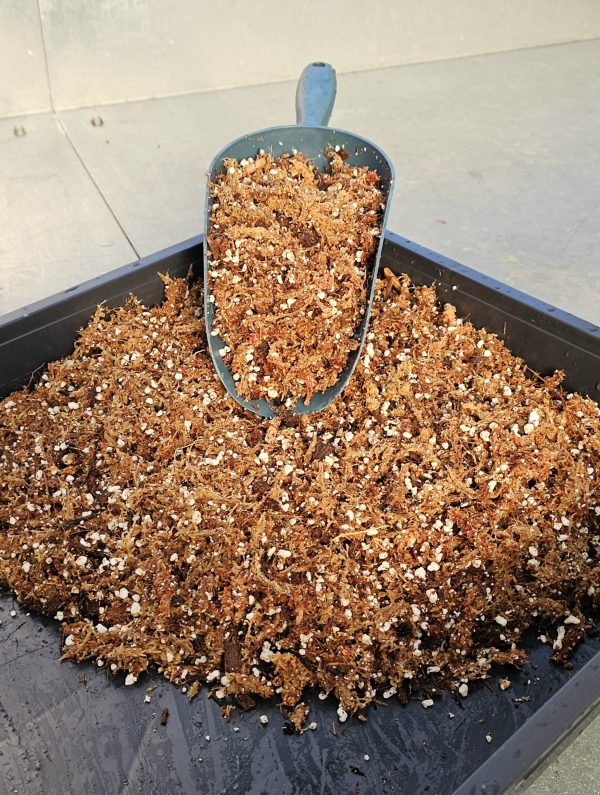
Nepenthes have black, thin, brittle roots that dread suffocation. The substrate should act like an airy sponge : holding moisture while letting oxygen circulate.
🧮 Mix Calculator & Choice of Container
Hybrids: depending on their parents, mix No. 3 or No. 4.
Mix proportions
🚿 Watering & Water Quality Simulator
Watering a Nepenthes is radically different from watering a Sarracenia. Check the good practices below:
Top watering & free draining
Always water generously from the top of the pot with rainwater, reverse-osmosis or demineralised water (no perfume or colouring), then let all the excess drain away. The substrate should stay moist and airy, never waterlogged.
Interactive Anatomy: From Lower Pitchers to Vines
Nepenthes show a fascinating leaf dimorphism : the pitchers change shape as the plant climbs as a vine! Click the 4 glowing dots on the diagram:
The Peristome & Lid: the Slippery Water Trap
Contrary to popular belief, the flat leaf (lamina) is actually just a widened base, while the true modified leaf blade is theurne at the end of the tendril!
- The peristome (collar): An ultra-smooth ribbed rim, often striped or toothed (e.g. N. hamata, N. villosa). Wet with humidity and nectar, it becomes like aquaplaning: insects’ legs lose all grip.
- The lid (operculum): Fixed in place, it overhangs the opening to attract prey with its nectar glands and to stop tropical rain from diluting the viscoelastic digestive fluid at the bottom of the pitcher.
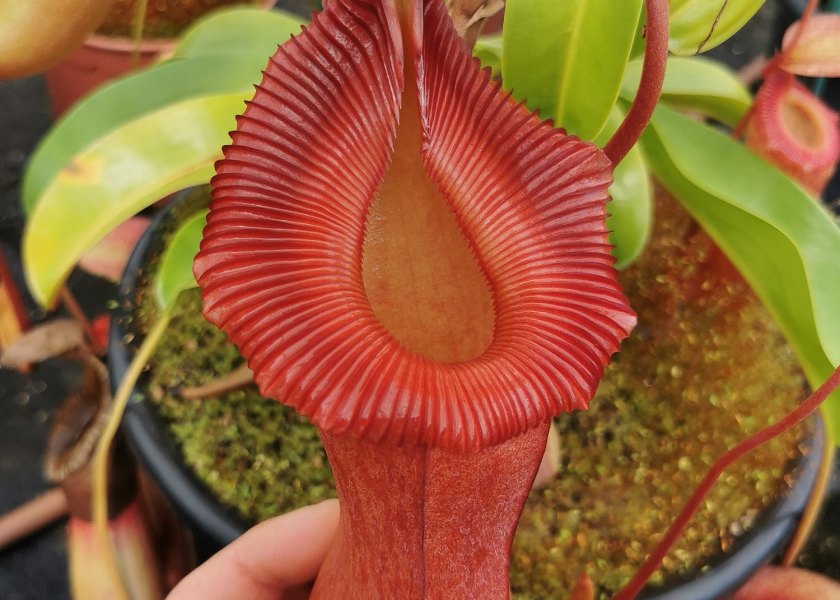
The plant itself secretes its own enzymatic fluid even before the lid opens! The more the prey struggles, the more stringy and sticky the fluid becomes.
© Photograph: Cédric Azaïs
Legendary Species & Must-Have Hybrids
Filter the species by their climate of origin to build a coherent collection.
Controlled Feeding, Cuttings & Dioecious Sowing
In a greenhouse or terrarium, natural prey is rare. Targeted feeding can multiply growth speed and pitcher size!
Impact of Targeted Feeding on Growth
Change in plant diameter and pitcher size over 24 months of cultivation
1. Osmocote in the pitchers
Targeted & safePlace 1 granule of Osmocote 15-9-11 (controlled release) in each mature, fully open pitcher, or 2 to 3 granules at the edge of a 10 to 12 cm pot.
- Check that the pitcher contains at least a third of digestive fluid.
- Feeds the plant directly through its enzymes without spoiling the sphagnum.
2. Gentle water-soluble feeding
2.4 ml/LOn vigorous young plants, Liquid Ocean fertiliser boosts the foliage spectacularly: 2.4 ml per litre when watering, or 1 ml per litre as a foliar spray.
Stem (vine) cuttings
The best method when your Nepenthes climbs too high.
- Cut the vine into sections with 1 to 2 nodes (axillary buds).
- Cut the leaves in half to limit transpiration.
- Wrap the base in moist sphagnum and keep it enclosed (85–95% humidity, 24–27°C): rooting in 6 to 12 weeks.
Air layering & basal shoots
To root a stem without detaching it from the mother plant.
- Basal shoots: As a vine ages, shoots appear at its base. Separate them once they have their own roots.
- Air layering: Lightly cut the bark below a node and wrap it in a sleeve of moist sphagnum closed with plastic film until roots appear.
Sowing & Dioecious Plants
A botanical peculiarity: each plant is either maleor female !
- A male and a female plant must flower at the same time to obtain viable seed.
- The thread-like seeds must be sown very fresh directly on the surface (without covering them) on finely chopped sphagnum.
📦 Gentle Acclimatisation (the 3-Week Rule)
After transport or a change of environment, a Nepenthes goes through a drop in humidity. Here is how to avoid any water shock:
Interactive Diagnosis of Diseases & Pests
Click a symptom you see on your Nepenthes to show what to do:
Diagnosis: Lack oflight intensity (cause no. 1 in 80% of cases), with or without humidity that is too low (< 50%).
Explanation: Making a pitcher costs the plant a lot of energy. If light is insufficient, the Nepenthes produces large dark green leaves to catch photons and aborts its tendrils.
Action: Move the plant closer to a very bright window or add horticultural LED lighting (12 to 14 h a day), while keeping the substrate moist.
Diagnosis: Root suffocation (root rot) or a cold shock on a lowland species.
Causes: Pot left in a saucer of standing water, or substrate too old and compacted that no longer lets air through.
Emergency action: Remove any saucer immediately. Repot in a fresh, airy mix such as our mix No. 3 (dead sphagnum 50%, coco mulch 30%, perlite 20%) in a basket pot. If the base of the stem is black, take cuttings of the healthy upper part at once!
Diagnosis: Most of the time, it is a healthy natural tan under good light!
Note: As long as the leaves stay firm and glossy, this colouring heralds beautifully coloured pitchers. However, if dry, scorched patches suddenly appear, move the grow light slightly further away or add a shade net (30%).
Diagnosis: Attack by Thrips, Mealybugs/scale or Mites.
Where to look: Inspect the undersides of the leaves, the leaf axils and the still-rolled leaf of the terminal bud (apex).
Action: Isolate the plant, remove mealybugs by hand and apply a suitable treatment, taking care not to pour insecticide into the pitchers.
Ready to grow your Nepenthes?
“Once you understand the balance between a light, well-oxygenated substrate, generous light and respect for their altitude of origin, Nepenthes give us the most extraordinary traps in the plant kingdom.”
Find our selection in the shop
Discover our Nepenthes species (highland, lowland, intermediate), our vigorous hybrids, plus our Chilean sphagnum and growing supplies:
Share this article:


