
 Français
 Español
 Deutsch
 Italiano



Growing guide: pygmy sundews


Pygmy Sundews
Miniature sundews from Australia, often under 2 cm, with a reversed cycle: they grow from autumn to spring and sleep in summer. Interactive guide based on the growing sheets and photographs of Cédric Azais (Cédric Carnivores).
A Year with a Pygmy Sundew
Careful, reversed cycle: unlike temperate carnivorous plants that sleep in winter, pygmies sleep in summer to survive heat and drought.
Water Level & Saucer
Plant Status
📋 Grower's Tasks
Water Level Through the Year
Tray full during growth, almost dry in summer
💡 Light: Intense
- • Ideal: 12 to 16 h of bright light a day.
- • Where: under powerful LED or fluorescent lights.
- • Avoid: direct summer sun, which is too intense.
🔄 Reversed Cycle
Growth: autumn, winter and spring, ideally between 10 and 25°C.
Dormancy: summer, out of direct sun.
🔬 Tiny and Very Fragile
Usually under 2 cm: handle them with care. Repotting is not recommended for this kind of sundew.
Soil & Watering Workshop
An airy, sterile soil: 50% blond sphagnum peat (no fertiliser) and 50% pure quartz sand, like our mix No. 2.
🧮 Mix Calculator
Mix Proportions
🪴 Repotting?
Repotting is not recommended for this kind of sundew. Gemmae are often a better way to rejuvenate your collection: sow them on a pot of fresh soil.
🚿 Water Quality Tester
Use pure water only. Test your water source:
Interactive Anatomy of a Pygmy Sundew
A plant under 2 cm, seen under a magnifying glass. Click the 4 glowing dots or the buttons.
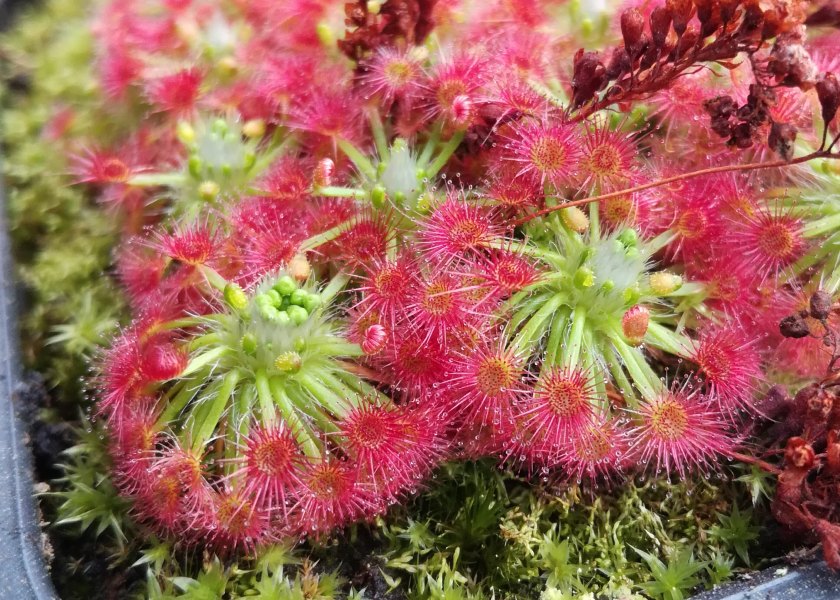
Photo: a pygmy sundew grown at the nursery. The whole rosette fits on a coin.
© Photograph: Azais Cédric
🌍 South-West Australia
- • Western Australia: almost all pygmy sundews are endemic to the south-west of Western Australia (only D. pygmaea has a wider range).
- • Hot, dry summers: their summer dormancy is an adaptation to survive heat and drought.
- • All our plants are nursery-grown.
Pygmy Sundews from the Nursery
Miniature species and hybrids, easy to propagate from gemmae.
Propagating from Gemmae
Reproduction by gemmae is the most fascinating feature of these plants: an extremely effective and fast method.
What Are They?
A small vegetative bud.
- It breaks off the mother plant to form a clone.
- It looks like a tiny ball.
- In the wild, raindrops scatter them.
When?
From November to December.
- Gemmae are produced in large numbers.
- They form in the centre of the rosette.
- The plant is then in full growth.
How?
Three simple steps.
- Pick them gently.
- Place them on the surface of a pot of fresh, moist soil.
- Within a few days: roots and small leaves!
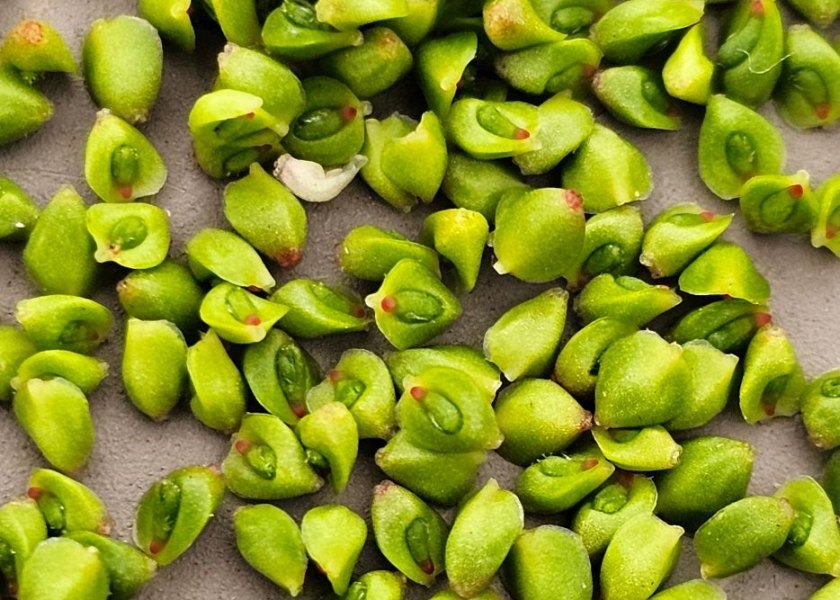
Pygmy sundew gemmae, harvested at the nursery.
© Photograph: Azais Cédric
🔄 Respect the Reversed Cycle
🚿 Watering Reminder
Interactive Diagnosis
Choose the season, then the symptom you see:
The Secret of Pygmies
“Plenty of light, a tray of pure water from autumn to spring, a dry summer… and gemmae to share at the end of every year.”
Recommended products


Share this article:


