The art of photography: our carnivorous plants up close

Published by Cédric Azaïs on 18/11/2026 20:49 and amended on 18/11/2026 21:05.

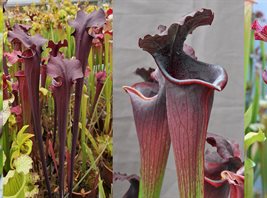
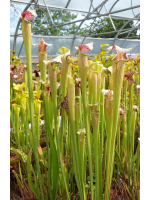
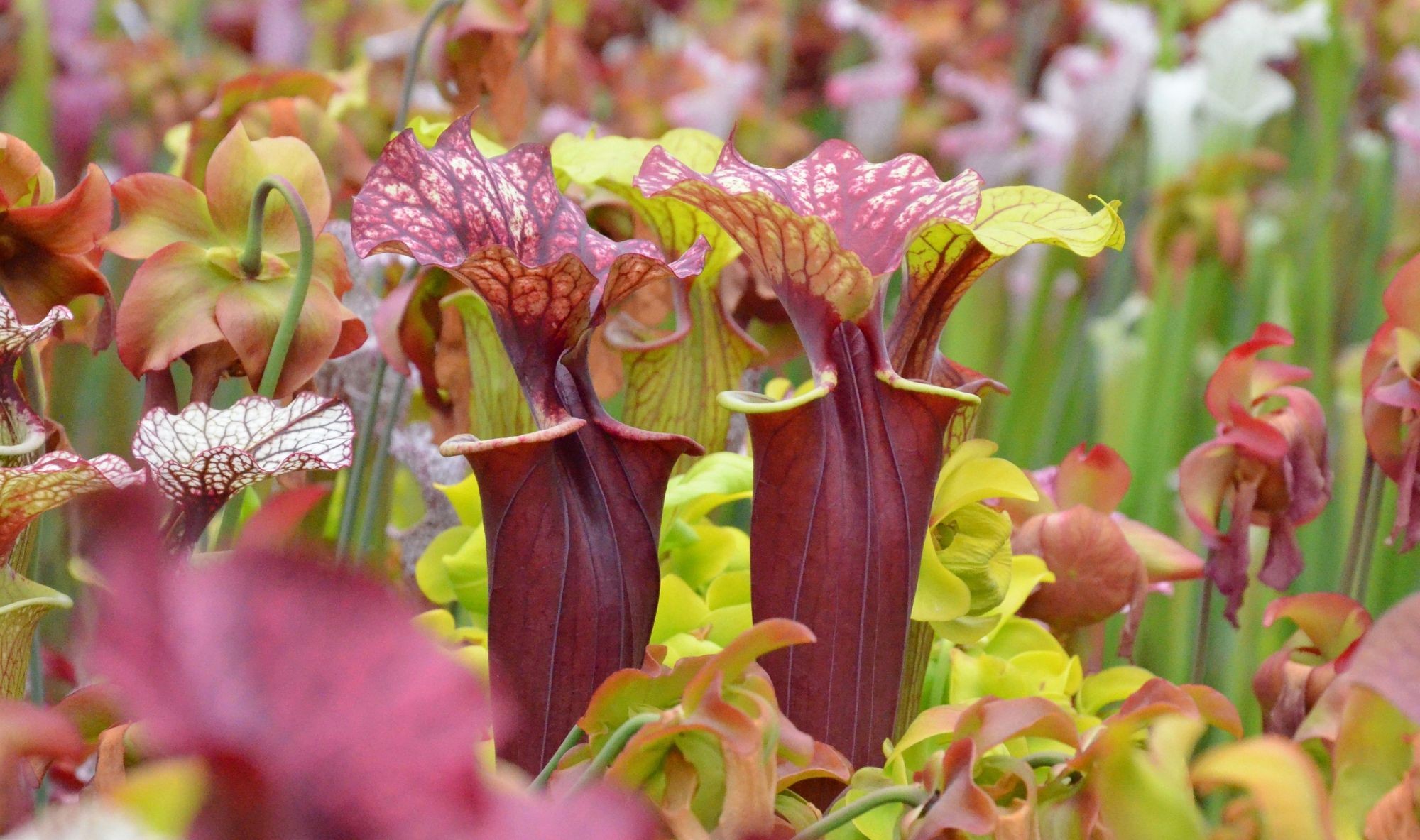
Two purple hybrid Sarracenia pitchers among flowers and colourful pitchers
Photographs by Cédric Azaïs

The art of photography

Our carnivorous plants, seen up close

Between two repottings, Cédric picks up his camera and gets close, very close. Carnivorous plants are made of details: teeth, drops, stripes, fangs. Here are some of his favourite photos.

✦ ✦ ✦

I

The Venus flytrap, the trap that snaps shut

Seen very close, the Venus flytrap shows what the naked eye never notices: teeth that interlock like a comb, trigger hairs in the middle of the trap, and colours ranging from apple green to blood red.


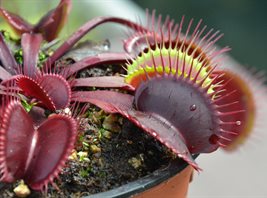
An all-red Venus flytrap, its traps wide open.Dionaea muscipula 'Akai Ryu'
A fly caught in the trap of a red Venus flytrap.Dionaea muscipula
The trigger hairs in the middle of the trap: they must be touched twice in a row for it to close.Dionaea muscipula
The fused, toothed edges of a « fused tooth » Venus flytrap.Dionaea muscipula 'Fused Tooth'
Inside a trap: thousands of tiny red glands.Dionaea muscipula
A green Venus flytrap held in the hand, to show its size.Dionaea muscipula
The same delicacy, in profile.Dionaea muscipula
II

The sundew, pearls of dew

Each tentacle of a Drosera carries a drop of glue that sparkles in the sun. In macro, you can see their colour, their shape and the young leaves unrolling.


Each drop of glue works like a small magnifying glass.Drosera cuneifolia
Red tentacles and their drops of glue.Drosera regia
Leaves beaded with glue.Drosera rosulata
A young leaf unrolling, already covered with drops.Drosera burmannii
Two pink rosettes covered with dew.Drosera burmannii
A red rosette seen from above.Drosera burmannii
Two round leaves and their pearls of glue.Drosera miniature
Tentacles and their drops, seen from below.Drosera
III

The Nepenthes, the peristome in detail

The peristome, the ring around the mouth of the pitcher, is slippery: insects lose their footing on it. Up close, its ribs, fangs and colours become real paintings.


The red and yellow stripes of a peristome.Nepenthes
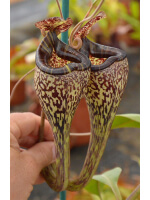
A striped peristome above a speckled pitcher.Nepenthes
Two pitchers seen from above, with their fluid.Nepenthes inermis
The ribs of the peristome, backlit.Nepenthes ovata
The peristome fangs, like hooks.Nepenthes ovata
Three peristome fangs, backlit.Nepenthes ovata
The ribs of a dark peristome.Nepenthes hamata
Dark fangs lined up like a comb.Nepenthes hamata
Shiny red fangs, very close up.Nepenthes
IV

The Cephalotus, the little pitcher from Australia

Cephalotus grows in south-western Australia. Its small hairy pitchers have a ribbed peristome that looks like a row of teeth. The 'Eden Black' clone is one of the darkest.


A pitcher with its lid open, in the moss.Cephalotus follicularis 'Eden Black'
The ribs of the peristome, very close up.Cephalotus follicularis 'Eden Black'
The peristome and the hairy lid.Cephalotus follicularis 'Eden Black'
V

The Heliamphora, the mountain pitcher

Heliamphora comes from the high plateaus of South America. Its pitchers, without a real lid, are covered with hairs and veins that change colour with the light.


The surface of a pitcher, covered with fine hairs.Heliamphora ciliata
A pitcher all curves and veins.Heliamphora neblinae
VI

The Sarracenia, and its visitors

Sarracenia pitchers attract insects with their colours, their veins and their nectar. Sometimes the camera catches these visitors at just the right moment.


Speckled purple pitchers and veined lids: each plant has its own colours.Sarracenia × moorei 'Saurus'
Two yellow lids veined with purple, like a map.Sarracenia flava var. ornata
Beads along the lid of a yellow Sarracenia.Sarracenia flava
The rim of a red pitcher and its mosaic of veins.Sarracenia hybrid
A purple pitcher beaded with drops.Sarracenia hybrid
A wasp on the rim of a pitcher.Sarracenia hybrid
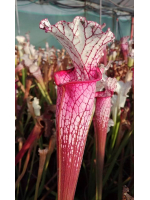
A small visitor on a pitcher with white windows.Sarracenia hybrid
VII

The residents of the nursery

The plants are not alone in the greenhouses. Tree frogs like to sit on the Sarracenia pitchers, where the insects pass by. And sometimes a more colourful visitor comes to look at the plants up close.


A tree frog sitting on the lid of a pitcher, as if in an armchair.
A tree frog safely tucked inside a purple pitcher.
A tree frog curled up in a pink and yellow pitcher, after the rain.
A tree frog resting right next to an unrolling sundew.
A tree frog clinging to a Sarracenia pitcher.
The eye of a tree frog, very close up.
A feathered visitor, very curious about the tall yellow pitchers.

✦ ✦ ✦

All these photos were taken by Cédric. More will be added as the seasons go by.

Photographs by Cédric Azaïs
Back to « Life at the nursery »