
 Français
 Español
 Deutsch
 Italiano


- Out-of-Stock
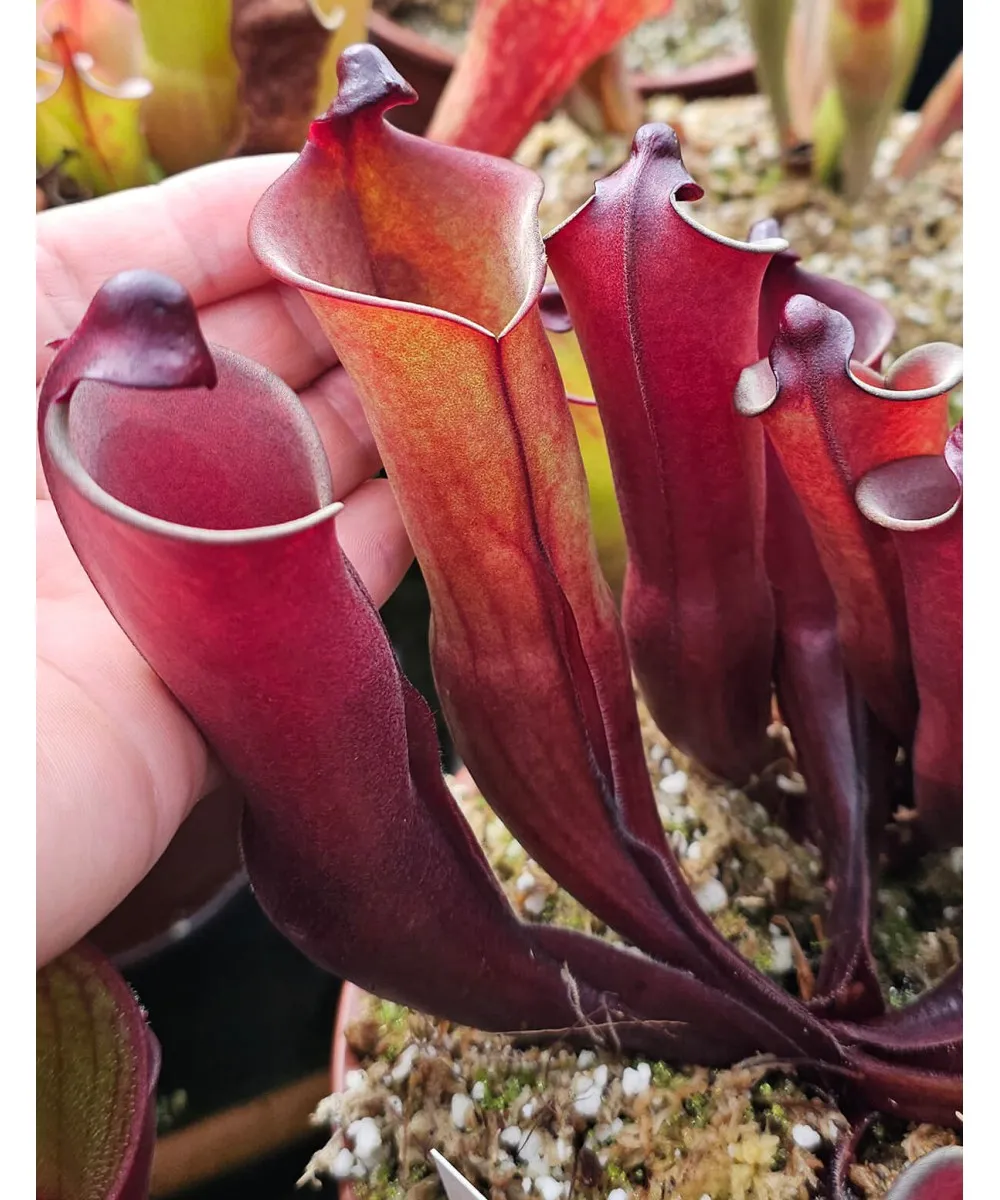
Photo of the mature mother plant: you receive a plant of the same clone, in the size you choose.

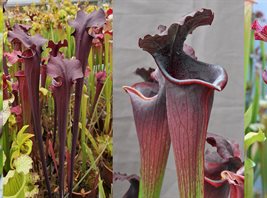
Photo of the mature mother plant: you receive a plant of the same clone, in the size you choose.
Heliamphora purpurascens (Ptari Tepui)

Delivery policy

Minimum order: €18
Heliamphora are carnivorous plants native to the high plateaus (tepuis) of Venezuela, Guyana and Brazil. They live in a unique environment of leached soils, strong light, cool temperatures and almost constant rainfall. They are known to be demanding and need constant stability and a coolness to thrive.
1. Light
Ideal: Very strong light, ideally 12 to 14 hours per day. About 15,000 to 30,000 lux is often needed for good colouring.
Location: Indoors, powerful artificial lighting (horticultural LED lamps) is almost essential. Near a window, choose a south- or west-facing exposure to maximise light, but watch out for excess heat.
Signs of good light: The pitchers are sturdy, well formed and take on a beautiful reddish hue (depending on the species/hybrid).
Signs of insufficient light: The pitchers are floppy and pale green, and growth is slow or absent. The plant becomes etiolated (long and thin).
2. Temperature
Consistency and coolness are the key factors. There is not the same need for day/night variation as with highland Nepenthes, but keeping them cool is critical.
Day: 18-24 °C (64-75 °F). Temperatures above 25 °C (77 °F) for a prolonged period can stress the plant and lead to rapid decline.
Night: 10-18 °C (50-64 °F). The key is to avoid stagnant heat. Heliamphora grow best in cool growingconditions. A moderate difference is beneficial.
3. Humidity
Ideal: 60-90%
How to achieve it: A ventilated terrarium or a greenhouse is strongly recommended for Heliamphora to keep humidity up and temperatures cool. Using an ultrasonic mister is effective, but make sure the air circulates well to avoid mould problems. Excellent ventilation is as important as humidity to avoid stagnation and heat.
4. Watering
Type of water: Soft water only: distilled water, rainwater or reverse osmosis water.
Frequency: The substrate must be constantly moist, even waterlogged. These plants grow in permanently soaked soils.
Method: Ideally, use the tray method: place the pot in a saucer or tray holding 1 to 2 cm of soft water at all times.
5. Substrate
*The substrate must be airy, free-draining and hold a little moisture.
*Typical composition: A mix of live sphagnum moss or sphagnum peat, perlite, pine bark and/or coconut fibre. A good mix can be 50% sphagnum peat and 50% perlite.
6. Fertilising
*Heliamphora do not need fertilising through the roots. They get their nutrients by catching insects.
*Optional: To help your Heliamphora, you can occasionally put a small dried insect (such as a mealworm) or fish food into a pitcher. Be careful not to overfeed the plant, as this can make the pitchers rot.
*You can also use a foliar orchid fertiliser. Apply it to the leaves, sticking strictly to the doses, or even diluting it further to be safe.
7. Pruning
Heliamphora generally do not need regular pruning.
Remove pitchers and leaves that are completely brown or black to prevent mould. Cut them off at the base with clean scissors.
8. Repotting
Repot the plant every 2 to 3 years, or when the plant becomes too big for its pot.
Choose a slightly larger pot. The ideal time is often at the end of winter or in early spring.
Soyez very gentle with the root system, which is fine and fragile.
⚠️ Final tip: The most common failure with Heliamphora is not keeping a low, stable temperature and not giving enough light. Growing in a climate-controlled enclosure (terrarium, display cabinet) is often the only viable way to keep them healthy in the long term in a temperate home.
➜ Learn more about this species: Heliamphora purpurascens, in our encyclopedia
Data sheet
These plants share its growing conditions: you can grow them together.
Nepenthes vogelii - selected clone: BE-3256 is part of our Highland Nepenthes selection. It is produced by Borneo Exotics (reference BE-3256), our partner nursery specialising in Nepenthes. It is a highland Nepenthes that needs cool nights (12-16 °C), high humidity and bright light without direct sun.
This plant is a cross between Nepenthes veitchii and mira. It is produced by Borneo Exotics (reference BE-3696), our partner nursery specialising in Nepenthes. It is a highland Nepenthes that needs cool nights (12-16 °C), high humidity and bright light without direct sun.
Nepenthes spathulata – best selected clone: BE-3175 is part of our Highland Nepenthes selection. It is produced by Borneo Exotics (reference BE-3175), our partner nursery specialising in Nepenthes. It is a highland Nepenthes that needs cool nights (12-16 °C), high humidity and bright light without direct sun.
This plant is a cross between Nepenthes ventricosa and hamata. It is produced by Borneo Exotics (reference BE-3672), our partner nursery specialising in Nepenthes. It is a highland Nepenthes that needs cool nights (12-16 °C), high humidity and bright light without direct sun.
A hybrid of two Heliamphora from the South American tepuis: plenty of light, cool temperatures (18 to 24 °C by day), high humidity and lime-free water.
Hybrid made at our nursery between Heliamphora folliculata and Heliamphora exappendiculata (Bubble giant). A tepui plant: plenty of light, cool conditions, high humidity and lime-free water.
Hybrid made at our nursery between Heliamphora collina and Heliamphora parva. A tepui plant: plenty of light, cool conditions, high humidity and lime-free water.
A question about this product or how to grow it? Ask it: the nursery answers, and the answer helps other growers too.
No questions yet: be the first to ask one!
Do you have this plant?
Share a photo of it from your My collection page: it will join our customers’ gallery.
Heliamphora purpurascens (Ptari Tepui)


